
learn the breath of resilience with dr.bhanote
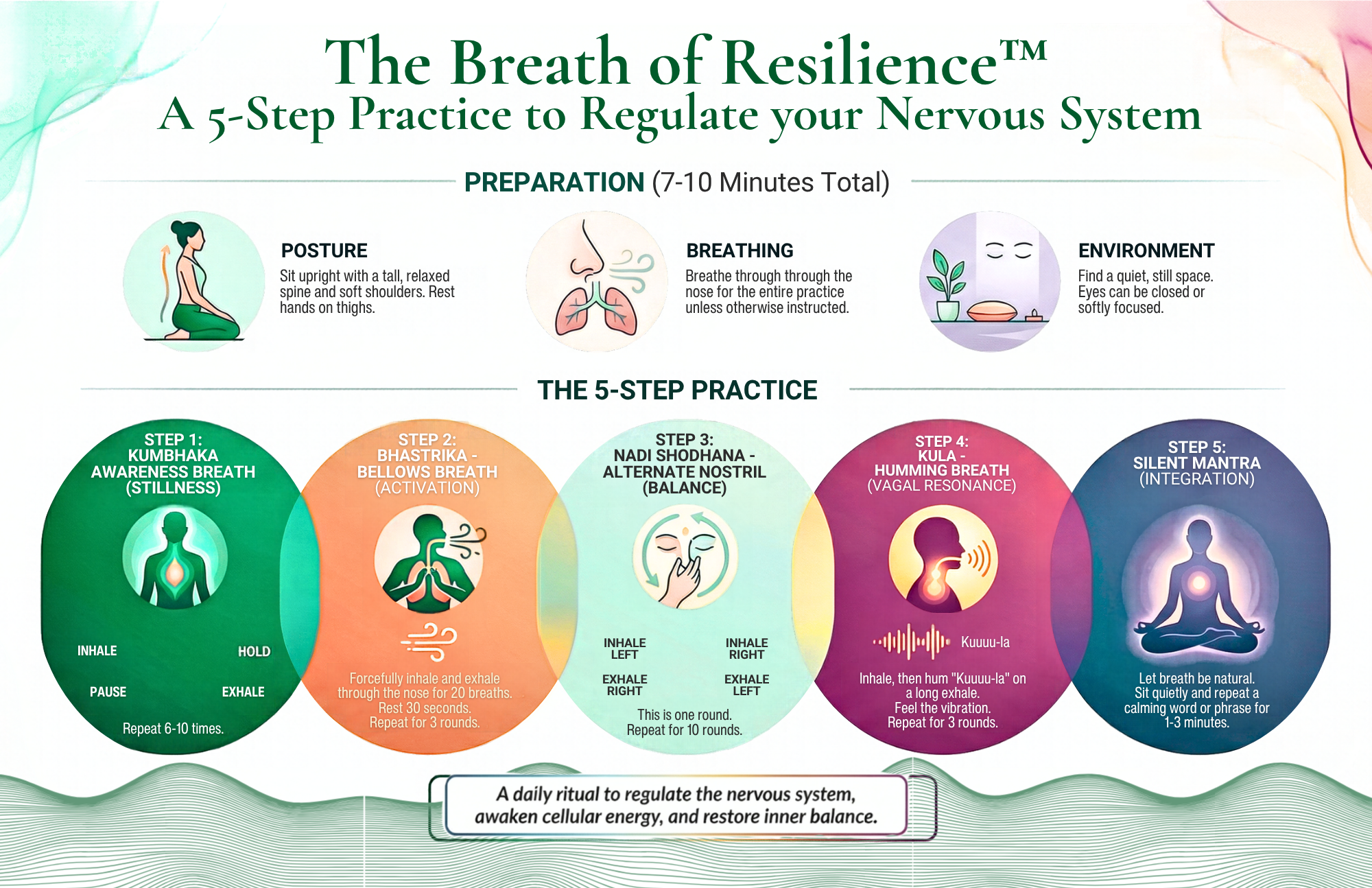
The Breath of Resilience™
A 5-Step Practice to Regulate Your Nervous System
Breathe with intention. Create space for stillness. Build resilience from within.
The Breath of Resilience™ is a five-step breathing and mindfulness ritual developed by Dr. Monisha Bhanote to encourage nervous system regulation, body awareness, and a deeper connection between mind and body.
Combining traditional yogic breathing techniques with intentional stillness, this practice invites you to move from activation to balance, and finally into quiet reflection.
Preparation: Set aside approximately 7–10 minutes. Find a quiet space, sit comfortably with your spine upright and shoulders relaxed, and breathe through your nose unless otherwise instructed.
Step 1: Kumbhaka — Awareness Breath
Stillness | Breath Awareness
Begin by establishing a steady, intentional breathing rhythm.
Inhale slowly through your nose for 4 counts.
Hold your breath gently for 4 counts.
Exhale slowly through your nose for 4 counts.
Pause with your lungs comfortably empty for 4 counts.
Repeat this four-part breathing cycle 6–10 times.
Allow the transitions between each phase to feel smooth and unforced. Notice the stillness between breaths.
Intention: Cultivate awareness, steadiness, and a sense of inner calm.
Step 2: Bhastrika — Bellows Breath
Activation | Energy
Bhastrika is a traditional yogic breathing technique involving active, rhythmic inhalations and exhalations.
Sit upright with your shoulders relaxed.
Inhale actively and deeply through your nose, allowing your abdomen and rib cage to expand.
Exhale actively through your nose, allowing your abdomen to contract.
Continue with 20 rhythmic inhalation–exhalation cycles, keeping both phases active and controlled.
After 20 breaths, return to natural breathing and rest for approximately 30 seconds.
During your rest, gently roll your shoulders or make slow, comfortable neck movements to release tension.
Repeat for 3 rounds total.
Keep the breathing rhythmic rather than excessively fast or forceful. Stop if you feel lightheaded.
Intention: Encourage alertness, invigorate the body, and bring awareness to your energy.
Step 3: Nadi Shodhana — Alternate Nostril Breathing
Balance | Centering
This traditional breathing practice alternates airflow between the left and right nostrils.
Bring your right hand toward your nose. Use your right thumb to close your right nostril and your ring finger to close your left nostril.
Close your right nostril and inhale through your left nostril.
Close your left nostril, release your right nostril, and exhale through your right nostril.
Keeping the left nostril closed, inhale through your right nostril.
Switch sides and exhale through your left nostril.
This completes one full round.
Repeat for 10 rounds, breathing slowly and comfortably without forcing the breath.
Intention: Encourage mental clarity, steady attention, and a sense of balance.
Step 4: Kula — Humming Breath
Vibration | Connection
Inspired by the traditional humming breath, this practice incorporates the word Kula, a Sanskrit term associated with community, belonging, and intentional connection.
Inhale gently through your nose.
As you exhale, softly vocalize “Kuuuu-la”, extending the sound across one comfortable exhalation.
Feel the gentle vibration through your throat, chest, and face.
Allow the sound to fade naturally as you complete the exhalation.
Take a comfortable breath and repeat for 3 rounds.
Reflect on your connection to yourself and the community around you.
Intention: Use sound and vibration to encourage relaxation, presence, and connection.
Step 5: Silent Mantra
Integration | Inner Stillness
Complete your practice by moving into silence.
Close your eyes or soften your gaze.
Allow your breathing to return to its natural rhythm.
Choose a word or short phrase that reflects what you want to cultivate.
Your mantra might be:
I am resilient.
I am grounded.
I trust my body.
I am present.
I create space for myself.
Silently repeat your chosen mantra with each natural breath.
Continue for 1–3 minutes, allowing your mind and body to settle.
Before opening your eyes, notice how you feel compared with when you began.
Intention: Integrate the practice and reinforce your personal commitment to resilience.
Make Resilience a Daily Ritual
Resilience isn't simply about how much stress you can withstand. It's also about how intentionally you respond, recover, and reconnect with yourself.
The Breath of Resilience™ is an invitation to create a few moments of conscious awareness each day, wherever life takes you.
Your breath is always with you. Let it become a daily reminder to care for yourself.
Continue Your Journey
Experience Cellular Resilience at Our Longevity Retreats
Take your practice beyond the everyday. Join Dr. Monisha Bhanote for immersive longevity retreats that bring together science, mindful movement, nourishing food, nature, creativity, and meaningful connection.
Practice Note: Breathing exercises should feel comfortable and controlled. Never force your breath or push through dizziness, tingling, or discomfort. Bhastrika and breath-retention practices may not be appropriate during pregnancy or for individuals with certain cardiovascular, respiratory, or neurological conditions. Consult your healthcare professional before practicing if you have a relevant medical condition. You may also skip breath retention or vigorous breathing and continue with gentle, natural breathing.