
#CellCare Ritual | The 7-Minute Nervous System Reset

“Regulation is the new resilience.”
~ Dr. Monisha Bhanote, MD
WEEKLY WELLNESS PRACTICE | #CELLCARE RITUAL
Hey there, Wellkulå Friend,
This ritual is for the Monica mornings.
The Olivia moments.
The times you wake up are already bracing.
Wired. Tight. Internally preparing for impact.
This is not about escaping stress.
It is about regulating your biology.
Because longevity is not built by powering through sympathetic overdrive.
It is built by teaching your nervous system that activation can resolve safely.
Today’s practice is simple, precise, and deeply regulatory:
The 7-Minute Nervous System Reset.
Four steps.
Seven minutes.
A measurable biological shift.
Let’s begin.

#HOW TO DO IT | THE 7-MINUTE NERVOUS SYSTEM RESET RITUAL
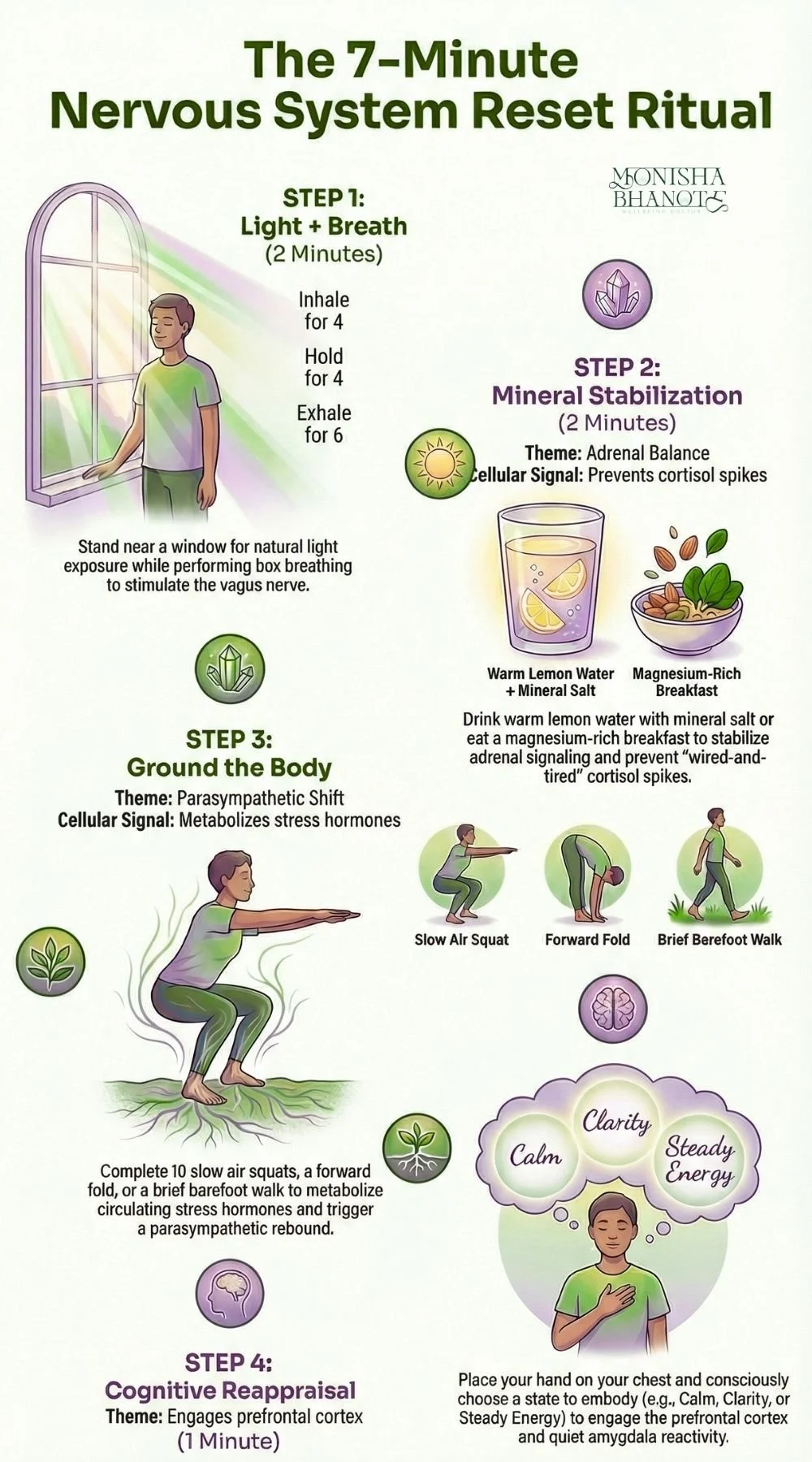
Time Commitment: 7 minutes
Environment: Near natural light
Intensity: Gentle
Goal: Regulation — not productivity
This ritual works because it layers biological safety with cognitive intention.
STEP 1 — LIGHT + BREATH (2 Minutes)
Theme: Circadian Anchoring • Vagal Activation • Cortisol Balance
Stand near a window.
Let natural light reach your eyes (without staring directly at the sun).
Then begin slow nasal breathing:
Inhale for 4
Hold for 4
Exhale for 6
Longer exhales stimulate the vagus nerve and increase parasympathetic tone.
Why This Works
Morning light anchors your circadian rhythm, supporting melatonin regulation later at night.
Slow breathing lowers cortisol and improves heart rate variability within minutes.
You are signaling safety to your nervous system before the day accelerates.
Cellular Signal
Light exposure stimulates intrinsically photosensitive retinal ganglion cells, which communicate directly with the suprachiasmatic nucleus — the brain’s master clock. This regulates cortisol timing, mitochondrial energy production, and downstream hormonal rhythm.
Slow exhalation activates vagal pathways connecting the brainstem to the heart, lungs, and gut. Within minutes, heart rate variability improves and inflammatory signaling begins to decrease.
This is circadian alignment layered with autonomic recalibration.
STEP 2 — MINERAL STABILIZATION (2 Minutes)
Theme: Biochemical Safety • Cortisol Prevention • Nerve Conduction
Before coffee, have:
Warm lemon water with a pinch of mineral salt
ORA magnesium-rich plant-based breakfast (leafy greens + seeds)
Magnesium is a cofactor in over 300 enzymatic reactions, many involving nerve conduction and stress modulation.
Why This Works
Morning cortisol is natural.
But when layered with caffeine and mineral depletion, it becomes destabilizing.
This step prevents the 10 a.m. wired-and-tired spike.
Nervous system regulation is biochemical before it is psychological.
Cellular Signal
Magnesium regulates NMDA receptors and modulates excitatory neurotransmission. Adequate magnesium reduces excessive neuronal firing and supports GABA activity — the brain’s primary calming neurotransmitter.
Electrolyte balance stabilizes adrenal signaling and supports proper sodium-potassium pump function, essential for nerve impulse transmission and cellular energy production.
When minerals are sufficient, the stress response does not amplify unnecessarily.
STEP 3 — GROUND THE BODY (2 Minutes)
Theme: Hormone Metabolism • Parasympathetic Rebound • Completion
Choose one:
10 slow air squats
A forward fold
A 2-minute barefoot walk outside
Not a workout.
Not intensity.
Just intentional movement.
Why This Works
Movement metabolizes circulating stress hormones.
Stillness after movement increases parasympathetic rebound.
You are teaching your body that activation can resolve — not linger.
Cellular Signal
Gentle muscular contraction increases glucose uptake and enhances mitochondrial ATP production. It also assists in metabolizing circulating adrenaline and cortisol through increased circulation.
When movement is followed by stillness, baroreceptors and vagal pathways engage more fully, enhancing parasympathetic recovery.
This improves insulin sensitivity, reduces inflammatory cytokine signaling, and shifts the body from defense into repair.
STEP 4 — CHOOSE ONE THOUGHT (1 Minute)
Place your hand on your chest.
Ask:
What state do I want to embody today?
Calm.
Clarity.
Steady energy.
Neuroscience shows that intention alters neural firing patterns.
When the prefrontal cortex engages consciously, it quiets amygdala reactivity.
Why This Works
Intentional cognitive engagement reduces stress reactivity and enhances emotional regulation.
This is cognitive regulation layered onto biological safety.
Cellular Signal
When the prefrontal cortex is activated intentionally, it exerts top-down control over the amygdala, reducing threat perception and sympathetic discharge.
Lower sympathetic activation decreases cortisol and inflammatory cytokine output.
Over time, repeated intentional regulation strengthens neural pathways associated with resilience, improving heart rate variability, immune signaling balance, and hormonal stability.
The brain changes.
The chemistry changes.
The cells respond.
EXPLORE FURTHER | DEEPENING THE NERVOUS SYSTEM RESET
The 7-Minute Nervous System Reset reflects a deeper biological truth:
The nervous system must experience safety consistently for the body to thrive.
Resilience is not built by staying activated or pushing through stress.
It emerges when activation completes and the body returns to baseline.
Regulation is not avoidance — it is physiological recalibration.
When you anchor light, slow your breath, stabilize minerals, move intentionally, and set a conscious intention, you guide your nervous system through a sequence it recognizes:
Alignment → Stabilization → Completion → Intention.
Chronic stress is cellular:
Inflammation rises.
Digestion weakens.
Hormones destabilize.
Energy fragments.
But when regulation becomes ritual:
Cortisol steadies.
Vagal tone strengthens.
Metabolism improves.
Cells shift from defense into repair.
This principle is explored in The Anatomy of Wellbeing by Dr. Monisha Bhanote, showing how circadian rhythm, breath, mineral balance, and perceived safety influence immunity, hormones, and long-term resilience.
👉 Book Reference:
The Anatomy of Wellbeing
In the book, you’ll see how intentional regulation — through light, breath, rhythm, nourishment, and cognition — moves the body out of survival chemistry and back into coherence.
Especially during chronic stress, travel, hormonal shifts, or cognitive overload, small daily regulatory inputs become powerful biological resets.
The 7-Minute Reset is one practical expression of that science:
When the body aligns with light, cortisol regulates.
When breath slows, vigilance softens.
When minerals stabilize, stress does not amplify.
When movement completes, hormones metabolize.
When intention engages, the brain quiets threat signaling.
And resilience becomes sustainable.
Not because you optimized harder.
But because you reduced unnecessary activation — and allowed the nervous system to remember safety.
WHY IT WORKS | THE SCIENCE BEHIND THE 7-MINUTE NERVOUS SYSTEM RESET
Breath & Autonomic Tone
Longer exhales increase parasympathetic output and reduce sympathetic drive. This shifts the body from vigilance to repair within minutes.
Mineral Stability & Cortisol Modulation
Electrolyte and magnesium balance directly influence nerve conduction, adrenal output, and muscular tension. Stabilizing minerals prevents stress amplification.
Movement & Hormone Clearance
Gentle movement metabolizes adrenaline and cortisol, preventing hormonal stagnation that contributes to anxiety and sleep disruption.
Intention & Neural Regulation
Conscious cognitive engagement strengthens prefrontal pathways, reducing amygdala-driven stress reactivity.
This is layered regulation — body first, mind second.
REALIZATION | YOUR #CELLCARE TIP OF THE WEEK
Within one week of practicing the 7-Minute Nervous System Reset, many people notice:
Less morning tension
More stable energy
Fewer stress spikes
Improved digestion
Clearer thinking
Not because life became calmer.
But because the nervous system did.
Monica doesn’t need more productivity.
Olivia doesn’t need more control.
They need regulation.
And so do we.
You don’t restore your nervous system by escaping your life.
You restore it by building rituals inside it.
Your Commitment This Week:
Practice the 7-Minute Reset every morning before coffee.
Track how your body feels by Day 5.
Resilience is not built by pushing harder.
It is built by teaching the nervous system how to complete activation — safely.
When the nervous system feels safe, cells remember how to thrive.
Until next time,
Dr. Monisha
The information on this website has not been evaluated by the Food & Drug Administration or any other medical body. We do not aim to diagnose, treat, cure or prevent any illness or disease. Information is shared for educational purposes only. You must consult your doctor before acting on any content on this website, especially if you are pregnant, nursing, taking medication, or have a medical condition. Our content may have affiliate links, through which we earn a small commission at no extra cost to you. We only recommend products we sincerely love and believe will benefit your wellbeing. Thank you for supporting #CellCare Wellness!





by Dr. Monisha Bhanote
✅ EVIDENCE-INFORMED REVIEWED ARTICLE