
#CellCare Ritual | The Breath of Resilience Ritual
“When the breath steadies, the body heals.”
~ Dr. Monisha Bhanote, MD
WEEKLY WELLNESS PRACTICE | #CELLCARE RITUAL
Hey there, Wellkulå Friend,
Every week, I invite you into a ritual that speaks directly to the nervous system—one that feels steady, intelligent, and deeply supportive of how the body is actually wired to heal.
This week’s ritual centers on something essential, yet often overlooked:
Regulation before resilience.
In moments of stress, travel, hormonal shifts, or cognitive overload, the body doesn’t need more discipline.
It needs a clear biological message that it is safe to stabilize, mobilize, and then return to balance.
This week’s #CellCare Ritual is The Breath of Resilience™—a five-part, nervous-system–forward breathwork practice developed by Dr. Monisha Bhanote.
This is not breath “training.”
It is not performance-based.
And it is never forced.
It is a regulatory ritual designed to guide the body through the exact sequence the nervous system requires to restore calm focus, awaken cellular energy, and build true resilience.
The breath leads.
The nervous system follows.
The cells respond.
Let’s begin.

#HOW TO DO IT | THE BREATH OF RESILIENCE RITUAL
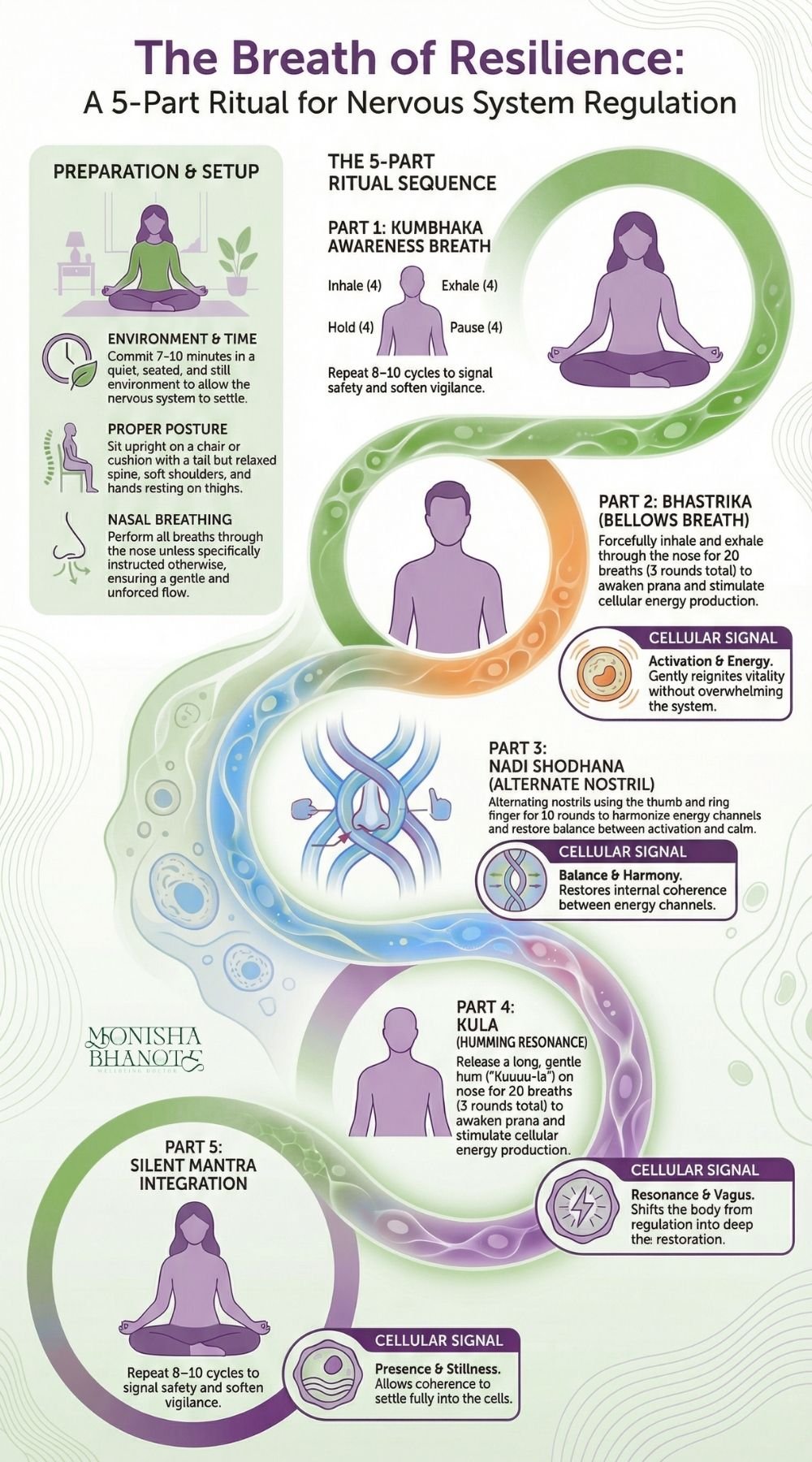
Time Commitment: 7–10 minutes
Environment: Quiet, seated, and still
Breathing: All breaths through the nose unless stated otherwise
General Practice Setup
Posture
Sit upright on a chair or cushion
Spine tall but relaxed
Shoulders soft
Chin parallel to the floor
Hands
Rest hands on thighs unless instructed otherwise
Eyes
Closed or softly focused
Move gently.
Never strain.
This ritual works through ease, not effort.
PART 1: Kumbhaka Awareness Breath
Theme: Stillness • Safety • Awareness
The Practice
Inhale slowly through the nose for 4 counts
Gently hold the breath for 4 counts
Exhale slowly through the nose for 4 counts
Pause at the bottom of the exhale for 4 counts
This completes one cycle.
Repeat for 8–10 cycles.
Key Cue
The pauses are soft and relaxed—not forced.
Cellular Signal
This phase introduces stillness and brings awareness to the space between breaths. Those gentle pauses send a powerful signal of safety to the nervous system, allowing vigilance to soften and attention to settle.
PART 2: Bhastrika (Bellows Breath)
Theme: Activation • Prana • Cellular Energy
The Practice
Sit upright with the spine tall
Inhale forcefully through the nose
Immediately exhale forcefully through the nose
Allow the belly to naturally expand and contract
Continue at a steady rhythm for 20 breaths.
Rest quietly for 20–30 seconds.
Repeat for 3 total rounds.
Important Notes
This breath is active—but not aggressive
Stop if you feel dizzy or uncomfortable
Always return to natural breathing during rest
Cellular Signal
Bhastrika awakens prana, clears stagnation, and stimulates cellular energy production. This is where vitality is gently reignited—without overwhelming the system.
PART 3: Nadi Shodhana (Alternate Nostril Breathing)
Theme: Balance • Harmony • Nervous System Integration
The Practice
Bring the right hand to the nose
Close the right nostril with the thumb
Inhale slowly through the left nostril
Close the left nostril with the ring finger
Exhale slowly through the right nostril
Inhale through the right nostril
Close the right nostril
Exhale through the left nostril
This completes one round.
Repeat for 10 rounds.
Breath Quality
Slow
Smooth
Unforced
Equal length inhale and exhale
Cellular Signal
This phase harmonizes left and right energy channels, bringing coherence to the nervous system and restoring internal balance between activation and calm.
PART 4: Kula (Humming Resonance Breath)
Theme: Vagus Nerve • Resonance • Calm Expansion
The Practice
Inhale slowly through the nose
On the exhale, release a long, gentle hum: “Kuuuu-la”
Feel vibration in the throat, chest, and face
Let the exhale be longer than the inhale
Pause briefly after the exhale
Repeat for 3 rounds.
Key Cue
The hum should feel soothing—not loud or strained.
Cellular Signal
Vibration directly stimulates the vagus nerve, expanding calm through resonance rather than effort.
This is where the body shifts from regulation into restoration.
PART 5: Silent Mantra Integration
Theme: Integration • Presence • Stillness
The Practice
Allow the breath to return to its natural rhythm
Sit quietly and repeat your mantra internally
If no mantra is provided, choose a calming word or phrase
When the mind wanders, gently return to the mantra.
Continue for 1–3 minutes.
Cellular Signal
This phase integrates the entire sequence, allowing coherence to settle fully into the nervous system and cellular environment.
EXPLORE FURTHER | DEEPENING RESILIENCE
The Breath of Resilience™ Ritual reflects a deeper biological truth:
The nervous system must feel regulated before the body can heal.
Resilience is not built by staying activated.
It emerges when the body is guided—intentionally—through completion, balance, and integration.
This principle is explored throughout The Anatomy of Wellbeing by Dr. Monisha Bhanote, where breath patterns, nervous system signaling, and cellular stress responses are shown to directly influence inflammation, digestion, hormonal balance, emotional regulation, and longevity.
In the book, you’ll learn how intentional regulation—through breath, rhythm, vibration, and ritual—guides the body out of survival mode and back into coherence. Especially during periods of chronic stress, travel, hormonal transitions, or cognitive overload, the breath becomes a biological bridge between effort and restoration.
👉 Book Reference:
The Anatomy of Wellbeing
The Breath of Resilience™ Ritual is one practical expression of that science:
When the breath stabilizes, the nervous system recalibrates.
When the nervous system finds balance, cells shift from defense into repair— and resilience becomes sustainable.
WHY IT WORKS | THE SCIENCE BEHIND THE BREATH OF RESILIENCE RITUAL
Breath & Nervous System Signaling
Breath is the fastest, most direct way to influence autonomic tone. Structured sequences guide the nervous system through safety, activation, balance, and integration—rather than leaving it stuck in one state.
Vagal Tone & Emotional Regulation
Pauses, humming, and slow exhales improve vagal tone, enhancing emotional resilience, digestion, heart rate variability, and stress recovery.
Cellular Energy & Longevity
Efficient oxygen use, reduced stress signaling, and coherent rhythms allow cells to shift from defense into repair—supporting energy, clarity, and long-term resilience.
REALIZATION | YOUR #CELLCARE TIP OF THE WEEK
Within the first week of practicing the Breath of Resilience™ Ritual, many people notice:
• Calmer focus without fatigue
• Improved stress tolerance
• Greater emotional steadiness
• Less reactivity to daily demands
• A deeper sense of internal balance
Not because the ritual is complex—
but because the nervous system recognizes regulation immediately.
Your Commitment This Week:
Practice the Breath of Resilience™ once daily.
Notice how your body responds to stress, stimulation, and rest.
Let regulation become your foundation for resilience
You don’t build resilience by pushing harder.
You build it by teaching the nervous system how to return to balance.
When the breath stabilizes, the nervous system listens.
When the nervous system feels safe, cells remember how to thrive.
Until next time,
Dr. Monisha
The information on this website has not been evaluated by the Food & Drug Administration or any other medical body. We do not aim to diagnose, treat, cure or prevent any illness or disease. Information is shared for educational purposes only. You must consult your doctor before acting on any content on this website, especially if you are pregnant, nursing, taking medication, or have a medical condition. Our content may have affiliate links, through which we earn a small commission at no extra cost to you. We only recommend products we sincerely love and believe will benefit your wellbeing. Thank you for supporting #CellCare Wellness!




by Dr. Monisha Bhanote
✅ EVIDENCE-INFORMED REVIEWED ARTICLE