
Did Your Last Round of Antibiotics Cause an 8-Year Gut Shift? How to Rebuild Your Cellular Resilience

“Your resilience isn’t lost after antibiotics—it’s rebuilt by how you care for your cells every day. ”
Ever feel like your body has been holding a grudge since one random sick season years ago?
You cleaned up your diet. You got serious about sleep. You started reading labels, walking more, maybe even meditating between meetings. And yet your digestion is still dramatic, your energy feels unreliable, and your brain occasionally opens seventeen tabs and forgets why.
We’ve all been there. Or at least, we’ve all met that person.
Picture a typical high-performer: busy calendar, strong coffee, decent habits, and a genuine commitment to “doing wellness right.” A sinus infection hits. Or maybe a dental procedure. Antibiotics go in, life moves on, and nobody thinks twice about it.
Until years later, when the body still feels... off.
That’s what makes this research so compelling. A major study published in Nature Medicine suggests that a single course of antibiotics may alter the gut microbiome for up to eight years.
That matters because your microbiome—the ecosystem of bacteria and other microbes living in your gut—isn’t just helping with digestion. It’s influencing inflammation, metabolism, immune signaling, and even how resilient your cells are under stress.
So yes, that old orange pill bottle may deserve a second look.
As a physician, I spend a lot of time helping people connect the dots between “I’m doing everything right” and “Why do I still feel off?” Most of the time, the answer is not about willpower. It’s about the terrain. It’s about your cells, your gut, and the environment your body has been trying to function in ever since.
Let’s unpack what this 8-year gut shift really means—and what you can do to support true CellCare from the inside out.
The 8-Year Ripple Effect: What the Science Says
For a long time, the standard medical narrative was that your gut "bounces back" a few weeks after antibiotics. We now know that’s an oversimplification.
A massive 2026 study in Nature Medicine, which analyzed nearly 15,000 individuals, found that antibi-otic exposure leaves a long-lasting signature on the gut. Researchers discovered that while the initial "crash" in microbial diversity happens quickly, the recovery is incredibly slow and often incomplete.
The Key Takeaways from the Study
The 8-Year Window: Significant associations between antibiotic use and altered gut composition persisted for up to 8 years post-exposure.
The "Heavy Hitters": Specific classes like clindamycin, fluoroquinolones, and flucloxacillin showed the most aggressive and persistent effects, wiping out "good" bacteria and allowing "bad" ones to take up residence.
Missing Friends: Beneficial species like Alistipes communis (linked to metabolic health) often declined, while species associated with metabolic risk increased.
This isn't just about digestion. This is about gut dysbiosis: an imbalance in your microbial community that quietly drives inflammation and throws off the signals your body depends on. In plain English? Your internal ecosystem gets a little chaotic, and your cells pay for it.
Why This Matters for Your Cellular Resilience
You might be wondering, "Why does a gut shift affect my energy or how I age?"
Think of your microbiome as the boardroom behind the scenes. It helps direct your immune system, metabolism, mood, and repair systems. When too many key players are missing, the messaging gets sloppy.
This is where cellular resilience comes in. It’s your body’s ability to adapt, recover, and stay steady under stress. A demanding workweek. A long-haul flight. Poor sleep. One too many “healthy-ish” air-port meals.
If your gut has been operating from a post-antibiotic deficit, your resilience drops. You may feel more inflamed, more reactive, and less able to bounce back. Not because you’re failing. Because your internal systems are spending too much energy compensating.
That’s the CellCare lens: we stop blaming the body and start supporting biology.
For high-performers, this matters in ways that are subtle at first and then strangely expensive.
Not expensive just financially. Expensive in attention. Expensive in patience. Expensive in the quality of your leadership presence.
You may still be showing up. You may still be delivering. But internally, the system is less efficient.
Maybe your mornings take longer to ramp up.
Maybe your focus is good for 90 minutes and then suddenly vanishes.
Maybe you’re more irritable in meetings, less creative under pressure, or oddly flattened after travel when you used to bounce back in a day.
That’s not just “getting older.” Sometimes it’s a biology story.
Your gut microbiome helps regulate short-chain fatty acids—compounds like butyrate that help
maintain the gut lining, reduce inflammation, and support metabolic stability. In plain language, these are chemical messengers that help keep your inner environment calm, fueled, and resilient.
When antibiotics reduce microbial diversity, those helpful compounds can drop. That changes the terrain.
And when the terrain changes, leadership changes too.
You become more vulnerable to:
Stress spillover: A normal stressor feels bigger than it should.
Decision fatigue: Your brain tires faster because inflammatory load is competing for bandwidth.
Recovery debt: You can perform on command, but you don’t recover cleanly afterward.
Motivation mismatch: You want to do the healthy thing, but your body feels one step behind your intentions.
This is one reason I care so deeply about cellular health. We tend to talk about wellness as if it lives invisible habits alone: workouts, meal prep, supplements, morning routines. But health is also about invisible capacity.
Can your cells make energy efficiently?
Can your nervous system shift out of survival mode?
Can your gut maintain a healthy barrier so your immune system isn’t reacting to everything?
Can your body repair after a hit?
That’s vitality. That’s resilience. And for many people, the microbiome is a hidden part of the equation.
Think about the executive who travels twice a month, eats fairly well, and still feels wrecked after crossing time zones.
Think about the entrepreneur who is “fine” but lives with daily bloating, inconsistent focus, and low-grade inflammation.
Think about the retiree who finally has time to enjoy life but notices that digestion, energy, and mental sharpness are not as dependable as they once were.
These are different life stages. Same underlying question: what is draining resilience at the cellular level?
Sometimes, part of the answer is the long echo of antibiotic exposure.
The Science of the Shift
Let’s go one layer deeper, because this is where the conversation gets interesting.
Not all antibiotics affect the gut in the same way. Some have a narrower spectrum, meaning they target a smaller range of bacteria. Others are broad-spectrum, meaning they hit a wide swath of microbes—helpful, harmful, and neutral. That broader impact is where we tend to see more disruption in the microbiome.
Two classes that stand out in the research are clindamycin and fluoroquinolones.
Why Clindamycin Can Hit So Hard
Clindamycin is well known for strongly disrupting the gut microbiome. It is particularly active against anaerobic bacteria, which are bacteria that live in low-oxygen environments like the colon. That matters because many beneficial gut organisms are anaerobes.
These organisms help produce butyrate, a short-chain fatty acid that nourishes the cells lining your colon, supports barrier function, and helps calm inflammation. When those butyrate-producing microbes decline, your gut lining may become more vulnerable and your microbial ecosystem less stable.
In simple terms: clindamycin can clear out some of the very organisms that help your gut stay resilient.
It can also create ecological “open space.” And nature hates a vacuum.
When beneficial species are reduced, more opportunistic organisms can expand. Some are inflammatory. Some are simply less useful. Some may alter bile acid metabolism, immune tone, or energy extraction from food in ways that do not support long-term health.
This is one reason clindamycin has long been associated with major microbiome disruption and, in some cases, C. difficile overgrowth.
What About Fluoroquinolones?
Fluoroquinolones are another powerful class of antibiotics, often used for urinary, respiratory, or
more serious infections. Their mechanism targets bacterial DNA replication by inhibiting enzymes such as DNA gyrase and topoisomerase IV. Translation: they interfere with how bacteria copy and maintain their genetic material.
That makes them effective. It also makes them disruptive.
Because they act broadly, they can significantly reduce microbial diversity—the variety of species in the gut. And diversity matters. In ecology, whether we are talking about a rainforest or a microbiome, diverse systems tend to be more stable, more adaptable, and harder to knock off balance.
When diversity falls, a few things can happen:
You lose metabolic flexibility in the gut.
You reduce the number of microbes producing beneficial compounds.
You alter communication between the gut, immune system, and brain.
You create conditions where less favorable species can dominate.
This isn’t just about the presence or absence of one magical microbe. It’s about network effects. The gut microbiome is like a city. Different organisms do different jobs. Some break down fibers. Some produce vitamins. Some regulate pH. Some keep neighboring microbes in check. Some influence neurotransmitters and immune signaling. Broad-spectrum antibiotics can remove not just individual “workers,” but entire departments.
Cellular Diversity, Microbial Diversity, and Why the Terrain Matters

Strictly speaking, antibiotics affect microbial diversity, not the diversity of your own human cells. But the downstream impact reaches your cells quickly.
Your intestinal lining is made up of rapidly renewing cells that rely on microbial metabolites—especially short-chain fatty acids—to function well. Your mitochondria, the energy generators inside your cells, are also sensitive to inflammation, nutrient availability, and oxidative stress.
So when microbial diversity shrinks, cellular resilience can shrink with it.
That happens through several pathways:
Reduced postbiotic production: Fewer beneficial microbes means fewer helpful compounds like butyrate.
Barrier vulnerability: The gut lining may become more permeable, increasing immune activation.
Inflammatory signaling: Immune cells get more reactive when the gut environment becomes unstable.
Mitochondrial strain: Chronic inflammation can impair energy production over time.
Nervous system effects: The gut-brain axis becomes less harmonious, which can affect mood, cognition, and stress tolerance.
So, what can you do about it?
You rebuild the terrain.
Slowly. Intentionally. Consistently.
Not with panic. Not with twelve random wellness trends from the internet. With a physician-led strategy that respects how the body actually heals.
Are You Still Feeling the Shift?
So, how do you know if your past antibiotic use may still be shaping your current baseline?
Meet the “functional but frustrated” high-performer. They’re not falling apart. They’re just not fully thriving.
They often notice:
Persistent Fatigue: You get the hours of sleep, but not the recovery. (Check out our post on improving energy levels through diet).Brain Fog: Your thoughts feel slower, fuzzier, or harder to organize. This is often part of the gut-brain connection.
New Food Sensitivities: Foods that used to be easy now trigger bloating, skin issues, or discomfort.
Metabolic Resistance: You’re consistent, but your body feels less responsive than it used to.
None of this proves antibiotics are the only cause. But it does tell us your microbiome—and your cellular environment—deserve attention

Science-Backed Wellness for Recovery: How to Rebuild Your Internal Ecosystem
If you’ve taken antibiotics in the last decade, don’t panic. Your biology is adaptive. That’s the good news.
We’re not chasing a trendy “gut reset.” We’re building a longevity lifestyle that supports repair over time. That’s a very different mindset—and a much smarter one
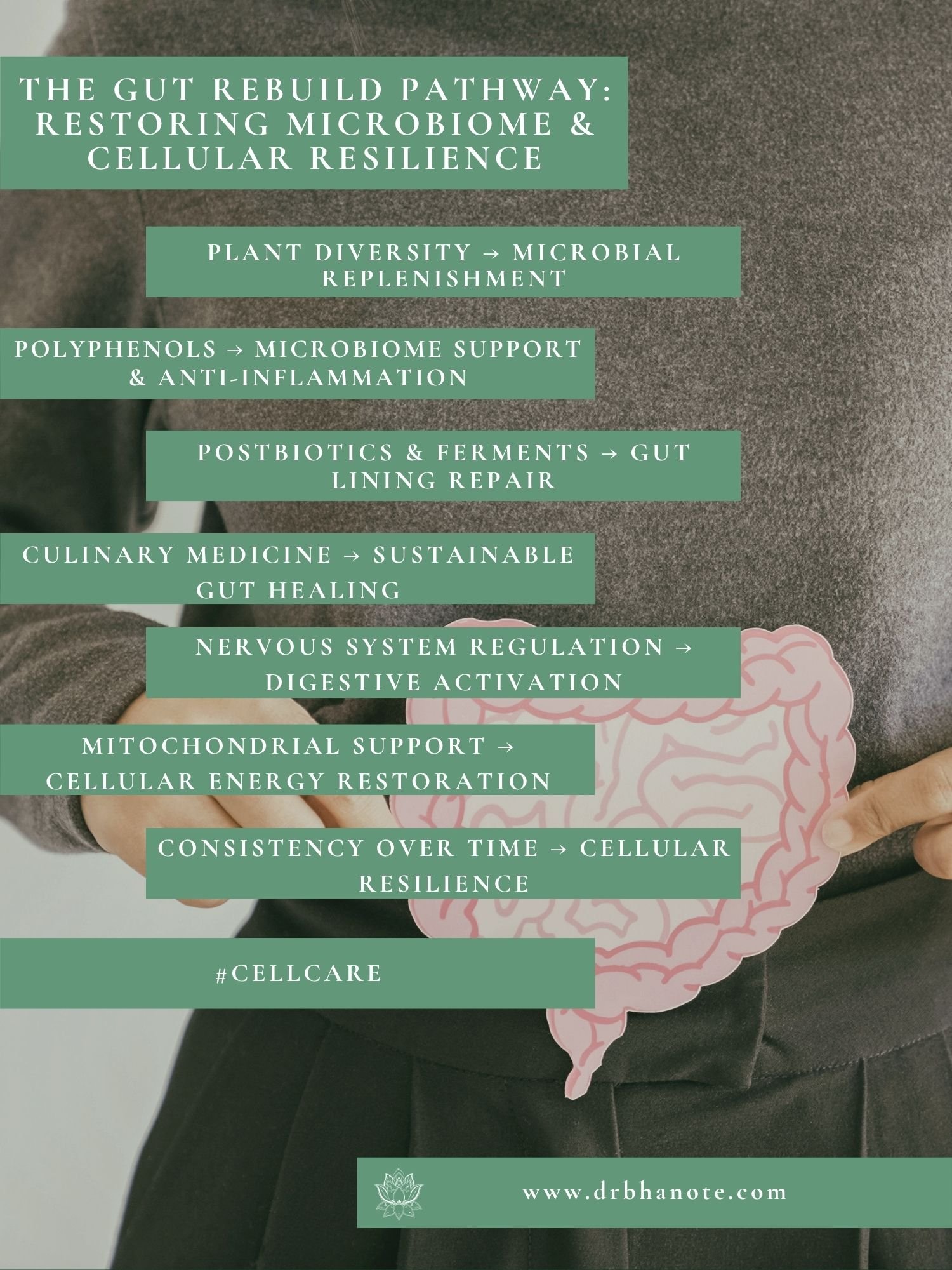
Here is how we approach rebuilding that resilience:
1. The "30 Plants a Week" Challenge
Diversity is the antidote to the "narrowing" effect of antibiotics. Aim for 30 different types of plant fibers each week. This includes vegetables, fruits, nuts, seeds, legumes, and even spices. Each unique fiber feeds a different "colony" of bacteria. Think of it as replanting a forest that was once cleared.
A practical way to do this without turning your grocery list into a full-time job:
Rotate colors: greens, reds, purples, whites, yellows.
Count herbs and spices: parsley, mint, cumin, coriander, turmeric all count.
Add legumes strategically: lentils, chickpeas, black beans, white beans.
Use “micro-diversity”: hemp seeds, pumpkin seeds, walnuts, flax, sesame.
If you’re already feeling bloated, go slowly. More fiber is not always better on day one. Better is better.
Start with cooked plants instead of raw if your gut is reactive. Roasted carrots, sautéed zucchini, cooked greens, and stewed apples are often gentler than giant salads.
2. Focus on Polyphenols Like a CEO, Not a Tourist
Polyphenols are plant compounds that act like microbial fertilizer for the right organisms. They help shape the microbiome in beneficial ways and have antioxidant and anti-inflammatory effects. Think of them as strategic investments in your internal ecosystem.
Some of my favorite physician-led polyphenol foods include:
Blueberries and blackberries
Pomegranate seeds
Green tea
Extra virgin olive oil
Cocoa powder
Purple cabbage
Red onions
Artichokes
Herbs like oregano, rosemary, and thyme
Why do these matter? Because polyphenols are transformed by gut microbes into bioactive compounds that can reduce oxidative stress and support metabolic health. It’s a beautiful two-way relationship: you feed the microbes, and the microbes make compounds that help protect you.
An easy starting strategy:
Add berries to breakfast.
Use extra virgin olive oil generously but thoughtfully.
Swap one coffee for green tea a few days a week.
Add fresh herbs to lunch and dinner.
Build one “polyphenol plate” daily with at least three colorful plant foods.
Minimal effort. Real return.
3. Focus on Postbiotics
The wellness world is shifting from Probiotics (the bacteria) to Postbiotics (the beneficial compounds produced by the bacteria). These are the real "medicine" for your gut lining.
You can support postbiotic production by feeding microbes with fiber and by carefully introducing fermented foods. But this is where nuance matters. A lot of people hear “fermented foods are “healthy” and then eat half a jar of kimchi and wonder why their abdomen starts filing complaints.
Start low. Really low.
If you’re sensitive, begin with:
1 teaspoon of sauerkraut brine
1 teaspoon of plain coconut yogurt or unsweetened yogurt if tolerated
1–2 teaspoons of miso stirred into warm, not boiling, water
A small forkful of fermented carrots
A tablespoon of kefir if dairy is tolerated
Then pause and observe for 48 to 72 hours.
You’re looking for patterns:
Do you feel fine?
Mildly bloated?
Flushed or itchy?
More refluxy?
Better digestion?
If fermented foods flare symptoms, it does not automatically mean they are “bad” for you. It may mean your gut needs slower pacing, smaller doses, or support for issues like histamine sensitivity, SI-BO, or significant dysbiosis.
Think about it this way: even good input can feel like too much when the system is inflamed.
4. Use Culinary Medicine, Not Food Fear
Culinary medicine is the practice of using food intentionally, therapeutically, and realistically to support health. Not perfectly. Not obsessively. Intentionally.
This is one of my favorite ways to help patients rebuild after microbiome disruption because it ispractical, sustainable, and deeply empowering.
Culinary medicine means:
Choosing foods for their biological effect, not just their calories
Preparing them in ways that increase tolerance and nutrient access
Using the kitchen as part of the care plan
For gut repair, culinary medicine often looks like:
Slow-cooked soups with leeks, onions, garlic, and herbs for prebiotic support
Stewed lentils with cumin and turmeric for fiber plus anti-inflammatory compounds
Cooked apples or pears with cinnamon for gentle polyphenols
Salmon, legumes, or tofu paired with bitter greens and olive oil for metabolic support
Miso broths with mushrooms and scallions for a low-effort microbial nudge
The goal is not restriction. The goal is rhythm.
You do not need a cleanse. You need a repeatable template.
Here’s a simple CellCare plate:
A fiber source
A polyphenol source
A quality protein
A healthy fat
Something calming for the nervous system: warm temperature, mindful pacing, fewer distractions
That last point matters more than people realize. Eating in a stressed-out, rushed, multitasking state is not ideal for digestion. Your nervous system influences motility, enzyme release, and blood flow to the gut. In other words: the body notices the vibe.
5. Regulate Your Nervous System
Your gut and your brain are in a constant conversation via the vagus nerve. If you are stuck in "fight or flight" (sympathetic drive), your body shuts down the "rest and digest" functions needed for gut repair. Practices like deep diaphragmatic breathing, cold plunges, or simply intentional movement can tell your gut it’s safe to rebuild.
For many high-performers, nervous system regulation is the missing step because they’re trying to heal in the same state that helped create the problem: rushed, vigilant, overstimulated, overbooked.
Try this physician-approved baseline:
5 minutes of slow nasal breathing before one meal daily
10-minute walk after meals when possible
Morning light exposure within an hour of waking
A firm boundary around late-night work and scrolling
At least one screen-free meal a day
Not glamorous. Very effective.
6. Support Mitochondrial Health
Your gut cells (enterocytes) require massive amounts of energy to maintain the gut barrier. By supporting your mitochondria—the powerplants of your cells—you give your gut the fuel it needs to keep the bad actors out.
Mitochondrial support includes:
Stable blood sugar through balanced meals
Adequate protein intake
Mineral-rich foods
Sleep regularity
Movement that challenges but does not deplete you'
If you are exhausted, inflamed, and under-recovered, more intensity is usually not the answer. Restoration is.
Sometimes the most advanced form of lifestyle optimization is eating lunch, going outside, and getting to bed on time. Wild, I know.
7. Respect the Timeline
This is important: microbiome repair is rarely linear.
You may feel better for two weeks and then have a flare after travel, stress, a virus, or disrupted sleep. That does not mean you are back at zero. It means biology is dynamic.
The question is not, “Did I fix my gut forever?”
The better question is, “Am I building a system that becomes more resilient over time?”
That is a much more useful standard.

CellCare vs. Self-Care
Let’s talk philosophy, because this is where our approach is different.
Self-care has become a very crowded phrase. It can mean anything from a facial to a weekend off-grid to buying another wellness gadget you may or may not use twice.
And listen, I’m not against a beautiful routine. But CellCare goes deeper.
CellCare asks a more foundational question: what does your body need at the cellular level to repair, adapt, and thrive?
Self-care often focuses on how you feel in the moment.
CellCare focuses on what is building resilience underneath the moment.
That includes:
Lowering inflammatory burden
Supporting mitochondrial energy
Protecting gut barrier integrity
Creating microbial diversity
Regulating the nervous system
Reducing the gap between effort and recovery
This is not anti-self-care. It is self-care with a biological backbone.
When we talk about CellCare, we are talking about:
The meal that stabilizes your blood sugar instead of spiking it
The breathwork that helps you digest, not just “relax”
The sleep routine that improves immune repair
The plant diversity that feeds your microbiome
The daily choices that influence longevity quietly, cumulatively, and powerfully
A bubble bath is lovely. A resilient gut lining is better.
The point is not perfection. The point is alignment.
When your habits align with your biology, healing becomes more possible.
Your Resilience Checklist: Next Steps
Ready to stop ignoring your gut and start your rebuild? Here is your actionable "next steps" list:
Audit Your History: Can you link a decline in your energy or digestion to a specific period of illness or antibiotic use?Awareness is the first step in intentional health practices.
Build a Symptom Timeline: Note sleep, bloating, bowel patterns, focus, skin changes, and travel recovery for two weeks.
Diversify Your Plate: Tomorrow, try to buy three vegetables you haven't eaten in a month.
Prioritize Polyphenols: Dark berries, green tea, and extra virgin olive oil are simple, strategic
starting points.
Start Ferments Small: Think teaspoons, not scoops.
Cook More, Stress Less: Use culinary medicine to make food gentler, warmer, and easier to digest.
Support the Vagus Nerve: Slow your breathing before meals and take post-meal walks.
Practice "Clean" Eating (Literally): Focus on organic, non-GMO produce whenever possible to avoid trace pesticides that can further disrupt your microbial diversity.
Frequently Asked Questions
How long does it take to recover from antibiotics?
It depends on the person, the antibiotic class, the number of exposures, diet, stress load, age, sleep quality, and baseline gut health. Some people recover quickly. Others experience a longer rebuilding phase. The important thing is not to assume symptoms are random or that healing is impossible.
Should everyone take probiotics after antibiotics?
Not necessarily. Probiotics can be helpful in some cases, but they are not a one-size-fits-all fix. Some people do better focusing first on food diversity, polyphenols, nervous system support, and fermented foods introduced slowly. It’s best to individualize the plan.
What if fermented foods make me feel worse?
That can happen. It may reflect histamine sensitivity, significant dysbiosis, SIBO, or simply a system that needs a gentler pace. Start with very small amounts, or work with a practitioner if symptoms are strong.
Can you rebuild the gut years later?
Yes, support is still possible even years after antibiotic use. The body remains dynamic. While we cannot promise a perfect rewind, we can improve terrain, resilience, and function.
Is bloating always a sign of dysbiosis?
No. Bloating can come from many things including meal timing, constipation, food intolerances, rapid eating, hormonal shifts, and altered motility. Dysbiosis is one possible contributor, not the only one.
When should I seek medical guidance?
If you have severe GI symptoms, unintentional weight loss, blood in stool, persistent diarrhea, significant pain, fever, or symptoms that are worsening, medical evaluation is essential. Educational content is helpful, but it should never replace appropriate medical care.
Let’s Build a Resilient Future

Recovery from a major microbiome shift doesn't happen overnight. It’s a journey of intentional living. By choosing to focus on your cellular health today, you aren't just fixing a past issue—you are investing in your future longevity.
At the WELLKULÅ Institute, we believe that "CellCare" is the ultimate form of self-care. When you nourish your cells and support your microbiome, you aren’t just surviving; you’re building the kind of resilience that supports energy, clarity, and vitality over time.
Think about it: your body is always trying to heal. Let’s give it the environment it needs to succeed.


MAKE A DIFFERENCE BY SHARING THIS ARTICLE WITH OTHERS TO ENCOURAGE WELLBEING ⤵
The information on this website has not been evaluated by the Food & Drug Administration or any other medical body. We do not aim to diagnose, treat, cure or prevent any illness or disease. Information is shared for educational purposes only. You must consult your doctor before acting on any content on this website, especially if you are pregnant, nursing, taking medication, or have a medical condition. Our content may include products that have been independently chosen and recommended by Dr. Monisha Bhanote and our editors. We may earn a small commission if you purchase something mentioned in this article.
YOU MAY ALSO LIKE:


by Dr. Monisha Bhanote
✅ EVIDENCE-INFORMED REVIEWED ARTICLE