Precision Nutrition for Longevity: Why One-Size- Fits-All Diets Fail Your Cells

“Your health is not built by following trends—it’s built by learning how your cells uniquely respond to nourishment.”
Have you ever noticed how the modern wellness world keeps promising a perfect food, a perfect plan, a perfect app: as if your biology should behave like everyone else’s?
It’s a seductive idea. One trending superfood. One AI-diet app. One universal framework that claims to decode what every body should eat for optimal health. But your biology has never been generic. Your cells are not looking for a trend. They are looking for the right signals.
This is where so many people get stuck. They eat the “healthy” breakfast. They buy the expensive greens powder. They follow the app-generated meal plan. And yet the bloating persists, the energy crashes continue, and the afternoon brain fog still rolls in right on schedule.
Why? Because health is not built by chasing a universally perfect diet. It is built by embracing your body’s unique design.
As a physician, I come back to this truth again and again: food is not just calories, macros, or labels. Food is information. Every meal sends instructions to your microbiome, your mitochondria, your immune system, and your nervous system. And those instructions are interpreted through the lens of your individual terrain.
That is why one person thrives on a food another person barely tolerates. A “superfood” is not universally super. A generic AI recommendation may be convenient, but convenience is not the same as biological precision. The future of longevity belongs to a more intelligent, more nuanced approach: one that respects individuality, leverages data wisely, and restores the art of nourishment.
Dr. Bhanote’s Philosophy: Botanical Intelligence and the #CellCare Plate
At the center of my work is #CellCare: the idea that true wellbeing begins with caring for the smallest, most intelligent units of the body first.
When your cells are supported, your energy changes. Your gut barrier becomes more resilient. Your inflammatory load may soften. Your nervous system becomes less reactive. In other words, the body begins to remember how to regulate itself.
This is where I bring in the concept of Botanical Intelligence.
Botanical Intelligence is the therapeutic wisdom embedded in plants: the fibers, polyphenols, pigments, bitter compounds, and phytonutrients that communicate directly with the microbiome and influence cellular signaling. These compounds do far more than decorate a plate. They shape microbial diversity, help generate beneficial metabolites, and support the internal conditions associated with longevity.
That’s also why I think less in terms of restrictive food rules and more in terms of the #CellCare Plate.
A #CellCare Plate is not a rigid prescription. It is a guiding framework that asks:
What will nourish my cells?
What will support microbial diversity?
What will create steadier energy and less inflammation?
What can I repeat consistently in real life?
In practice, the #CellCare Plate emphasizes:
Colorful, polyphenol-rich plants
A tolerated fiber source
Quality protein
Healthy fats
Herbs, spices, and bitter elements that support digestion and microbial richness
This is not about perfection. It is about pattern. It is about creating a nutritional rhythm that works with your biology instead of against it.
The Editorial Reality Check: Why Generic “Healthy” Advice Falls Apart

We are living in an era of nutritional oversimplification.
Superfoods are marketed like miracle cures. AI-diet apps generate meal plans in seconds. Social feeds reward certainty, not nuance. But the microbiome does not care about marketing language, and your cells do not respond to hype.
A single “healthy” food does not work the same way in every microbiome.
That matters more than ever, because your microbiome: the ecosystem of bacteria and other microbes living primarily in your gut: influences how you process fiber, metabolize polyphenols, regulate inflammation, and even shape appetite and mood. If your microbial terrain is different from someone else’s, your response to the same food may be dramatically different too.
This is precisely why generic recommendations often fail high-performing adults and intentional agers alike. You may be doing all the “right” things on paper, but if the inputs are mismatched for your physiology, your cells still experience friction.
The Science in 2026: Precision Nutrition Gets More Specific
In 2026, precision nutrition is no longer theoretical. The science is becoming sharper, more practical, and more personal.
One of the most compelling developments is the Dietary Index for Gut Microbiota (DI-GM) study published in Frontiers in Nutrition in 2026. Researchers found that individuals with the highest adherence to a gut-supportive dietary pattern: one rich in fiber and polyphenol-dense plant foods: had a 68% lower risk of colorectal cancer compared with those with the lowest adherence. That is a striking reminder that microbial-friendly food patterns are not just about digestion. They may have profound implications for long-term disease prevention and cellular resilience.
Another fascinating signal came from the 2026 Nature Medicine Human Phenotype Project, which linked specific foods with specific microbes in measurable ways. Coffee intake was associated with Lawsonibacter asaccharolyticus, while yogurt intake was associated with Streptococcus thermophilus. On the surface, those names may sound highly technical, but the takeaway is simple: foods leave microbial fingerprints. What you eat helps shape which organisms flourish in your internal ecosystem.
That insight should change how we think about healthy eating.
The conversation is no longer just about whether a food is “good” or “bad.” The better question is: What is this food doing inside your biology?
Current research continues to reinforce several themes:
1. Food responses are highly individualized
Two people can eat the same meal and produce very different blood sugar, inflammatory, digestive, and satiety responses. That variability is influenced by sleep, stress, metabolic status, activity, and especially microbiome composition.
2. Fiber works best when it is diverse and contextual
Fiber remains foundational, but more is not always better overnight. Different microbes ferment different fibers. If your gut terrain is inflamed or imbalanced, aggressive fiber loading can backfire. Precision matters.
3. Polyphenols are active longevity signals
Polyphenols: plant compounds found in berries, cacao, olive oil, tea, herbs, spices, and deeply colored produce: appear to help shape the microbiome in beneficial ways while also influencing oxidative stress and inflammatory signaling.
4. Microbial diversity is a marker of resilience
A more diverse microbial ecosystem is generally associated with stronger gut barrier integrity, more short-chain fatty acid production, and better adaptability. Short-chain fatty acids, such as butyrate, are compounds produced when gut microbes ferment certain fibers. They help nourish the colon and support immune balance.
5. The era of generic meal planning is ending
Apps can be useful tools. But if they flatten nutrition into generic templates without considering microbiome individuality, symptom patterns, and metabolic context, they miss the very thing that makes precision nutrition powerful.

Actionable Solutions for Cellular Resilience
So, what can you do with all of this? Let’s bring it back to daily life.

1. Stop looking for the perfect universal food
Instead of asking whether a food is “healthy,” ask whether it is supportive for you, right now. Your energy, digestion, mood, skin, and cravings offer real-time clues.
2. Build your #CellCare Plate
At least once a day, create a meal around:
2–3 colorful plants
A quality protein
A healthy fat
A fiber source you tolerate well
Herbs, spices, or bitter botanicals
Think of this as a daily ritual for signaling safety, nourishment, and repair to your cells.
3. Prioritize polyphenol richness
Bring in more foods that express Botanical Intelligence:
Berries
Pomegranate
Extra-virgin olive oil
Green tea
Cocoa
Turmeric
Ginger
Garlic
Rosemary, mint, oregano, and parsley
These foods do not just “add nutrients.” They help create a more intelligent biochemical conversation inside the body.
4. Increase fiber with intention
If you are currently fiber depleted, increase gradually. Rotate legumes, seeds, cooked vegetables, resistant starches, and diverse plants across the week. The goal is not just quantity. The goal is microbial diversity and tolerance.
5. Support cellular resilience with a physician-formulated ritual
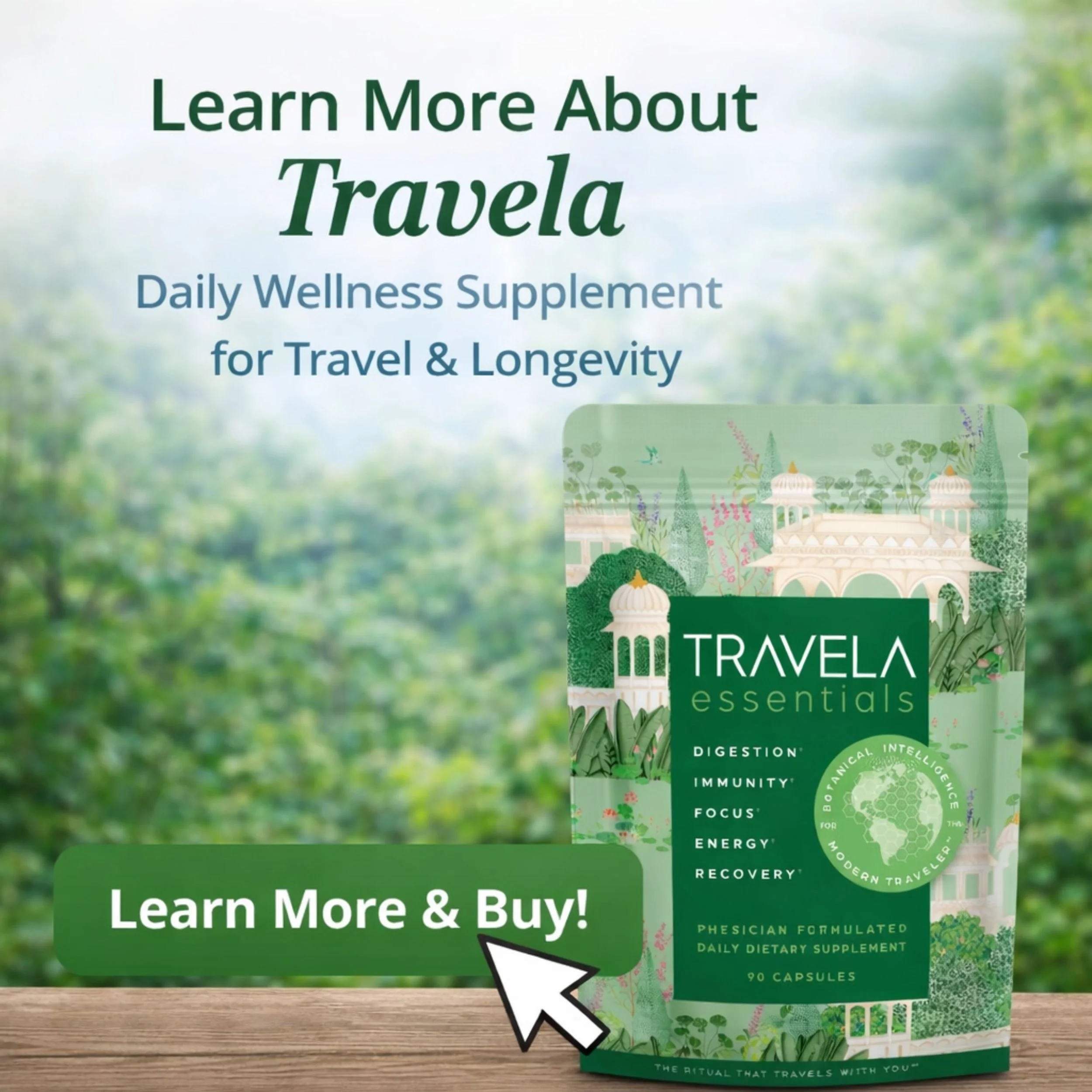
This is exactly where Travela Essentials fits in.
I created Travela Essentials as a practical, physician-formulated ritual for modern life: especially for people who travel, work intensely, eat on the go, or simply need more support than food alone can reliably provide every single day.
Travela Essentials supports:
Gut protection when routine, food quality, and digestion are under pressure
Mitochondrial energy for steadier cellular output and less depletion
Cellular resilience through plant-based nutritional support designed to complement a #CellCare lifestyle
It is not meant to replace intentional eating. It is meant to reinforce it.
6. Use data wisely, not obsessively
Microbiome testing, continuous glucose monitoring, and personalized nutrition platforms can be
valuable. But data works best when paired with clinical insight and lived experience. Use information to deepen self-awareness, not create more noise.

Final Thoughts: Longevity Nutrition Must Become More Personal
The next era of wellness will belong to those willing to move beyond nutritional dogma.
Not every superfood is super for every person. Not every AI-generated plan is intelligent. Not every healthy label tells the full story.
When you begin embracing your body’s unique design, you step into a more sophisticated model of care: one rooted in precision, guided by Botanical Intelligence, and grounded in #CellCare.

This is how we move from food confusion to food clarity. This is how we support the microbiome without oversimplifying it. And this is how we build cellular resilience in a world that constantly asks more of the body. Start with one plate. One ritual. One smarter choice at a time.
That is where transformation begins.


MAKE A DIFFERENCE BY SHARING THIS ARTICLE WITH OTHERS TO ENCOURAGE WELLBEING ⤵
The information on this website has not been evaluated by the Food & Drug Administration or any other medical body. We do not aim to diagnose, treat, cure or prevent any illness or disease. Information is shared for educational purposes only. You must consult your doctor before acting on any content on this website, especially if you are pregnant, nursing, taking medication, or have a medical condition. Our content may include products that have been independently chosen and recommended by Dr. Monisha Bhanote and our editors. We may earn a small commission if you purchase something mentioned in this article.
YOU MAY ALSO LIKE:



by Dr. Monisha Bhanote
✅ EVIDENCE-INFORMED REVIEWED ARTICLE