
The Hidden Cellular Story Behind Bone Loss—And What Actually Helps

“Strong bones are built long before a bone density scan—through the daily signals that tell your body it’s safe to keep rebuilding.”
Janet is 52. She lifts weights twice a week, eats plenty of leafy greens, takes her calcium and vitamin D, and still walked out of her annual physical with a bone density scan result that surprised her. “But I do everything right,” she told me. “How is this happening?”
I hear some version of this almost every week. A patient who is disciplined, informed, and proactive—and yet their body seems to be telling a different story than their habits suggest. And almost every time, the missing piece isn’t a missing supplement or a forgotten exercise. It’s a missing lens.
Because bone is not the static, mineral-packed structure most of us were taught to picture. Bone is living tissue. It is metabolically active, constantly being broken down and rebuilt, and deeply responsive to everything else happening in your body—your stress levels, your sleep, your gut, your hormones, even your travel schedule. Bone health isn’t a calcium story. It’s a cellular one.

Your Skeleton Is a Construction Site, Not a Storage Unit
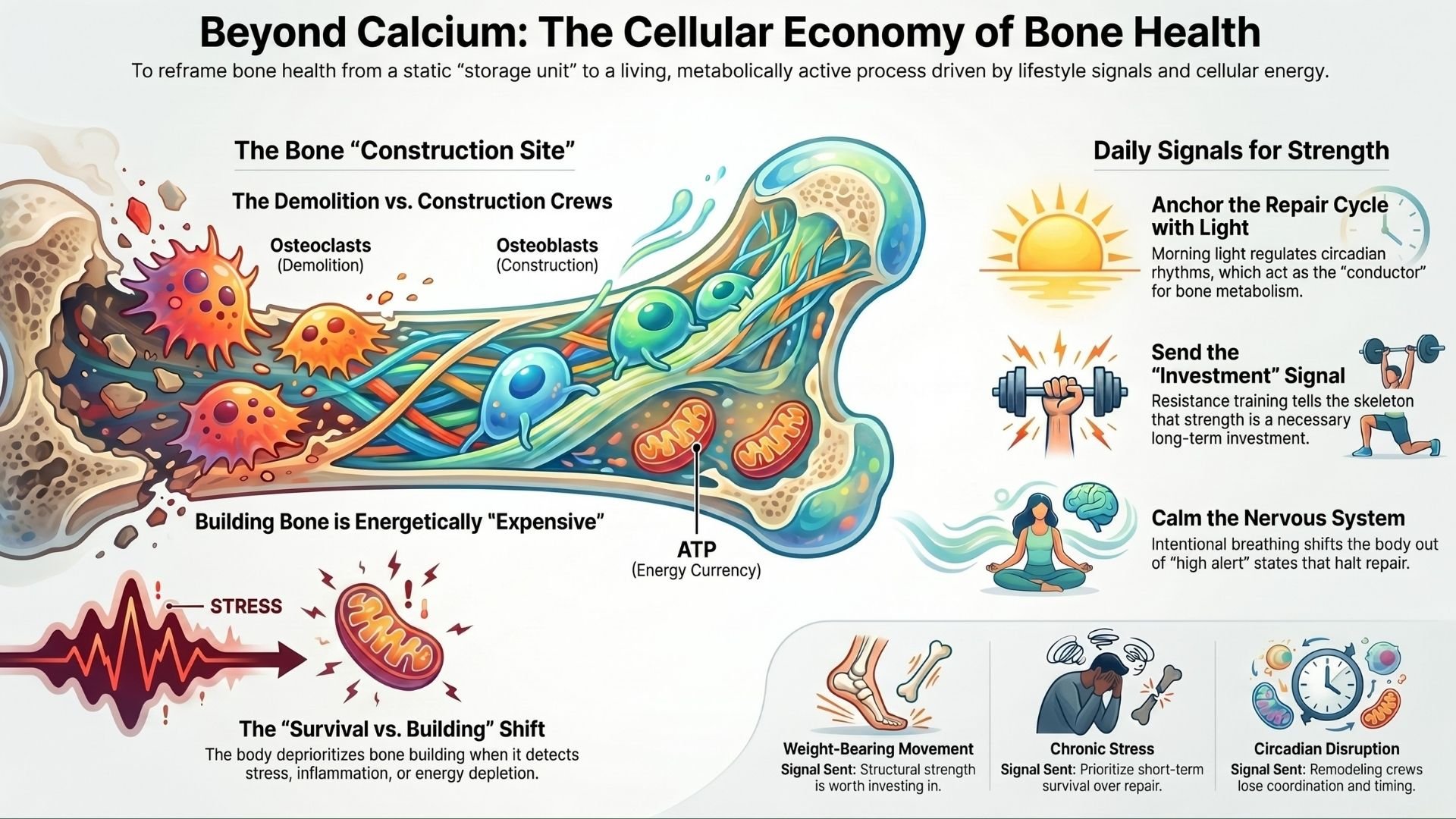
At any given moment, your body is running two crews on your skeleton. One crew, called osteoclasts, breaks down old or microdamaged bone. The other, osteoblasts, builds new bone in its place. This continuous cycle—bone remodeling—is how your skeleton repairs wear and tear, adapts to the demands you place on it, and maintains your structural integrity over decades.
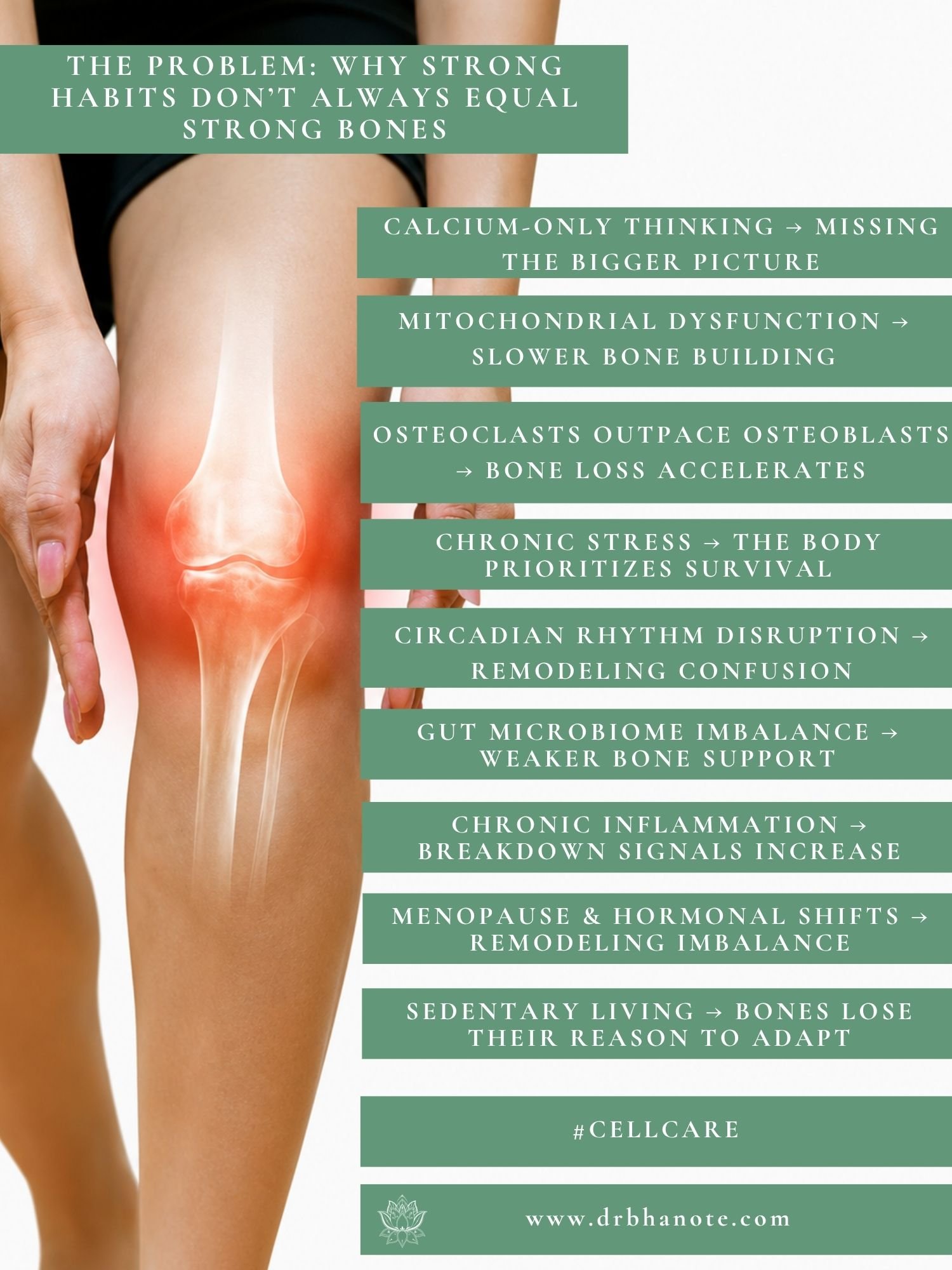
When these two crews are in balance, your bones stay strong. When the demolition crew (osteoclasts) start outpacing the construction crew (osteoblasts), bone density gradually declines—not because your body is failing, but because it’s responding to signals it’s receiving from everywhere else.
This is where science gets genuinely interesting. Building new bone is expensive. Osteoblasts need a steady supply of ATP—the energy currency produced by your mitochondria—to synthesize collagen, transport minerals, and carry out the meticulous work of laying down new bone matrix. Recent research has increasingly focused on how mitochondrial quality and function in bone cells directly shape this balance between formation and breakdown, with mitochondrial quality control in osteoblasts and osteoclasts and their antioxidant pathways offering new insight into supporting healthy bone turnover.
In other words, your mitochondria aren’t just powering your bone cells—they’re helping decide whether your body believes this is a season for building or a season for survival.
When the Body Decides It’s Not Safe to Build
Here’s the part that often gets missed in conversations about bone density. Your body is extraordinarily intelligent, but it’s also relentlessly practical. If your internal environment is signaling chronic stress, poor sleep, inflammation, or energy depletion, your physiology shifts its priorities. Long-term investments—like building bone—get deprioritized in favor of short-term survival.
Sleep and circadian rhythm play a similar role. Bone remodeling, like much of your physiology, follows a daily rhythm. When that rhythm gets disrupted—through irregular sleep, late-night eating, or frequent travel across time zones—the coordination between your bone-building and bone-breaking cells can lose its conductor. Researchers have been examining circadian rhythm disruption as a factor in bone metabolism and skeletal health, recognizing that the timing of biological processes matters just as much as the processes themselves.
And then there’s your gut. Emerging research continues to highlight how the gut microbiome influences bone metabolism—through its role in nutrient absorption, immune signaling, and inflammation. A gut environment that’s inflamed or imbalanced doesn’t just affect digestion; it sends signals throughout the body that can influence how your bone cells behave.
The Whole-Body Web Around Your Skeleton
I find it helpful to think of bone health less as a single data point and more as a window into your overall cellular environment. Your skeleton is in constant conversation with your hormones, your nervous system, your mitochondria, and your gut. When that conversation is calm, coordinated, and well-resourced, bone remodeling tends to proceed elegantly. When that conversation is chaotic—chronic stress, poor sleep, inflammatory foods, sedentary days—your skeleton hears it, too.
This doesn’t mean bone loss is “all in your head” or purely lifestyle-driven; genetics, hormonal changes (especially during and after menopause), and age all play significant roles that deserve appropriate medical evaluation, including bone density screening when recommended by your physician. But it does mean that the daily signals you send your body matter more than most people realize, and that there's a real opportunity to support your skeleton long before a scan tells you something has already changed.

What You Can Do Today
Move with intention
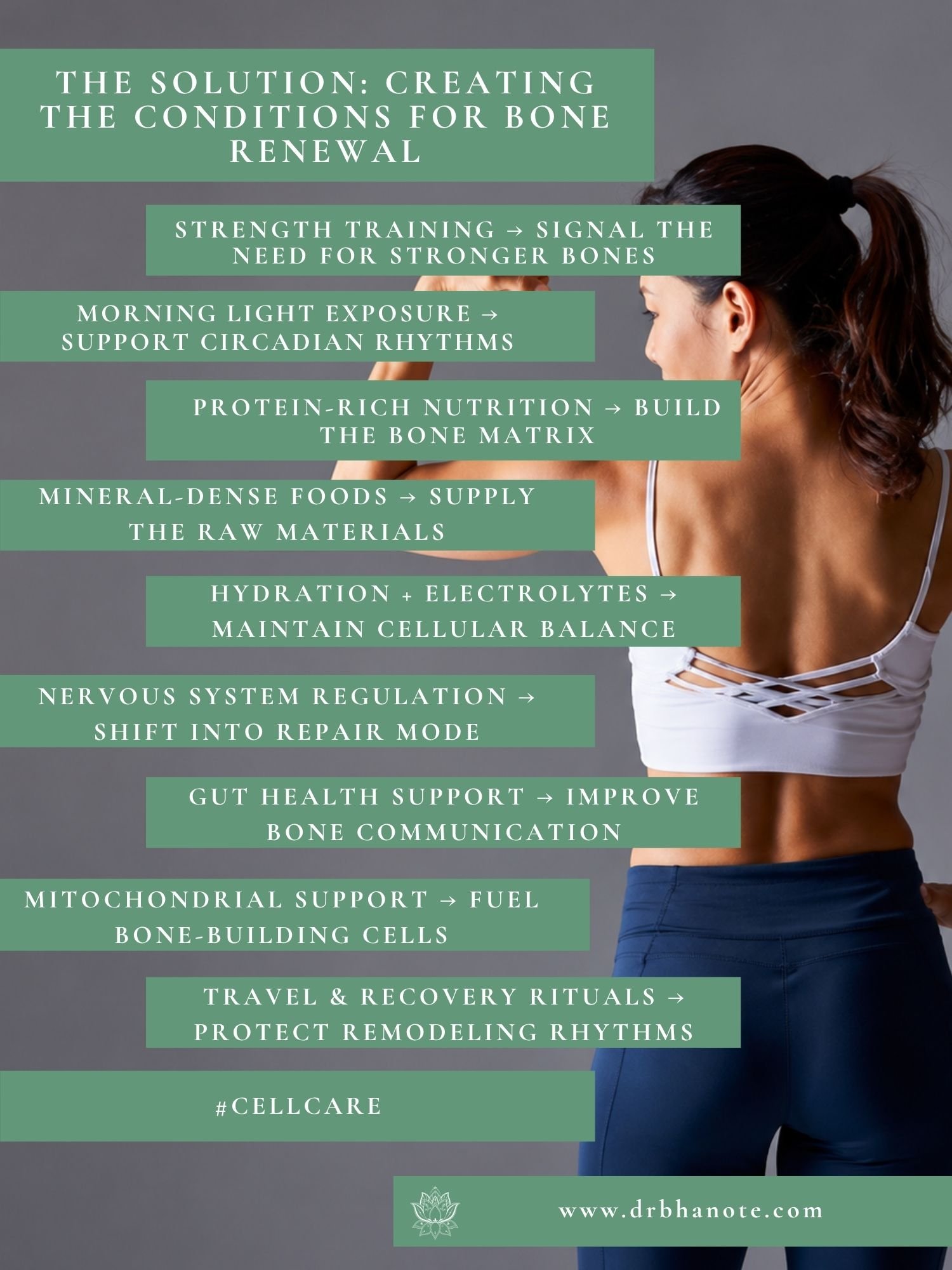
Resistance training and weight-bearing movement—even brisk walking—send a direct signal to your skeleton that strength is needed and worth investing in. You don’t need to overhaul your routine; consistency matters more than intensity.
Get morning light
Stepping outside within an hour of waking helps anchor your circadian rhythm, which supports the timing of repair processes throughout your body, including in bone tissue.
Build mineral-rich, protein-sufficient meals
Bone is roughly 90% type I collagen by organic content, so the amino acids and micronutrients you eat—leafy greens, legumes, nuts, seeds, and quality protein sources—directly supply the raw materials for that matrix.
Hydrate with minerals in mind
Especially if you travel often, pairing water with electrolytes or mineral-rich foods can help your body avoid pulling from its own reserves to maintain balance.
Take stress physiology seriously
This doesn’t have to mean a complete lifestyle overhaul. Even five minutes of slow, intentional breathing before bed, or a consistent wind-down routine, can help shift your nervous system out of a chronic “high alert” state—which is the state that tends to deprioritize long-term repair.
Support your travel rituals

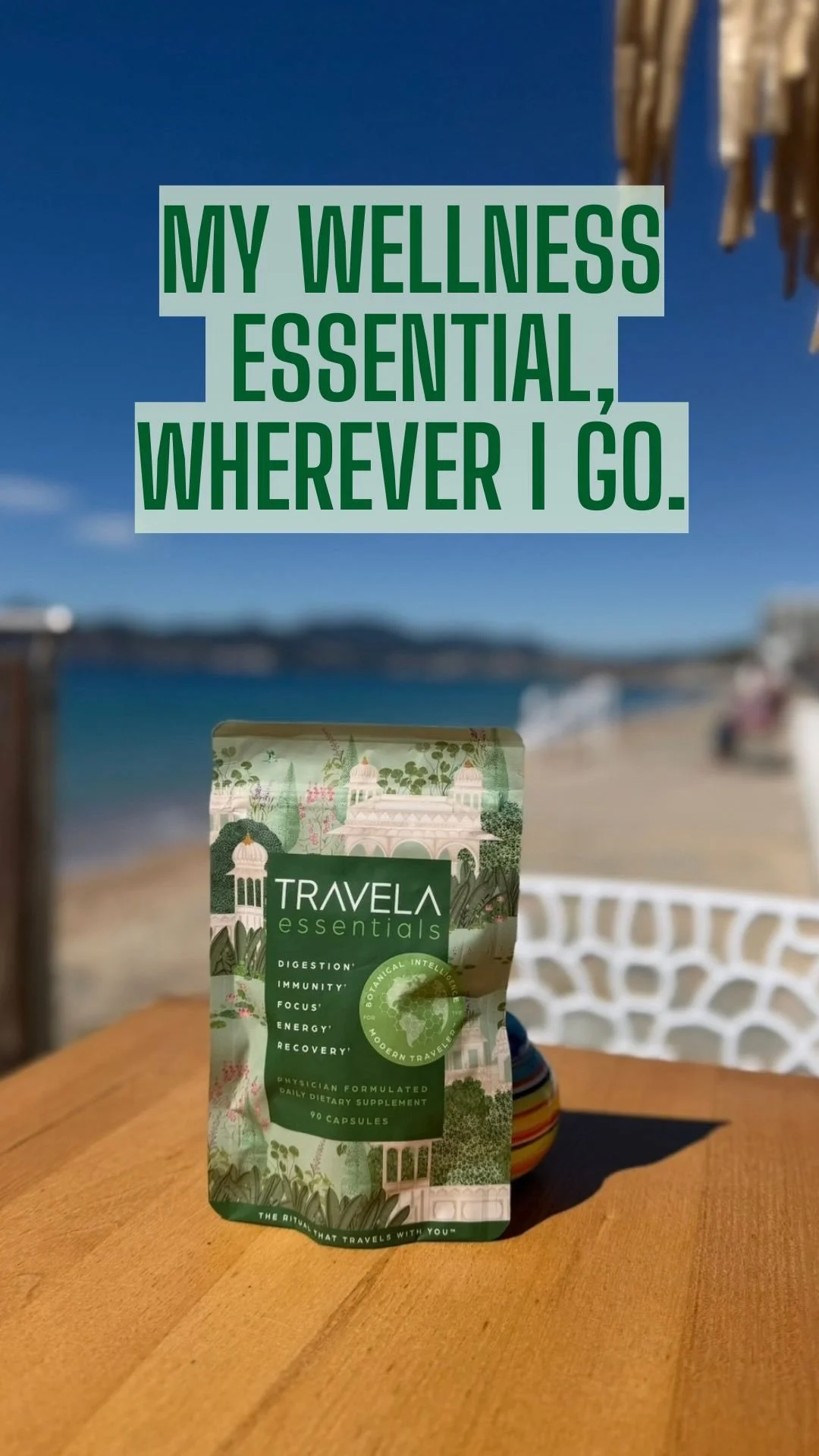
If you travel frequently, your circadian rhythm, hydration, and gut take the biggest hits. This is where a daily ritual that travels with you becomes valuable—not as a quick fix, but as a way of giving your body consistent support for digestion, stress resilience, and energy production, even when your schedule isn’t consistent. Ingredients like magnesium bisglycinate, PQQ, and adaptogenic herbs such as ashwagandha or holy basil are often included in these kinds of formulations because they support the cellular processes—mitochondrial energy production, antioxidant defense, and stress modulation—that underlie so much of what we’ve discussed here. The goal isn’t to feel something dramatic; it’s often what you stop noticing—less travel fatigue, fewer digestive disruptions, steadier energy—that signals things are working.

The Clinical Picture
When I talk with patients like Janet, I try to reframe the bone density conversation. A scan is a snapshot, not a verdict. It tells us where things stand today, but it doesn’t tell the whole story of why—and it doesn’t have to define where things go from here. The body’s remodeling process is ongoing, which means there is always an opportunity to shift the signals you’re sending it.
This is also why I encourage a broader evaluation that looks at sleep quality, stress levels, digestion, hormonal status, and movement patterns alongside bone density itself. Bone health is rarely an isolated issue, and addressing it in isolation rarely tells the full story.
The Longevity Connection
Skeletal strength is foundational to almost everything we associate with healthy aging: balance, mobility, independence, confidence in movement. But beneath that visible strength is an invisible cellular economy—one based on energy production, inflammation control, hormonal rhythm, and repair capacity.
When we support that cellular economy, we’re not just supporting bone. We’re supporting the same systems that influence how we age across the board: how our cells generate energy, how well our tissues repair, and how resilient we are to the stressors of daily life. Bone health, viewed this way, becomes less of a standalone concern and more of an entry point into a much larger conversation about longevity.
#CellCare Reflection
Your skeleton is quietly telling a story about how your cells are doing—whether they have the energy, the rhythm, and the safety signals they need to keep rebuilding. That story isn’t fixed. Every meal, every night of rest, every moment of intentional movement is a small input into that ongoing conversation between you and your cells.
You don’t need to do everything today. Pick one thing—a morning walk, an earlier bedtime, a few minutes of quiet breathing—and let that be today’s signal to your body that it’s safe to keep building.


MAKE A DIFFERENCE BY SHARING THIS ARTICLE WITH OTHERS TO ENCOURAGE WELLBEING ⤵
The information on this website has not been evaluated by the Food & Drug Administration or any other medical body. We do not aim to diagnose, treat, cure or prevent any illness or disease. Information is shared for educational purposes only. You must consult your doctor before acting on any content on this website, especially if you are pregnant, nursing, taking medication, or have a medical condition. Our content may include products that have been independently chosen and recommended by Dr. Monisha Bhanote and our editors. We may earn a small commission if you purchase something mentioned in this article.
YOU MAY ALSO LIKE:





by Dr. Monisha Bhanote
✅ EVIDENCE-INFORMED REVIEWED ARTICLE