
Why Your Hair Loss Might Actually Be a Mitochondrial Energy Crisis

“Before hair loss becomes visible, the story often begins at the cellular level—where energy production, repair, and resilience determine what can grow.”
A patient of mine — a busy marketing director in her late forties — came to see me not for her hair, but for her energy. She described feeling “run on fumes” for months: waking up tired despite eight hours of sleep, relying on coffee to get through back-to-back video calls, and feeling like her brain was wrapped in cotton by 3 p.m.
It was almost an afterthought when she mentioned, almost apologetically, that her hair had been shedding more than usual. More strands in the shower drain. A part that looked just slightly wider in photos. She'd already tried a new shampoo, a scalp serum, even a biotin gummy from the pharmacy. Nothing seemed to move the needle.
Here's what I told her, and what I want to share with you: her hair and her energy were not two separate problems. They had the same problem, showing up in two different places.
We tend to think of hair as purely aesthetic — a “crown” to be styled, colored, and pampered. But in #CellCare, we read hair differently. It's one of the most honest, high-fidelity signals of what's happening inside your cells. Hair is one of the most metabolically expensive tissues your body produces, and when it loses its density or shine, it's rarely just a beauty issue. More often, it's a window into your cellular energy reserves.
At the center of that energy story are your mitochondria — the tiny powerhouses inside every cell that generate the fuel (ATP) needed for rapid cell division, including the cell division that builds every strand of hair. In this article, we'll explore why hair follicles are some of the most energy-hungry structures in your body, what happens when that energy system falters, and which evidence-backed, bio-intelligent nutrients — including PQQ, Glutathione, Amla, and CoQ10 — can help support the cellular foundation for thicker, more resilient hair over time.

The Metabolic Engine: Why Your Hair Follicles Are Such Energy Hogs
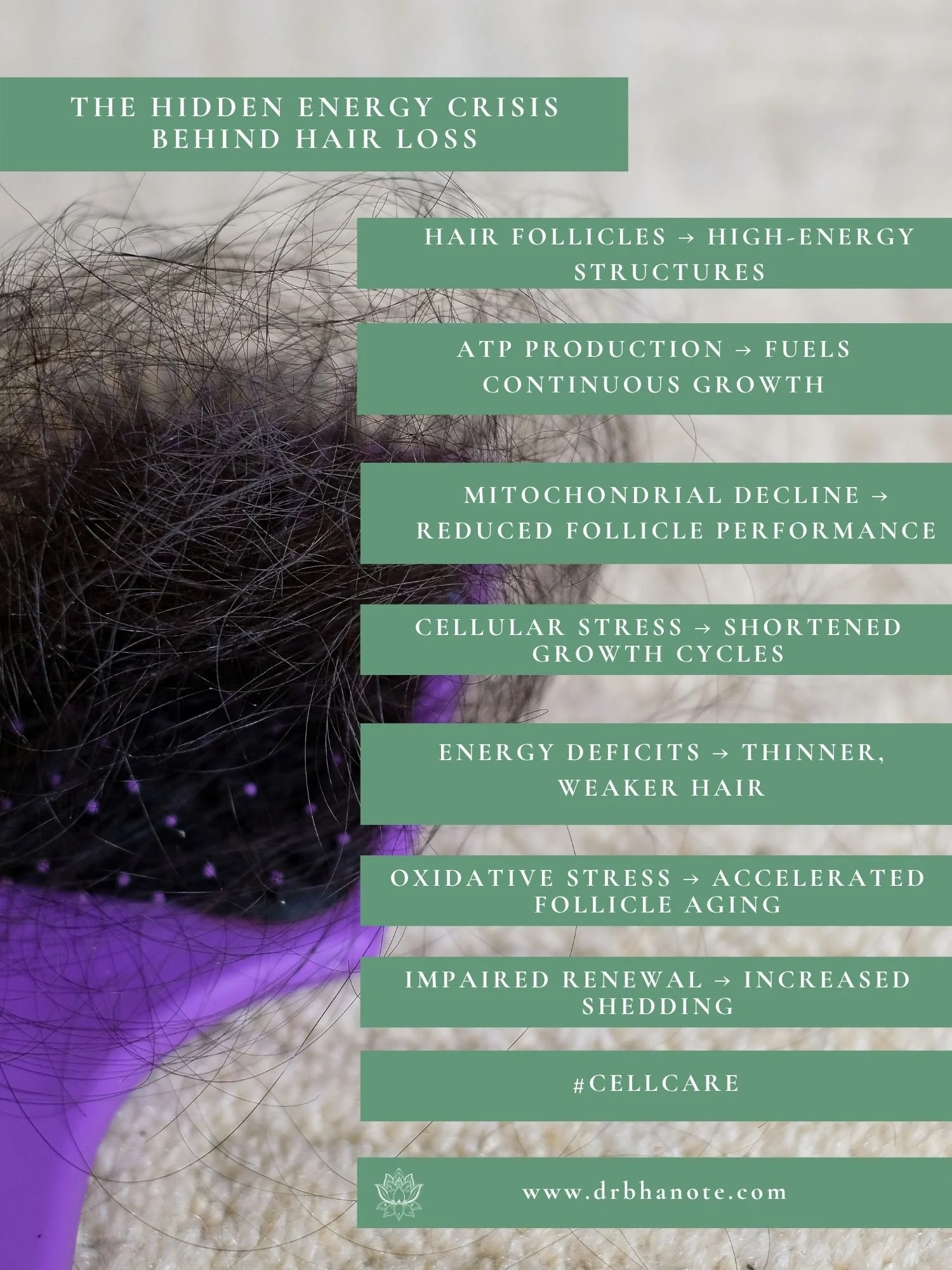
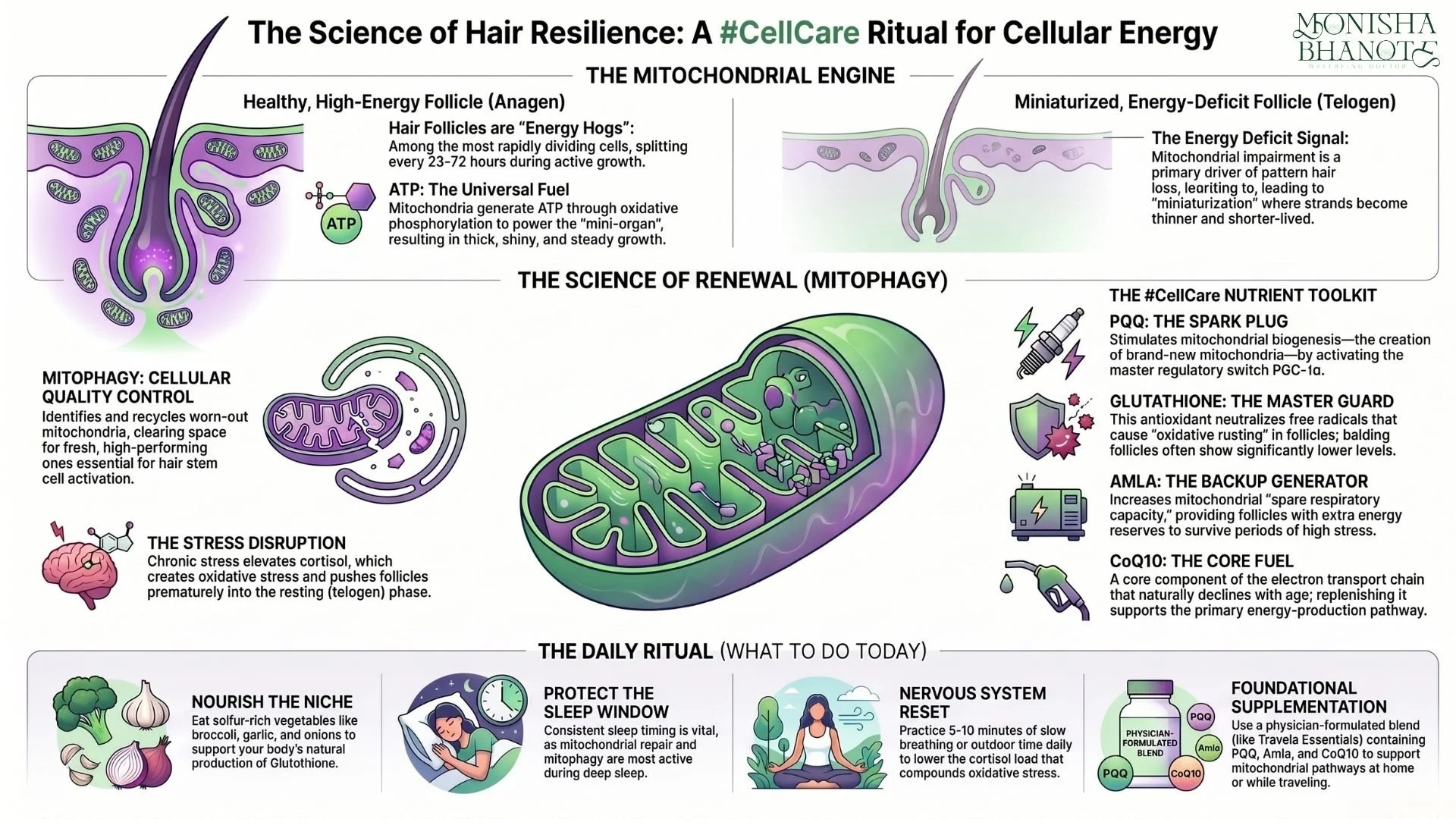
To understand hair thinning, it helps to appreciate just how demanding a hair follicle really is. It's a “mini-organ” that cycles through continuous regeneration for your entire life. During the anagen phase — the active growth phase — hair follicle cells are among the most rapidly dividing cells in your entire body, splitting every 23 to 72 hours.
That kind of performance requires an enormous amount of adenosine triphosphate, or ATP — the universal energy currency of the cell. Mitochondria generate ATP through a process called oxidative phosphorylation. Think of it like a power plant running around the clock: when it's well-maintained and well-supplied, your follicles have the fuel reserves to sustain a long, healthy anagen phase. The result is hair that feels thick, looks shiny, and grows at a steady, reliable pace.
But as we age — or move through seasons of chronic stress, inconsistent sleep, processed diets, or environmental toxin exposure — mitochondrial function naturally begins to decline. This is mitochondrial dysfunction, and in the follicle, it shows up as a shortened growth cycle and a gradual “miniaturization” of the hair strand — thinner, weaker, shorter-lived hairs. Cutting-edge 2025 research has confirmed that mitochondrial impairment is a primary driver of androgenetic alopecia, or pattern hair loss. It's not only about hormones. It's about an energy deficit happening at the cellular level, every day.
The Cellular Science of Renewal: Mitophagy and the Art of Recycling
One of the most exciting areas of recent research is our deepening understanding of mitophagy — your cell's internal quality-control and recycling system. Mitophagy is the process by which cells identify, break down, and recycle damaged or worn-out mitochondria, clearing space for fresh, high-performing ones.
A landmark 2025 study found that mitophagy is essential for hair follicle stem cell activation. Your follicles house a quiet reservoir of stem cells that sit dormant during the resting, or telogen, phase. For these stem cells to wake up and launch a new growth cycle, they undergo a rapid metabolic shift — clearing out old, sluggish mitochondria through mitophagy and generating fresh, efficient ones to power the transition.
What Happens When Mitophagy Stalls
When mitophagy is impaired — whether from aging, poor nutrition, or environmental toxins — old, damaged mitochondria linger, leaking reactive oxygen species (ROS) much like a rusted pipe leaking toxic fluid. This oxidative stress creates a hostile environment that keeps follicles locked in a state of prolonged dormancy. Supporting mitophagy isn't a fringe concept; it's a foundational piece of cellular health and lasting hair regeneration.

The Nervous System Connection: Why Stress Shows Up in Your Hair
If you've ever noticed more shedding during a stressful season — a big move, a demanding work project, international travel — you weren't imagining it. Chronic activation of the stress response elevates cortisol, which can disrupt the hair growth cycle by pushing follicles prematurely out of the anagen phase and into telogen.
This is where nervous system regulation becomes more than a wellness buzzword — it's a cellular strategy. Sustained stress increases oxidative load throughout the body, including in the follicle, compounding the mitochondrial strain we just discussed. Practices that help regulate the nervous system, like the ones we teach at the WELLKULÅ Institute, aren't separate from hair health. They're part of the same cellular conversation.
PQQ: The Spark Plug for Mitochondrial Biogenesis
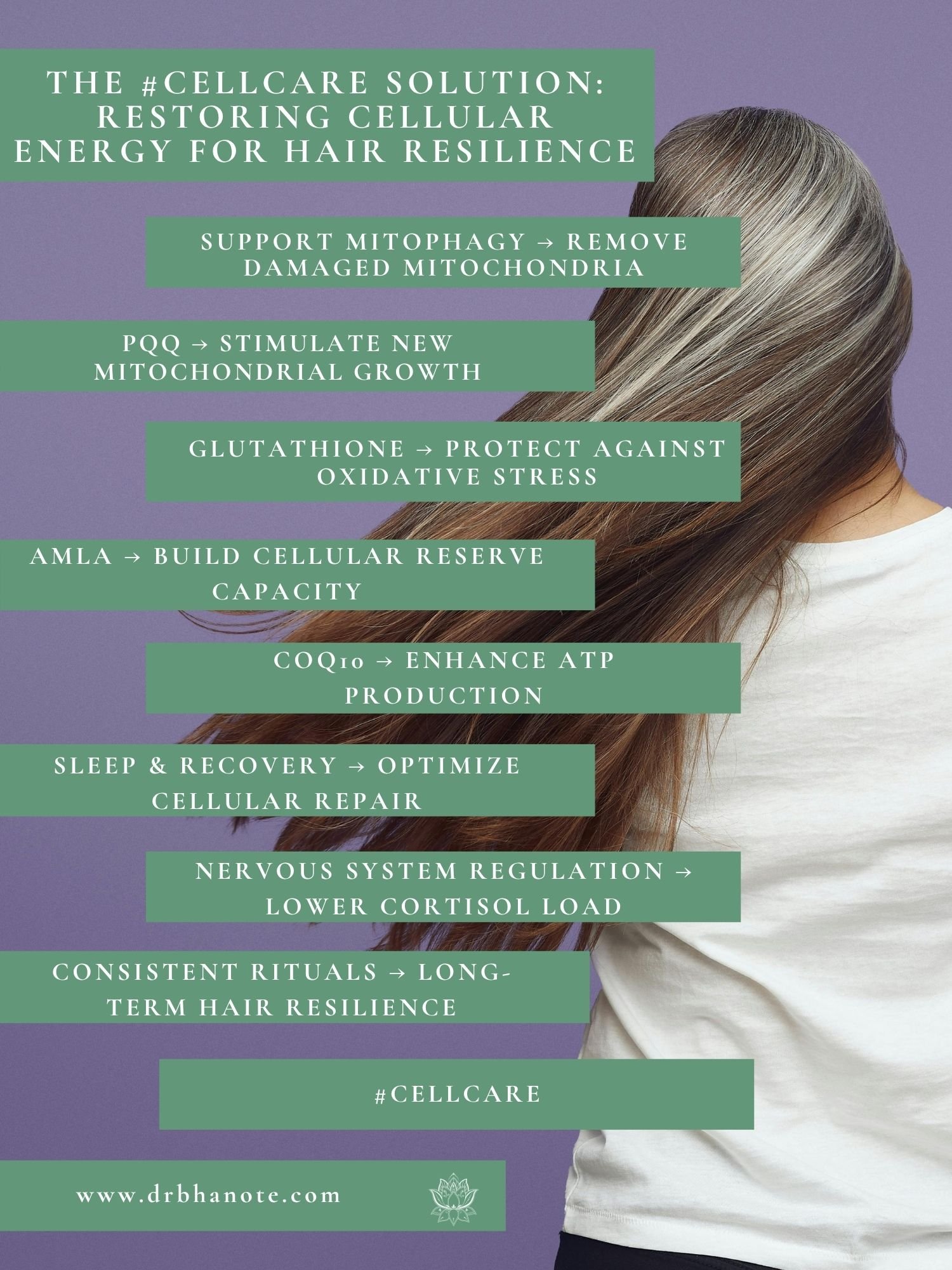
If mitochondria are the engines powering your hair follicles, PQQ (Pyrroloquinoline Quinone) is the spark plug. PQQ is a unique redox cofactor with a remarkable ability: it stimulates mitochondrial biogenesis — literally, the creation of new mitochondria inside your existing cells.
It works by activating a master regulatory switch called PGC-1α (peroxisome proliferator-activated receptor gamma coactivator 1-alpha). When PGC-1α is switched on, it signals your DNA to begin building more mitochondria. For your hair, this matters enormously: by increasing mitochondrial density within the dermal papilla — the command center of the follicle — PQQ helps create the energy surplus follicles need to shift back into a productive anagen phase.
PQQ doesn't just create more mitochondria — it helps make them better ones. As a potent antioxidant, it protects delicate mitochondrial DNA (mtDNA) from the oxidative damage that so often leads to hair thinning over time. In the CellCare philosophy, we consider PQQ a bio-intelligent tool because it works with your biology, supporting your body's own innate regenerative capacity.
Glutathione: The Master Antioxidant That Guards the Follicle
While PQQ helps build the engine, L-Glutathione helps protect it. Often called the “Master Antioxidant,” glutathione is a tripeptide your body naturally produces to neutralize free radicals and keep your cellular environment balanced.
Your hair follicles are exceptionally sensitive to redox imbalance — a state where free radical production outpaces your body's ability to neutralize it. New research published in 2026 found that balding hair follicles carry significantly lower levels of glutathione and significantly higher levels of oxidative stress compared to healthy follicles. This “oxidative rusting” effectively suffocates the follicle, contributing to inflammation and accelerated shedding.
Supporting healthy glutathione metabolism helps address that source. Glutathione doesn't just protect the follicle — it also supports liver function, which plays a major role in filtering the hormones and toxins that can disrupt healthy hair growth. When you support glutathione production, you're not only nourishing your hair; you're supporting microbiome health and whole-body cellular resilience.
Amla and CoQ10: Ancient Wisdom Meets Cellular Energy Science
In my practice, I love bridging ancient botanical wisdom with modern molecular science — and Amla (Phyllanthus emblica), or Indian Gooseberry, is one of my favorite examples. Amla has been used for centuries in Ayurvedic medicine to support hair health, and now we have data to help explain why it works.
Recent 2025 research shows that Amla does far more than supply vitamin C. It increases mitochondrial spare respiratory capacity — essentially your cells' backup generator, the extra energy reserve they can draw on under stress. Amla also activates Nrf2, a protein that acts as your body's internal thermostat for antioxidant production. In a clinical trial involving women with pattern hair loss, oral Amla supplementation significantly improved the anagen-to-telogen ratio — meaning more hairs shifted into the active growth phase and fewer into the resting, shedding phase.
CoQ10 (Coenzyme Q10) plays a complementary role. As a core component of the electron transport chain — the very system mitochondria use to generate ATP — CoQ10 levels naturally decline with age, right alongside our overall mitochondrial output. Replenishing CoQ10 supports the same energy-production pathway that PQQ helps build and Amla helps protect, making it a natural part of a comprehensive, cellular-energy-focused approach to hair resilience.

A Daily Ritual That Travels With You

Navigating the supplement aisle can feel overwhelming — which is part of why we formulated Travela Essentials. It isn't another generic “hair, skin, and nails” vitamin. It's a physician-formulated blend designed to support the cellular foundation — mitochondrial energy, antioxidant defense, and resilience — that underlies so much of how we look and feel, whether at home or on the road.
Travela Essentials brings together PQQ, Amla, CoQ10, and precursors that support L-Glutathione production, alongside other bio-intelligent ingredients like Magnesium Bisglycinate and Resveratrol, as part of a broader lifestyle strategy. Why these together? Because hair growth, energy, stress resilience, and travel recovery all draw from the same underlying well: your mitochondrial health.
I always remind my patients: the most meaningful changes are often what you stop noticing. Less travel fatigue. Less brain fog after a long flight. Less digestive disruption when your routine is disrupted. Less reactivity to everyday stress. These quiet shifts, sustained over months, are what cellular resilience actually feels like — and they're the same cellular environment in which healthier hair has the chance to grow.
What You Can Do Today
Reclaiming the health of your hair isn't an overnight process — hair grows at an average rate of about half an inch per month. But by changing your cellular environment today, you're setting the stage for the hair that will emerge three to six months from now.
A Few Places to Start
Audit your energy. Persistent fatigue and brain fog are often early signals of mitochondrial decline — and they tend to show up in your hair months later. Notice the pattern rather than dismissing it.
Nourish the niche. Build meals around a plant-forward, nutrient-dense foundation rich in sulfur-containing vegetables — broccoli, garlic, onions — to support your body's natural glutathione production.
Protect your sleep window. Mitochondrial repair and mitophagy are most active during deep sleep. Consistent sleep timing matters as much as total hours.
Build in a daily nervous system reset. Even five to ten minutes of slow breathing, time outdoors, or gentle movement can help lower the cortisol load that compounds oxidative stress in your follicles.
Consider a foundational supplement. A physician-formulated option like Travela Essentials can serve as a daily ritual that travels with you — supporting the same mitochondrial pathways whether you're at home or navigating time zones.
#CellCare Reflection
My patient's story isn't unusual. So many of us treat fatigue, brain fog, and hair thinning as separate inconveniences to be managed individually — a supplement here, a serum there. But your body doesn't work in silos. Your cells are in constant conversation with each other, and your hair is simply one of the places where that conversation becomes visible.
Your hair is a living reflection of your internal vitality — a quiet, ongoing report from your mitochondria about how well-supported your cells feel. When you choose to care for those cells, through sleep, nourishment, nervous system regulation, and thoughtful daily rituals, you're not chasing a quick fix. You're investing in longevity — in the kind of energy and resilience that shows up not just in your hair, but in how you move through your days.
You don't have to overhaul everything at once. Pick one small, sustainable shift from this article — a few extra minutes of morning sunlight, a sulfur-rich vegetable at dinner, an earlier wind-down for sleep — and let that be today's act of Cell Consciousness. That's how true CellCare begins: not with urgency, but with intention.
Want more #CellCare insights like this? Join the #CellCare Newsletter for science-backed rituals, explore Travela Essentials, or learn more about upcoming retreat experiences at the WELLKULÅ Institute.
Explore WELLKULÅ →




MAKE A DIFFERENCE BY SHARING THIS ARTICLE WITH OTHERS TO ENCOURAGE WELLBEING ⤵
The information on this website has not been evaluated by the Food & Drug Administration or any other medical body. We do not aim to diagnose, treat, cure or prevent any illness or disease. Information is shared for educational purposes only. You must consult your doctor before acting on any content on this website, especially if you are pregnant, nursing, taking medication, or have a medical condition. Our content may include products that have been independently chosen and recommended by Dr. Monisha Bhanote and our editors. We may earn a small commission if you purchase something mentioned in this article.
YOU MAY ALSO LIKE:




by Dr. Monisha Bhanote
✅ EVIDENCE-INFORMED REVIEWED ARTICLE