
The Silent Conductor: Why Your Vagus Nerve is the Real Secret to Longevity

“Longevity is not just about adding years to life—it’s about restoring the clarity of communication between the gut, brain, and body.”
The Gut-Brain Connection | When Doing Everything Right Still Doesn’t Feel Like Enough
You know this person because, in some season of life, you may have been this person.
They eat well. They work out. They optimize their sleep. They travel with supplements in neat little packets. Their labs are mostly “fine.” On paper, they are doing everything right. And yet, somewhere beneath the polished routine, they still feel braced. Their digestion is unpredictable. Their mind feels slightly foggy. Their chest tightens before meetings that should feel manageable. Their body hums with a kind of low-grade vigilance they can’t quite explain.
This is the experience many high-performers struggle to name. It is not dramatic enough to feel like a medical emergency, but it is persistent enough to shape daily life. It feels like internal noise: a subtle static in the system. You push through it, compensate for it, even normalize it. But over time, that internal noise starts to affect everything from focus and recovery to mood, digestion, sleep, and how safe your own body feels from the inside.
The vagus nerve rarely announces itself in obvious ways. It works more like a silent conductor, shaping the rhythm of digestion, inflammation, breath, heart rate, recovery, and the stream of internal signals moving from body to brain. When that rhythm is clear, you feel more regulated. When it is ditorted, life can feel strangely effortful, even when you are doing all the “healthy” things.
That is why the conversation around longevity needs to become more sophisticated. Because the real issue is often not a lack of discipline. It is a breakdown in communication.
Vagus Nerve Pathway | The Problem: Interoceptive Dysfunction and the Breakdown of Inner Communication
The Interoceptive Gut Is a Sensory Organ, Not Just a Digestive Tube
One of the most important shifts in modern health science is the recognition that the gut is not simply a place where food is processed. It is also a sensing organ. What I often call the interoceptive gut is the gut’s capacity to detect and relay information about the body’s internal environment: inflammation, nutrient status, microbial activity, stretch, motility, and metabolic signals: back to the brain.
This process is known as interoception, your brain’s reading of what is happening inside your body. In plain language, it is the inner awareness system that tells you whether you feel calm or braced, nourished or depleted, settled or reactive. When that signaling is clear, the body can adapt with precision. When it becomes distorted, symptoms often emerge long before disease is formally named.
The vagus nerve is one of the primary channels for that communication.

Why 90% Afferent Signaling Changes the Way We Think About Health
The detail that should change how more people think about the vagus nerve is this: roughly 90 percent of its fibers are afferent, meaning they carry information from the body to the brain. The brain is not simply issuing commands downward. It is constantly receiving reports upward.
That means your gut is briefing your brain all day long.
It is telling the brain whether the terrain is inflamed, whether digestion feels safe, whether the microbiome is sending useful chemical signals, whether the system is under stress, and whether it is appropriate to prioritize repair or defense. This is not a wellness metaphor. It is a biological reality with implications for cognition, mood, metabolism, immune tone, and how we age.
The 2026 Nature Finding That Reframed Longevity
A 2026 Nature paper made this even harder to ignore. Researchers showed that intestinal interoceptive dysfunction can drive age-associated cognitive decline. Age-related changes in the microbiome altered metabolite signaling, activated inflammatory pathways through GPR84 in myeloid immune cells, and weakened vagal afferent signaling from gut to brain. The consequence was impaired hippocampal function and poorer memory performance in animal models. When the signaling pathway was restored, memory improved.
That is a profound reframing of aging.
It suggests that cognitive decline is not only a brain story. It is also a gut-brain signaling story. A microbial story. An inflammatory story. A vagal story. In other words, the brain may age according to the clarity of information it receives from the body.
Why “Vagus Zapping” Is a Surface-Level Response to a Deeper Breakdown
Once people hear that the vagus nerve matters, the natural temptation is to try to stimulate it directly. That helps explain the 2026 surge in taVNS devices and “vagus zapping” wellness tools marketed for stress, focus, fatigue, and inflammation.
To be clear, transauricular vagus nerve stimulation is an area of real scientific interest. But the cultural story around it has become much simpler than the biology warrants. Even reporting in the Long COVID and ME/CFS world has described taVNS as a “muddy intervention”: a phrase that captures the complexity, mixed patient responses, inconsistent protocols, and still-emerging evidence base. A 2026 Frontiers in Neurology review echoed that uncertainty, noting heterogeneity in study design, stimulation parameters, and clinical outcomes.
This is where nuance matters.
If the vagus nerve is embedded in a wider ecosystem of immune signaling, microbiome function, sleep, trauma physiology, autonomic tone, and metabolic resilience, then a gadget alone cannot explain or repair the whole picture. “Zapping” the nerve may be compelling as a consumer story, but it is often a surface-level response to a deeper biological communication breakdown.
Vagal Tone, Inflammation, and the Post-Viral Era
This complexity becomes even more obvious in Long COVID and ME/CFS, where autonomic dysfunction and neuroimmune disruption are now central to the conversation. A 2026 Nature Reviews Neurology article on the long-term neurological effects of SARS-CoV-2 infection highlighted dysautonomia, fatigue, sleep disruption, cognitive dysfunction, anxiety, and gut-brain axis disruption as major parts of the post-COVID picture.5 A 2026 Nature Immunology article argued for a central role of chronic inflammation in Long COVID, reinforcing what many clinicians are seeing in real time: the nervous system and immune system are in constant dialogue, and when that dialogue becomes distorted, the entire organism feels the effect.
The vagus nerve participates in this through the cholinergic anti-inflammatory pathway, a mechanism by which neural signaling helps regulate inflammatory tone. When vagal signaling is impaired, the body may lose part of its braking system to inflammation. That does not mean every symptom is a vagus problem. But it does mean vagal tone belongs in any serious conversation about longevity, cellular resilience, and modern chronic illness.

The CellCare Solution: Dr. Bhanote’s Framework for Intentional Regulation

The Anatomy of Wellbeing Starts With Better Signaling
At the WELLKULÅ Institute, my work starts after science, not before it. Once you understand that longevity depends in part on the quality of communication between gut, brain, immune system, and mitochondria, a different philosophy of health begins to emerge.
This is where #CellCare is self-care.
In my Anatomy of Wellbeing framework, the goal is not to force the body into compliance. It is to
improve the conditions under which the body can regulate itself wisely. I call this honoring the body’s cellular intelligence: its constant ability to interpret the environment and decide whether to invest in repair, digestion, resilience, and energy, or divert resources toward vigilance and inflammation.
That means moving away from hacks and toward rituals that help the body receive a coherent message of safety.
Breathwork as a Signal of Safety
One of the most elegant ways to begin is through breath. Not performance breathing. Not another stress challenge. Just a simple, exhale-focused pattern that lengthens the out-breath enough to support parasympathetic tone without overwhelming the system.
A gentle inhale followed by a longer exhale can change the internal message from urgency to safety. That matters because your physiology responds not just to events, but to signals. For many people who live in a state of low-grade bracing, exhale-led breathwork becomes less of a technique and more of a biological conversation: one that reminds the silent conductor there is enough safety to soften.
MBSR and the Recovery of Interoceptive Clarity
The same principle applies to MBSR, or mindfulness-based stress reduction. Chronic stress distorts interoception. It can make ordinary sensations feel threatening, or disconnect you from your body so completely that you do not notice internal changes until they become symptoms.
Mindfulness, in this context, is not about emptying the mind or performing calm. It is about improving the accuracy of perception. Body scans, breath awareness, mindful walking, and deliberate stillness help refine the brain’s interpretation of internal signals. They reduce alarm and restore nuance.
Over time, that can help transform internal noise into usable information.
Culinary Medicine and the Education of the Gut
If the gut is a sensory organ, then food is not just fuel. It is instruction.
That is why culinary medicine is central to this conversation. A more diverse, fiber-rich, polyphenoldense dietary pattern can shape the microbiome, support gut barrier integrity, modulate immune tone, and improve the chemical signals sent through gut-brain pathways. Berries, olive oil, herbs, green tea, cacao, pomegranate, legumes, vegetables, and slower, more attentive meals are not superficial wellness choices in this framework. They are forms of communication that educate the gut toward resilience.
Travela Essentials as a Practical Anchor for Gut Resilience
And because modern life often disrupts rhythm: through travel, poor sleep, routine changes, stress, and inconsistent meals: strategic support can matter. That is where a physician-formulated option like Travela Essentials becomes useful.
I see it not as a shortcut, but as an anchor. A practical support for gut resilience, digestive stability, and cellular energy when the conditions of everyday life are less than ideal. In a world where many people lose regulatory rhythm the moment they leave home, consistency becomes part of the intervention.

Why the Real Secret to Longevity Is Better Inner Listening
Ultimately, the reason the vagus nerve matters is not because it is trendy. It matters because it reveals a more honest model of health. One in which the gut is listening and reporting. One in which the brain is constantly interpreting incoming signals. One in which inflammation is informational. One in which resilience is built less through force and more through rhythm, nourishment, and intentional regulation.
That is why cellular health education is so important.
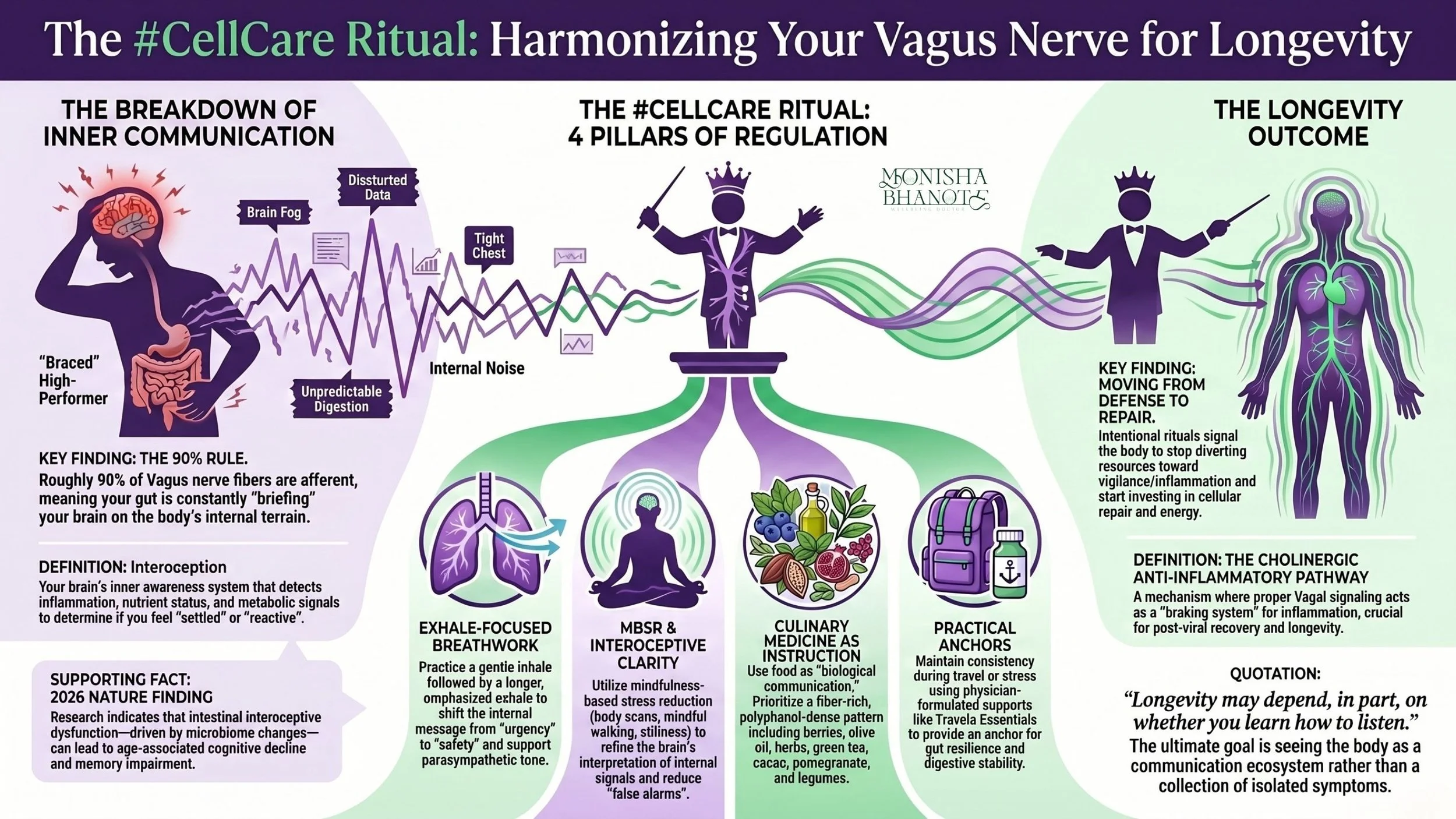
Once you understand the interoceptive gut, you stop chasing isolated symptoms and start seeing the body as a communication ecosystem. You begin to ask better questions. Not just “How do I fix this symptom?” but “What is my body trying to tell me?” Not just “How do I stimulate the system?” but “How do I create the conditions for better signaling?”
The silent conductor has always been there.
Longevity may depend, in part, on whether you learn how to listen.




MAKE A DIFFERENCE BY SHARING THIS ARTICLE WITH OTHERS TO ENCOURAGE WELLBEING ⤵
The information on this website has not been evaluated by the Food & Drug Administration or any other medical body. We do not aim to diagnose, treat, cure or prevent any illness or disease. Information is shared for educational purposes only. You must consult your doctor before acting on any content on this website, especially if you are pregnant, nursing, taking medication, or have a medical condition. Our content may include products that have been independently chosen and recommended by Dr. Monisha Bhanote and our editors. We may earn a small commission if you purchase something mentioned in this article.
YOU MAY ALSO LIKE:



by Dr. Monisha Bhanote
✅ EVIDENCE-INFORMED REVIEWED ARTICLE