
Your Nervous System Isn't "Fine"—It's Having a Cellular Summer

“Resilience isn't built when life finally slows down—it’s built through the daily signals that remind your cells they are safe to recover.”
There is a particular kind of tiredness that arrives in July. It has nothing to do with sleep. You can get eight hours, drink your greens, take your walk, and still feel it: a low hum behind the sternum, a shortness of patience, a body that startles at the fifth request of the morning before 9 a.m. The pool towels are still damp on the railing, the calendar insists this is the season of ease, and yet something in you is bracing rather than releasing.
If that sounds familiar, you are not imagining it, and you are not failing at rest. What you are describing is physiological, not characterological. Summer, for all its cultural promise of slowness, is one of the more biologically disruptive seasons of the year: sleep windows shift, structure disappears, decision-making multiplies, and the body is asked to stay "on" during a season that markets itself as "off."
As a physician — five times board-certified, and someone who has lived enough of my own difficult Julys to know better than to dismiss this — I've come to see this pattern clearly in both my patients and myself. This isn't a mood. It's a cellular event. And once you understand what is actually happening inside your cells when stress becomes chronic, you can stop trying to "relax harder" and start supporting the biology underneath the exhaustion.

The Hidden Mechanics of Stress: What's Actually Happening in Your Cells
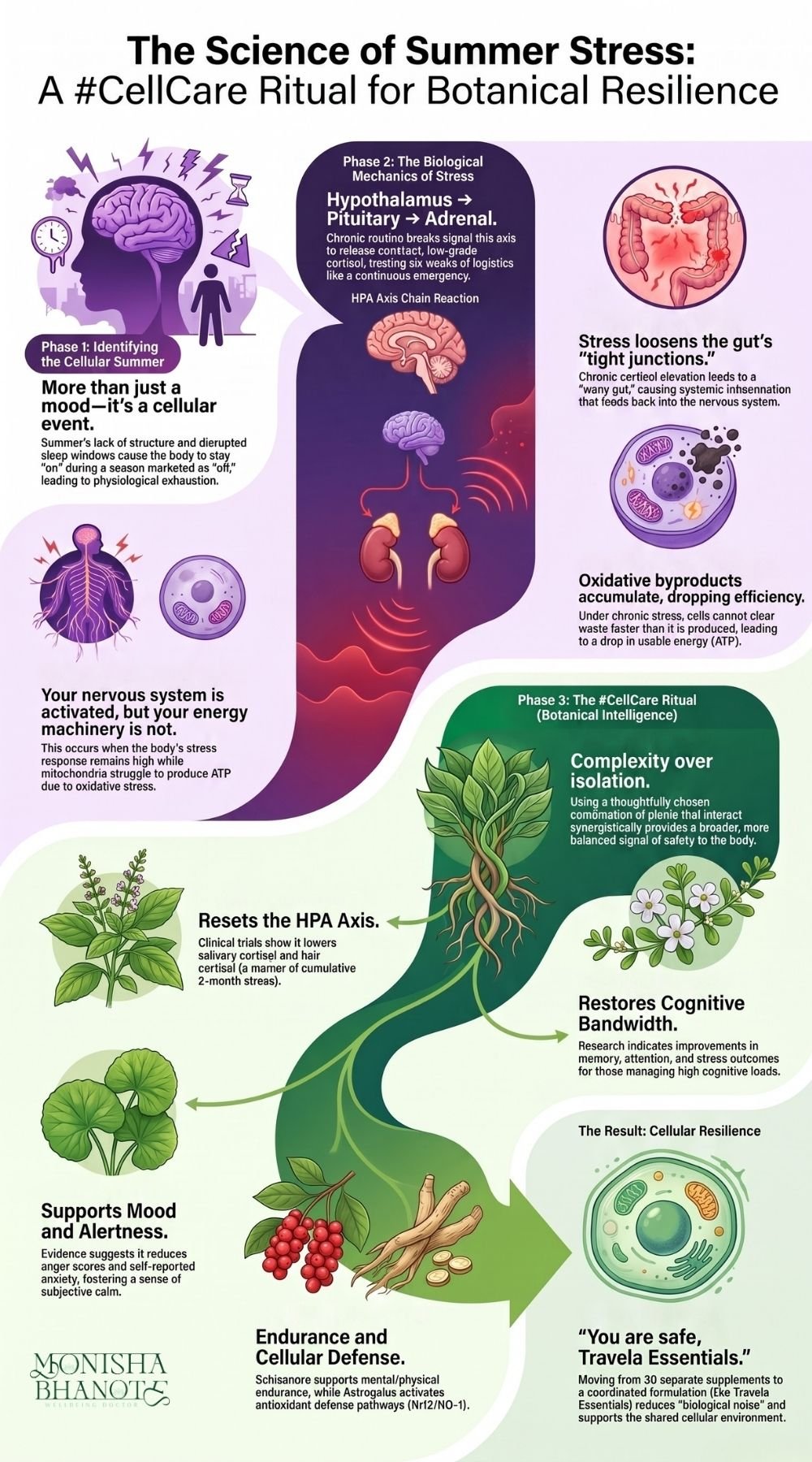
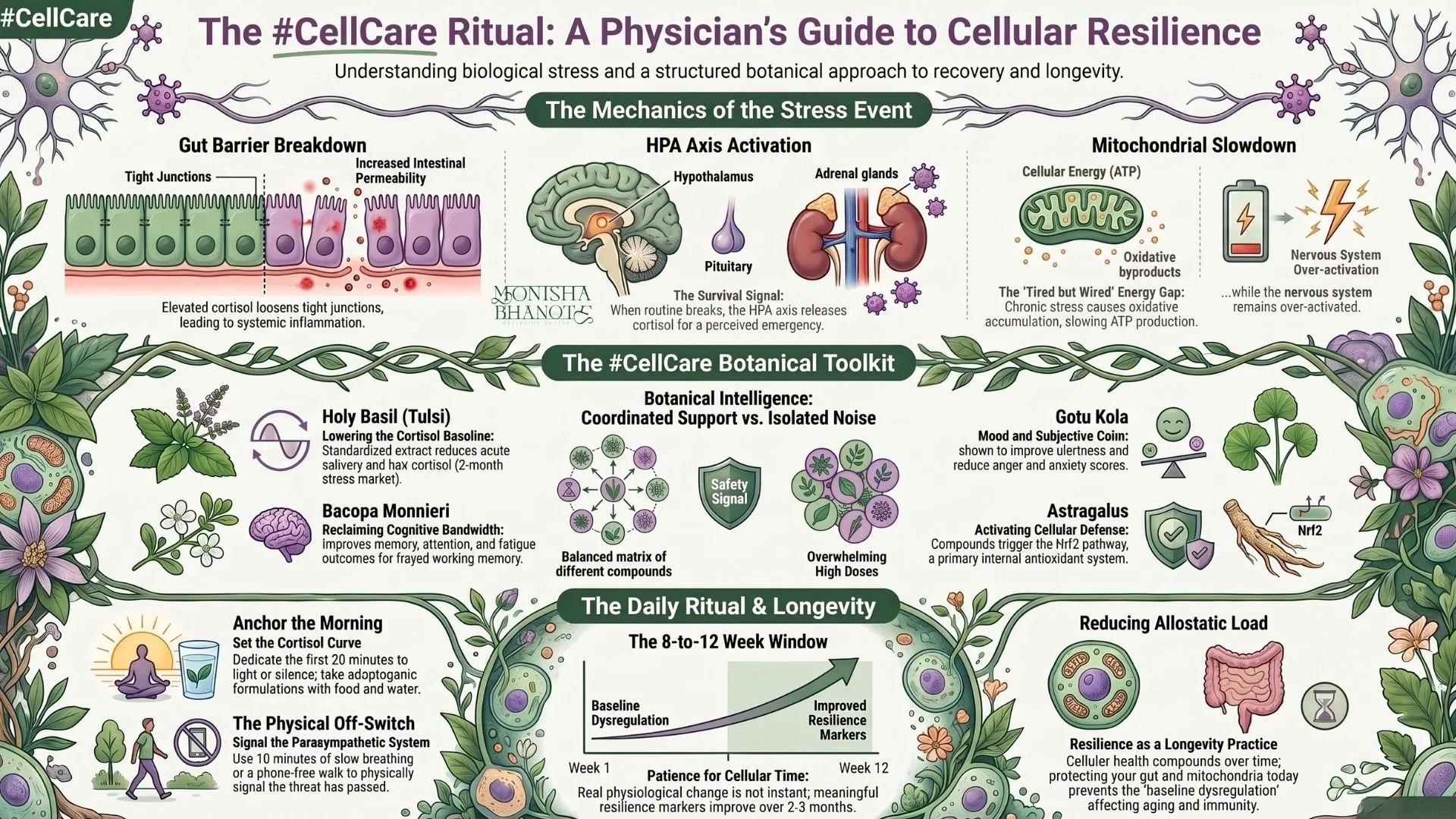
Every time your routine breaks — a missed morning ritual, a house full of visiting family, an inbox that hasn't heard it's summer — your hypothalamus sends a signal to your pituitary gland, which in turn signals your adrenal glands to release cortisol. This chain of communication is known as the hypothalamic-pituitary-adrenal axis, or HPA axis, and it is one of the oldest survival systems in human biology.
Cortisol, in short bursts, is not the enemy. It sharpens focus, mobilizes glucose for quick energy, and helps you rise to meet a genuine demand. The problem isn't cortisol itself — it's what happens when the "demand" never fully resolves, when the body registers back-to-back travel days, disrupted sleep, and constant social recalibration as one continuous, low-grade emergency. The HPA axis evolved to handle acute threats measured in minutes, not six weeks of rolling logistics.
When cortisol stays elevated for too long, two things tend to happen at the cellular level that rarely make it into casual conversations about stress.
Your Gut Lining Becomes More Permeable
Chronic cortisol elevation can loosen the tight junctions between the cells lining your intestines — a phenomenon often described informally as "leaky gut." Increased intestinal permeability is associated with more low-grade systemic inflammation, which in turn feeds back into the very nervous system that triggered the stress response in the first place. Your stress and your digestion are not two separate stories. They are the same story, told from two different organs.
Your Mitochondria Slow Down
Inside nearly every cell in your body, mitochondria convert nutrients into usable energy in the form of ATP. Under chronic stress, oxidative byproducts can accumulate faster than your antioxidant systems can clear them, and mitochondrial efficiency drops as a result. This is the biological explanation for a sensation many of my patients describe with striking consistency: tired, but wired. Your nervous system is activated. Your energy-producing machinery is not keeping pace.
This, to me, is the real definition of #CellCare — not a bath, not a vacation, not a single deep breath taken in a parking lot, but the ongoing maintenance of the cellular environment that your nervous system, your gut, and your mitochondria all quietly share. If that environment is under siege, no amount of "summer fun" will actually restore you.
A Physician's Confession: When "More Wellness" Became the Problem
A few years ago, my kitchen counter looked less like a home and more like a dispensary. A bottle for focus. A tincture for sleep. A powder for digestion. As a physician — someone whose entire career has been built on evidence — I had still fallen into the same trap as so many of my own patients: believing that if one supplement was helpful, thirty must be even more helpful.
The problem was never really the individual ingredients; most were reasonably well-studied on their own. The problem was that I was asking my body to process thirty isolated compounds with no coordination between them, while ignoring a fairly basic truth about plants: nature rarely produces anything in isolation. A single herb already contains hundreds of interacting compounds. Stacking bottle after bottle on top of that doesn't necessarily add more support — past a certain point, it can simply add more noise.
That realization — that supplement fatigue is its own quiet form of chronic stress — became the starting point for what I now call Botanical Intelligence: the idea that a thoughtfully chosen combination of adaptogenic plants, selected for how they interact rather than simply what each one does alone, can support the nervous system more meaningfully than an entire shelf of separate products ever could.
Botanical Intelligence: What the Research Actually Shows
I want to be careful here, because this is exactly where a lot of wellness writing loses its credibility. Adaptogens are not miracles, and no single botanical rewires a nervous system overnight. What the research does show is more modest — and, I'd argue, more useful: a set of specific plants with reasonably documented effects on the stress response, increasingly studied not just in animal models but in real, randomized human trials.
Holy Basil and the HPA Axis
Ocimum tenuiflorum, known in Ayurvedic medicine as Tulsi or Holy Basil, has one of the stronger human evidence bases of any adaptogen studied for stress. An eight-week, randomized, double-blind, placebo-controlled trial published in Frontiers in Nutrition in 2022 found that a standardized Holy Basil extract lowered salivary cortisol following an acute laboratory stress test, and also reduced hair cortisol — a marker of cumulative, weeks-long stress exposure — compared to placebo. [1] Hair cortisol matters clinically because it isn't measuring how you feel in a single moment; it's measuring what your adrenal glands have actually been doing for roughly two months. That's a meaningfully different category of evidence than a single mood questionnaire.
Bacopa Monnieri and Cognitive Bandwidth
If Holy Basil works primarily on the hormonal side of stress, Bacopa monnieri — an herb long used in Ayurveda for memory and mental clarity — appears to act more on the cognitive and fatigue side. A 2025 randomized, double-blind, placebo-controlled trial in Clinical Drug Investigation followed 101 adults aged 40 to 70 with self-reported memory and attention concerns over 12 weeks, and found measurable improvements in stress and fatigue outcomes alongside cognitive performance measures. [2] For anyone who has felt their working memory fray under the cognitive load of a chaotic season — more people in the house, more logistics, more decisions to make before coffee — this represents a genuinely different mechanism than simply "calming down."
Gotu Kola and Nervous System Support
Centella asiatica, or Gotu Kola, is often marketed as a blanket cognitive enhancer, and I want to be precise about what the evidence actually supports. A 2017 systematic review and meta-analysis in Scientific Reports, pooling eleven randomized controlled trials, did not find a significant overall effect on cognitive function domains — but it did find that Gotu Kola improved measures of alertness and reduced anger scores relative to placebo. [3] Separately, a small open-label clinical study published in the Nepal Medical College Journal followed 35 adults with generalized anxiety and reported reductions in self-reported anxiety and stress symptoms — though without a placebo comparison, which limits how much weight that particular finding can carry on its own. [4] Taken together, the honest read is that Gotu Kola's strongest evidence is for mood and subjective calm rather than memory enhancement — a more useful distinction than most marketing allows for.
Schisandra and Dual-System Resilience
Schisandra chinensis is traditionally described in Chinese medicine as a "five-flavor" berry, prized for supporting both mental and physical endurance under pressure. The human evidence here is earlier-stage: a small pilot study in elite basketball athletes tested a combination formulation of omega-3 fatty acids, Schisandra extract, and vitamin D3 over three months, and found statistically significant reductions in both cognitive and somatic competition anxiety, along with an increase in self-confidence scores. It's worth noting this was a combination product studied as a whole rather than Schisandra in isolation, and the sample size was small — so I'd describe this as a promising signal worth watching rather than settled science.
Astragalus and Cellular Defense
Astragalus membranaceus has a longer history in traditional immune-support formulas than in stress research specifically, but the mechanistic story is compelling. Laboratory research shows that Astragalus and its active compounds can activate the Nrf2/HO-1 pathway — one of the body's primary internal antioxidant defense systems — helping cells manage oxidative stress before it accumulates into lasting damage. Most of this evidence so far comes from cell and animal models rather than large human trials, so I hold it as an early-stage, mechanistically interesting piece of the picture rather than a proven human outcome — worth including for its biological plausibility, not for overstated claims.

Why Combinations, Not Isolated Compounds

This is the piece that's easy to skip past, but it matters most: nature doesn't hand you "pure resveratrol" or a single isolated cortisol-lowering molecule. It hands you a plant, which is already a matrix of hundreds of interacting compounds — and it's that complexity, not any single ingredient, that tends to show up favorably in research. When adaptogens like the ones above are paired with antioxidant-rich botanicals such as Amla (Indian gooseberry), which is exceptionally high in vitamin C and polyphenols, or anti-inflammatory compounds like turmeric and ginger, the goal isn't to overwhelm the body with a higher dose of any single thing. It's to offer a broader, more balanced set of signals — the biochemical equivalent of "you are safe, you can recover" rather than one loud instruction repeated at higher volume.
This is the underlying logic behind formulations like Travela Essentials, built around that exact principle: fewer, more thoughtfully coordinated ingredients in place of a counter full of separate bottles. It isn't a replacement for the fundamentals below — it's a tool that can sit alongside them, as part of a broader approach to cellular resilience rather than a substitute for it.
What You Can Do Today
None of this science is useful if it stays theoretical. Here is where I'd actually start, roughly in order of what tends to matter most.
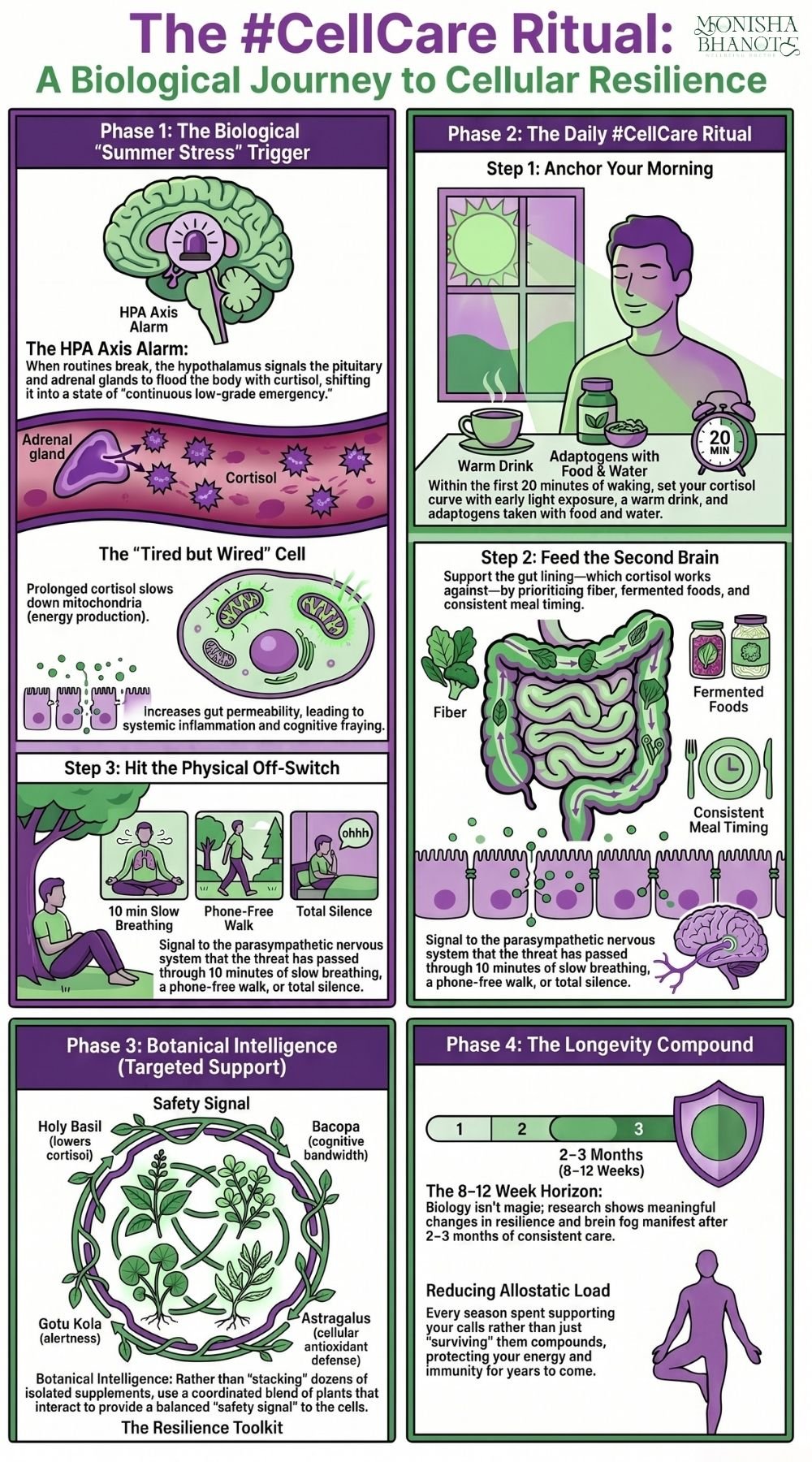
Anchor your morning before the day gets a vote. The first twenty minutes after waking help set the tone for your cortisol curve for hours afterward. That can look like early light exposure, a slow cup of something warm, or simply sitting quietly before anyone else in the house is awake. If you choose to take an adaptogenic formulation, morning — with food and a full glass of water — is generally the most physiologically sensible time, since it supports you before the day's demands accumulate rather than after.
Treat your gut like it's part of your nervous system, because it is. Fiber, fermented foods, and consistent meal timing all support the same gut lining that cortisol is working against. This matters more during travel and disrupted schedules, not less.
Give your body a real, physical off-switch. Ten minutes of slow breathing, a walk without your phone, or simply sitting in silence before the noise begins does more for your HPA axis than most people expect, because it directly signals to your parasympathetic nervous system that the perceived threat has passed.
Expect biology, not magic. If you choose to support your stress response with adaptogenic botanicals, give it real time. The research above measured outcomes over eight to twelve weeks, not eight to twelve hours. The most meaningful changes are often the ones you eventually stop noticing: less travel fatigue, less digestive disruption, less brain fog, more resilience under pressure. That quiet absence of struggle is usually the real sign that something is working.

The Longevity Connection: Why This Compounds Over Time
It's tempting to treat a stressful summer as a temporary problem that resolves itself once the schedule calms down. Physiologically, it doesn't quite work that way. Researchers describe the cumulative wear that chronic stress places on the body as allostatic load — the sum total of small, repeated demands on your HPA axis, your gut lining, and your mitochondria over months and years, not just over a single difficult week. A season of dysregulation rarely disappears without a trace; it tends to become the baseline the next season builds on.
This is why I think about cellular resilience as a longevity practice, not a seasonal fix. The gut lining you protect this July is the same gut lining you'll rely on for digestion and immunity a decade from now. The mitochondria you support with consistent sleep, nourishment, and thoughtful botanical care are the same mitochondria responsible for your energy and cognitive clarity as you age. Cellular health is cumulative. Every season you spend supporting it, rather than simply surviving it, is a season that compounds in your favor.
#CellCare Reflection
Your nervous system was never meant to sprint through a season built for stillness. The vibrating tightness you feel isn't a personal failing, and it isn't something more willpower will fix. It's your biology, asking for a different kind of attention — fewer isolated fixes, more coordinated support, and the patience to let real physiological change happen on cellular time rather than Instagram time.
You don't need thirty bottles on your counter, and you don't need one more thing to optimize. You need a body you're actually listening to. Start there — one cell, one choice, one morning at a time.




MAKE A DIFFERENCE BY SHARING THIS ARTICLE WITH OTHERS TO ENCOURAGE WELLBEING ⤵
The information on this website has not been evaluated by the Food & Drug Administration or any other medical body. We do not aim to diagnose, treat, cure or prevent any illness or disease. Information is shared for educational purposes only. You must consult your doctor before acting on any content on this website, especially if you are pregnant, nursing, taking medication, or have a medical condition. Our content may include products that have been independently chosen and recommended by Dr. Monisha Bhanote and our editors. We may earn a small commission if you purchase something mentioned in this article.
YOU MAY ALSO LIKE:



by Dr. Monisha Bhanote
✅ EVIDENCE-INFORMED REVIEWED ARTICLE