
#CellCare Ritual | The Fiber-First Longevity Plate

“Every bite is a vote for your cellular resilience.”
~ Dr. Monisha Bhanote, MD
WEEKLY WELLNESS PRACTICE | #CELLCARE RITUAL
Hey there, Wellkulå Friend,
Most nutrition advice focuses on what to restrict. This ritual flips that idea: it teaches your body to respond optimally to food, rhythm, and movement. Health doesn’t begin in the mind — it begins at the cellular level, when your metabolism, gut, and inflammatory signaling feel supported and regulated.
In a world wired for constant activity, late meals, and sugar spikes, metabolic regulation can feel unfamiliar. But biologically, it is essential. The body cannot repair, stabilize hormones, or optimize energy while it is stuck in post-meal stress or insulin overload.
This week’s ritual is simple yet powerful:
The Fiber-First Longevity Plate.
One meal per day, four steps, measurable cellular impact. With fiber to stabilize glucose, polyphenols to buffer oxidative stress, post-meal movement to optimize insulin, and a nightly glycemic close to support repair, this ritual guides your body through a sequence it deeply understands:
Fiber → Polyphenols → Movement → Rhythm.
You don’t need perfection. You don’t need restriction. You just need daily consistency, and your cells will start to remember how to repair, regulate, and thrive.
Let’s begin.

#HOW TO DO IT | THE FIBER-FIRST LONGEVITY PLATE RITUAL
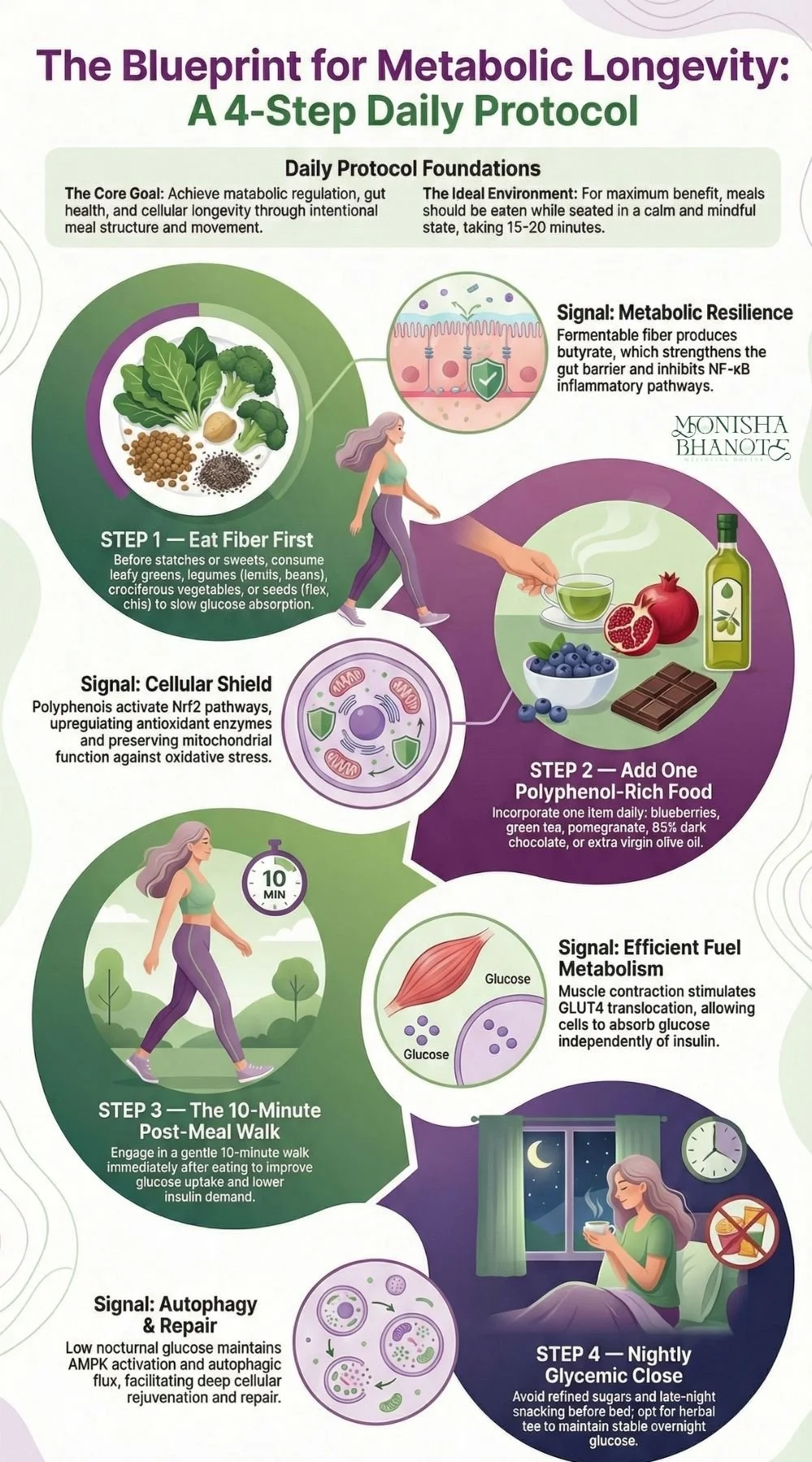
Time Commitment: 15–20 minutes per meal
Environment: Seated, calm, mindful
Goal: Metabolic regulation, gut health, cellular longevity
STEP 1 — EAT FIBER FIRST (Before Anything Else)
Theme: Glucose Modulation • Gut Microbiome Support • Insulin Control
At one meal per day — ideally lunch — begin with:
Leafy greens
Legumes (lentils, chickpeas, beans)
Cruciferous vegetables
Seeds (flax, chia, pumpkin)
Before starch, dessert, or anything refined.
Why This Works
Fiber slows glucose absorption, prevents post-meal insulin spikes, and feeds gut microbes that produce short-chain fatty acids (SCFAs) like butyrate — reducing inflammation and improving insulin sensitivity.
Cellular Signal
Fermentable fiber fuels SCFA-producing microbes. Butyrate strengthens the gut barrier, inhibits NF-κB inflammatory pathways, and enhances insulin receptor sensitivity. Your cells receive a direct anti-inflammatory signal, supporting metabolic resilience.
STEP 2 — ADD ONE POLYPHENOL-RICH FOOD DAILY
Theme: Oxidative Stress Buffer • Cellular Protection • Inflammaging Defense
Choose one per day:
Blueberries
Green tea
Pomegranate
85% dark chocolate
Extra virgin olive oil
Why This Works
Polyphenols reduce oxidative stress and regulate NF-κB activity, giving your cells daily protection against inflammaging.
Cellular Signal
Polyphenols activate Nrf2 pathways, upregulating endogenous antioxidant enzymes. This reduces reactive oxygen species, preserves mitochondrial function, and limits inflammatory cytokine release. Every polyphenol-rich bite is a cellular shield.
STEP 3 — THE 10-MINUTE POST-MEAL WALK
Theme: Glucose Regulation • Insulin Modulation • Mitochondrial Efficiency
After your meal:
Walk for 10 minutes at a gentle pace
No gym required — just consistency.
Why This Works
Post-meal movement improves glucose uptake, reduces insulin demand, lowers inflammatory markers, and optimizes mitochondrial efficiency. It interrupts the inflammation–insulin resistance loop, making metabolism more responsive and reducing biological friction.
Cellular Signal
Muscle contraction stimulates GLUT4 translocation, allowing glucose into cells independent of insulin. Mitochondrial oxidative phosphorylation increases, while postprandial inflammatory cytokines decrease. This improves insulin sensitivity, supports cellular repair, and shifts the body from defense into repair.
STEP 4 — NIGHTLY GLYCEMIC CLOSE
Theme: Circadian Metabolism • Cellular Repair • Autophagy Support
Before bed:
No refined sugar
No late-night snacking
Herbal tea instead
Why This Works
Stable overnight glucose enhances growth hormone release, autophagy, mitochondrial repair, and overall metabolic recovery. Insulin resistance is often worsened by late eating — respecting the body’s rhythm optimizes long-term health.
Cellular Signal
Lower nocturnal glucose maintains AMPK activation and autophagic flux, reduces oxidative stress, and facilitates cellular repair. Insulin signaling stabilizes, allowing cells to rejuvenate overnight and supporting longevity from a metabolic and cellular perspective.
EXPLORE FURTHER | DEEPENING THE FIBER-FIRST LONGEVITY PLATE
The Fiber-First Longevity Plate reflects a deeper biological truth: every meal shapes your metabolic legacy.
Chronic insulin elevation drives:
Pro-inflammatory cytokines
Oxidative stress
Endothelial dysfunction
Visceral fat accumulation
When fiber, polyphenols, movement, and circadian rhythm are prioritized:
Butyrate production rises
Gut barrier integrity strengthens
Systemic inflammation declines
Insulin sensitivity improves
This principle is explored in Dr. Monisha Bhanote’s The Anatomy of Wellbeing, which shows how nutrient sequencing, circadian rhythm, microbial metabolites, and metabolic signaling directly influence inflammation, cellular repair, hormonal balance, and longevity.
👉 Book Reference:
The Anatomy of Wellbeing
In this book, you’ll see how deliberate regulation — through nutrient sequencing, microbial metabolites, circadian rhythm, and movement — moves the body out of survival chemistry and back into coherence. Especially during periods of chronic stress, travel, hormonal shifts, or cognitive overload, these small daily practices stabilize insulin, reduce inflammation, and support cellular repair.
The Fiber-First Longevity Plate is one practical expression of that science:
When fiber comes first, glucose and insulin stabilize.
When polyphenols are included, oxidative stress is buffered.
When post-meal movement occurs, metabolism and mitochondrial efficiency improve.
When meals respect circadian rhythm, overnight repair is optimized.
And longevity becomes sustainable. Not because you ate perfectly, but because you consistently trained your metabolism, gut, and cells to function in rhythm.
WHY IT WORKS | THE SCIENCE BEHIND THE FIBER-FIRST LONGEVITY PLATE
Fiber & Microbial Metabolism
SCFA production lowers systemic inflammation, improves insulin receptor sensitivity, and strengthens the gut barrier.
Polyphenols & Oxidative Stress
Daily polyphenols buffer reactive oxygen species, protect mitochondria, and reduce inflammatory cytokine signaling.
Movement & Glucose Regulation
Post-meal activity enhances GLUT4 translocation, lowers insulin demand, and supports mitochondrial efficiency.
Timing & Circadian Metabolism
Nighttime fasting stabilizes glucose, activates AMPK, and supports autophagy for cellular repair.
REALIZATION | YOUR #CELLCARE TIP OF THE WEEK
Within one week of practicing the Fiber-First Longevity Plate, many notice:
More stable energy
Reduced bloating
Less post-meal fatigue
Subtle metabolic clarity
Not because you restricted calories, but because your biology received regulation.
Your Commitment This Week:
Pick one meal to start with fiber first, add a polyphenol, take a 10-minute post-meal walk, and close your evening with glycemic rhythm. Track how your body responds by Day 5.
Longevity is built one biologically-aligned meal at a time.
Until next time,
Dr. Monisha
The information on this website has not been evaluated by the Food & Drug Administration or any other medical body. We do not aim to diagnose, treat, cure or prevent any illness or disease. Information is shared for educational purposes only. You must consult your doctor before acting on any content on this website, especially if you are pregnant, nursing, taking medication, or have a medical condition. Our content may have affiliate links, through which we earn a small commission at no extra cost to you. We only recommend products we sincerely love and believe will benefit your wellbeing. Thank you for supporting #CellCare Wellness!




by Dr. Monisha Bhanote
✅ EVIDENCE-INFORMED REVIEWED ARTICLE