
#CellCare Ritual | The Ocular–Vagal Reset Ritual
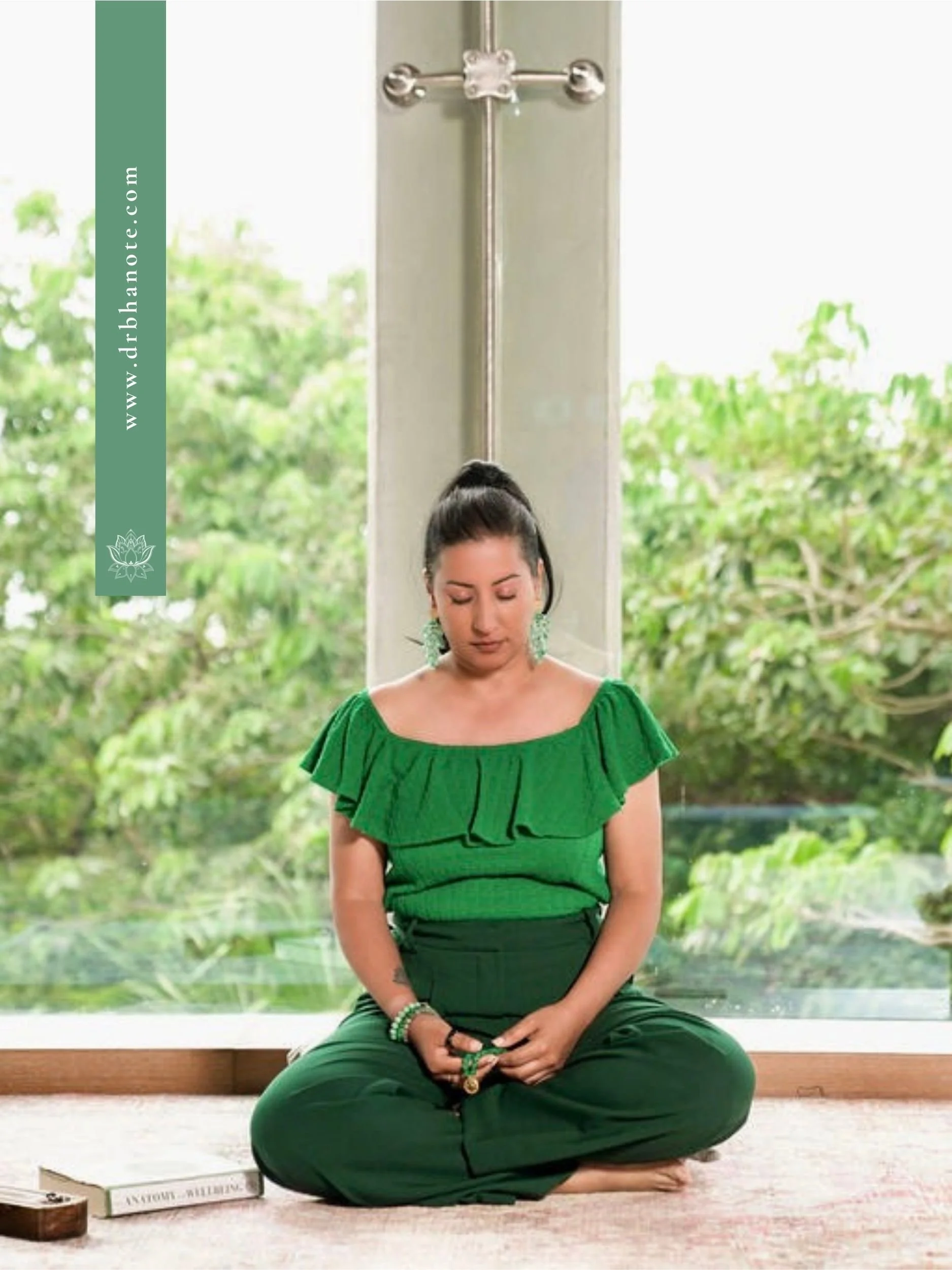
“When the eyes feel safe, the body can heal.”
~ Dr. Monisha Bhanote, MD
WEEKLY WELLNESS PRACTICE | #CELLCARE RITUAL
Hey there, Wellkulå Friend,
Every week, I invite you to reconnect with your body through a ritual that feels simple, restorative, and deeply intelligent. This week's ritual focuses on one of the most overlooked gateways to nervous system healing—your eyes.
This week's #CellCare Ritual is The Ocular–Vagal Reset Ritual.
A simple, daily practice designed to calm the nervous system, improve vagal tone, and signal deep cellular safety—through intentional eye movements, gaze softening, and breath.
When we think about nervous system regulation, we often overlook the simplest pathway. But the eyes are a direct extension of the brain—and one of the fastest ways to communicate safety to your vagus nerve.
Modern life keeps the eyes locked in hyper-focus: screens, scrolling, vigilance, and constant visual demand. This visual tension keeps the nervous system stuck in sympathetic overdrive—telling your cells to stay alert, guarded, and inflamed.
The Ocular–Vagal Reset Ritual gently interrupts that loop.
It's not about forcing relaxation. It's about sending accurate sensory signals that tell your body: you are safe now.
So let's begin.

#HOW TO DO IT | THE OCULAR-VAGAL RESET RITUAL
This is not just eye rest. It's a nervous system recalibration.
This ritual unfolds in three intentional phases, taking just 5–10 minutes total. Each phase activates a specific pathway between your eyes and your vagus nerve. You can practice this anytime—but it's especially powerful before bed, after screen-heavy work, or when you feel wired and disconnected.
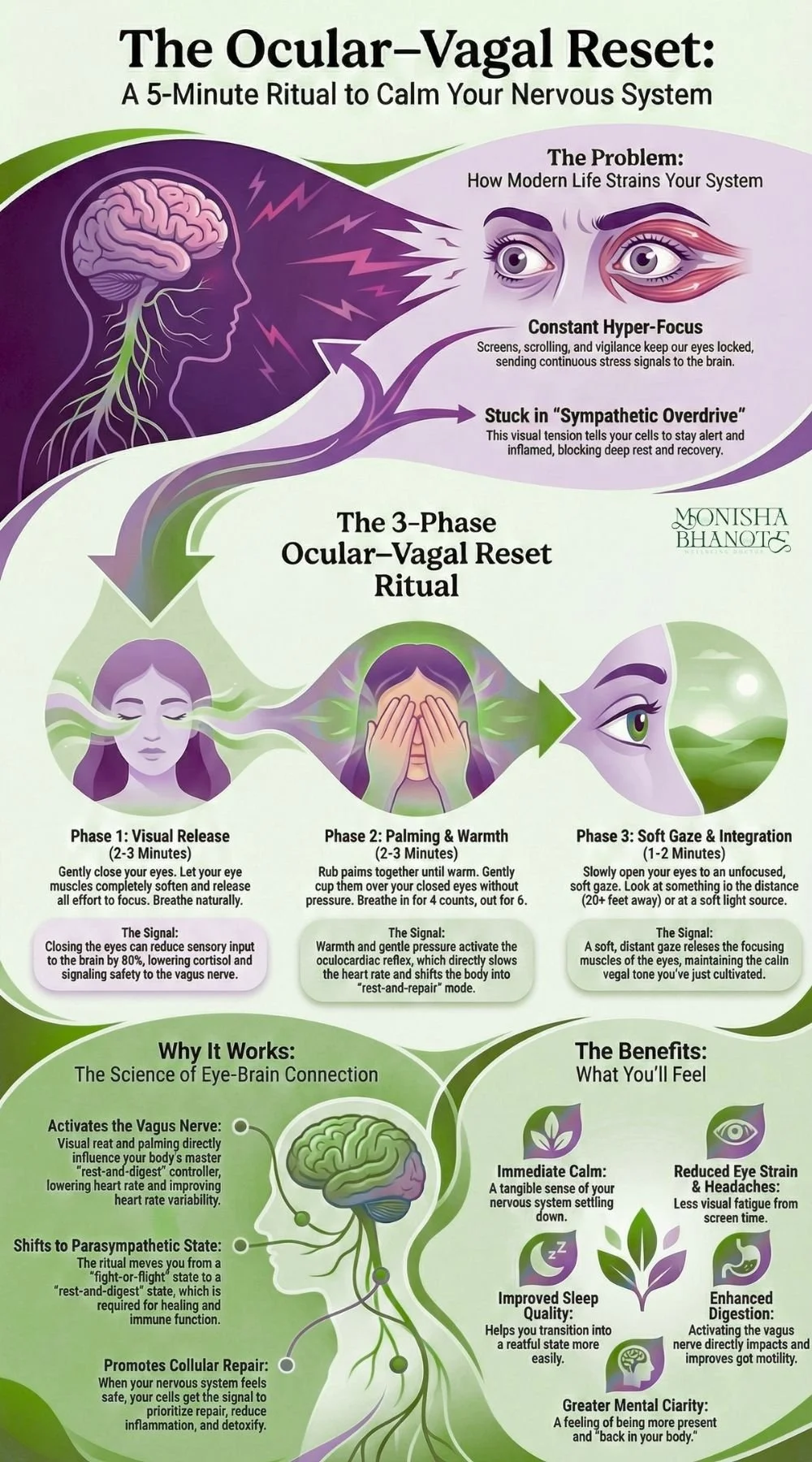
Ocular–Vagal Phase 1: Visual Release
The Practice:
Find a comfortable seated or lying position
Gently close your eyes and let them settle naturally—no squeezing, no forcing
Notice the weight of your eyelids and the darkness behind them
Allow your ocular muscles to soften completely, releasing all effort to focus
Rest here for 2–3 minutes, breathing naturally
Cellular Signal:
Closing the eyes reduces sensory input to the brain by up to 80%, immediately lowering cortisol and activating parasympathetic pathways. The vagus nerve responds to this visual rest by signaling safety throughout the body.
Pro Tip: If your eyes flutter or resist stillness, this reveals chronic activation. Be patient. Visual rest is a skill your nervous system remembers.
Ocular–Vagal Phase 2: Palming & Warmth
The Practice:
Rub your palms together briskly for 10–15 seconds until warm
Gently cup your warm palms over your closed eyes without pressing
Let the warmth and darkness envelop your eyes completely
Breathe slowly: inhale for 4 counts, exhale for 6 counts
Continue for 2–3 minutes, allowing complete visual blackout
Cellular Signal:
The warmth relaxes ocular muscles and increases circulation to the optic nerve. The gentle pressure stimulates the oculocardiac reflex, which directly activates vagal tone and slows the heart rate—shifting the entire body into rest-and-repair mode.
Pro Tip: Imagine the warmth melting tension not just in your eyes, but throughout your entire face, jaw, and skull.
Ocular–Vagal Phase 3: Soft Gaze & Integration
The Practice:
Slowly remove your palms and keep eyes gently closed for a few breaths
When ready, open your eyes to a soft, unfocused gaze
Look into the distance (at least 20 feet away) or at something soft like a candle flame or nature
Allow your eyes to rest in this soft focus for 1–2 minutes—no scanning, no reading, no analyzing
Blink naturally and breathe with ease
Cellular Signal:
Distant or soft gazing relaxes the ciliary muscles used for near-point focus, reduces sympathetic activation, and maintains the vagal tone you've cultivated. This phase integrates the reset and teaches your nervous system a new baseline of visual ease.
Pro Tip: This is not meditation—it's biological recalibration. Simply let your eyes rest in gentle awareness.
WHY IT WORKS | THE SCIENCE BEHIND THE OCULAR-VAGAL RESET RITUAL
The Eye–Vagus Connection
Your eyes are a direct extension of your brain and nervous system. The muscles that control eye movement, focus, and pupil dilation are intimately connected to your autonomic nervous system. When you rest your eyes, you rest your entire system.
Vagal Tone Activation
The vagus nerve—your body's master rest-and-digest controller—is directly influenced by visual input and ocular muscle tension. Palming and visual rest activate vagal pathways, lowering heart rate, improving heart rate variability, and enhancing cellular repair signals.
Parasympathetic Dominance
Chronic visual stimulation keeps you in sympathetic (fight-or-flight) mode. The Ocular–Vagal Reset shifts you into parasympathetic (rest-and-digest) dominance—the state required for deep healing, digestion, immune function, and longevity.
Cellular Detoxification & Repair
When your nervous system feels safe, your cells receive permission to prioritize repair over survival. Mitochondria function more efficiently. Detoxification pathways open. Inflammation decreases. All from resting your eyes.
REALIZATION | YOUR #CELLCARE TIP OF THE WEEK
Here's what most people notice within days of practicing the Ocular–Vagal Reset Ritual:
Immediate sense of calm and nervous system settling
Reduced eye strain, headaches, and visual fatigue
Improved sleep quality and faster transition into rest
Enhanced digestion and reduced bloating (vagal tone directly affects gut motility)
Greater mental clarity and emotional regulation
A felt sense of being "back in your body"
Not because the ritual is complicated—but because your biology is exquisitely responsive to the signal of safety your eyes provide.
Your Commitment This Week: For the next 7 days:
For the next 7 days:
Practice the full Ocular–Vagal Reset once daily (ideally before bed or after screen time)
Notice moments when your eyes feel strained—pause and palm for 60 seconds
Observe changes in your nervous system, sleep, digestion, and emotional state
Your eyes are not just windows to your soul—they are gateways to your vagus nerve, your cellular health, and your body's deepest capacity to heal.
When you rest your gaze, your cells remember how to restore.
Until next time,
Dr. Monisha
The information on this website has not been evaluated by the Food & Drug Administration or any other medical body. We do not aim to diagnose, treat, cure or prevent any illness or disease. Information is shared for educational purposes only. You must consult your doctor before acting on any content on this website, especially if you are pregnant, nursing, taking medication, or have a medical condition. Our content may have affiliate links, through which we earn a small commission at no extra cost to you. We only recommend products we sincerely love and believe will benefit your wellbeing. Thank you for supporting #CellCare Wellness!





by Dr. Monisha Bhanote
✅ EVIDENCE-INFORMED REVIEWED ARTICLE