The Anatomy of Enough: A Physician's Case for Fewer, Smarter Supplements

“The health you experience tomorrow is built by the signals you give your cells today.”
Sarah arrives four minutes early, the way she arrives at everything. I hear her before I see her—the particular rhythm of a woman who has learned to move fast without looking rushed, heels on the clinic floor, a phone call wrapping up just outside my door. When she sits, she sits the way she runs meetings: spine straight, bag on her lap, ready. It is only when she unzips the canvas tote that anything in her posture changes.
She doesn't pull out a laptop. She doesn't pull out the quarterly numbers I half expect from a woman who oversees multimillion-dollar accounts and a team of dozens across four time zones. What comes out, one after another, is amber plastic—bottle, then bottle, then bottle—until they've covered the consultation table between us like a small, disorganized skyline. Thirty-two of them, by my count. She lines the last few up with her fingertips, an unconscious habit, the same instinct that probably keeps her calendar color-coded and her inbox at zero.
“I know how this looks,” she says, and laughs—a short, tired laugh, the kind that isn't really about anything funny.
I want to say, before we go any further, that there is nothing inherently wrong with thirty bottles. In my own practice, I have built protocols with more moving pieces than this for patients navigating a defined diagnosis under close supervision, and when a regimen like that is medically indicated, it can be exactly right. Sarah knew that too. What she didn't know—what had been quietly eroding her confidence for three years—was why none of it seemed to be working.
“I take thirty pills a day,” she said, turning one of the bottles so the label faced her, as if it might explain itself. “But it isn't a plan. It's just everything I've collected trying to feel better. I still wake up tired. My stomach is unpredictable—I never know which version of it I'm getting. And by three o'clock, without fail, I'm puffy in my own clothes.” She looked up. “Why am I working this hard for my health and getting nothing back for it?”
I didn't have a quick answer for her that morning, not one that would have honored the question. What I had, instead, was a version of the same story—one I don't often tell in a consultation room, but one that explains, better than any textbook could, exactly what was happening in that cluttered tote bag.

What I Know From My Own Body
There was a stretch of time, after a traumatic brain injury, when I stopped trusting my own mind the way I once had. I am a physician. I had spent years learning to read a body's signals with precision. And still, in the aftermath, I found myself standing in front of my own bathroom mirror some mornings, disoriented by how unfamiliar my own fatigue felt—how it didn't behave the way fatigue was supposed to behave, how it came with a fog that sat behind my eyes and wouldn't lift no matter how much I slept.
What followed the injury was not contained to my head. It moved through my body the way weather moves through a valley—autoimmune flares I hadn't had before, chronic pain that shifted location as if it were looking for somewhere to settle, a kind of full-body static I couldn't supplement my way out of, though God knows I tried. My instinct, trained by the same wellness culture I now gently warn my patients about, was to treat each symptom as its own emergency. Fog in the morning: add something for focus. A flare in the afternoon: add something for inflammation. Exhausted by dinner: add something else. My own counter began to look like Sarah's tote bag.
It took me longer than I'd like to admit—longer than it should have, given my training—to understand that I wasn't managing four separate problems. I was managing one interconnected system that had been knocked out of rhythm, and every isolated bottle I added was one more uncoordinated signal for an already-overwhelmed body to sort through.
The research, when I finally went looking for it with a clinician's eye instead of a patient's desperation, confirmed what my body already knew. A traumatic brain injury doesn't stay politely contained above the neck. Within the first twenty-four hours, the research shows a measurable, whole-body inflammatory signature—significant elevations in circulating cytokines such as interleukin-6, interleukin-1 receptor antagonist, and interferon-gamma.¹ That response doesn't always resolve on its own schedule. In a meaningful number of people, it lingers, and it braids itself into the systems that govern energy, digestion, mood, and immune tolerance long after the original injury has technically healed.

At the cellular level, this becomes its own kind of feedback loop. Mitochondria—the structures inside every cell responsible for generating usable energy—and the brain's resident immune cells exist, after injury, in what researchers now describe as a self-amplifying “mitochondria-inflammation axis”: damaged mitochondria provoke inflammation, and that inflammation further impairs mitochondrial function, each one feeding the other in a loop that can quietly outlast the injury by months or years.² I didn't need the paper to tell me this was happening. I needed it to tell me why what I was already living through had a name.
There was a gut dimension to it, too, one that surprised me even with my training. The brain and the digestive tract are in constant, bidirectional conversation, and injury to the brain measurably disrupts gut motility, permeability, and the composition of the microbiome—intestinal changes that, in turn, feed back into neuroinflammation and keep the cycle turning.³ I was not simply recovering from a brain injury. I was managing a whole-body loop, and reaching for another isolated bottle for each downstream symptom was never going to interrupt it. It was only ever going to add to the noise my body was already straining to process.
That recognition arrived slowly, through my own recovery, not through a hypothesis I set out to prove is what eventually reorganized the way I think about supplementation altogether. Not as a list of symptoms to medicate one at a time, but as five interconnected pathways that needed to be supported together: digestion, immunity, focus, energy, and recovery. I'll walk through each of them. But first, it's worth understanding why the scattershot approach so many of us default to the one Sarah had built, the one I had built tends to backfire in such a predictable way.
The Anatomy of Supplement Fatigue
The traditional approach to supplementation has long operated on an industrial, reductionist model: isolate a compound, amplify the dose, and hope something sticks. Tired? Take more B vitamins. Stressed? Add an isolated adaptogen. Digestion off? Layer in a generic probiotic. This is not a physician-guided protocol; it's an accumulation of disconnected purchases, each one solving a momentary frustration but never woven into a coherent strategy.
When you introduce thirty different isolated compounds into your digestive tract, each manufactured by a different facility using different fillers and binders, you do not create harmony. You create friction. The gut is home to the majority of the body's immune tissue, by some estimates, roughly seventy percent of the body's immune cells reside there. And it is also the seat of ongoing, bidirectional communication with the brain via the vagus nerve and circulating microbial metabolites.⁴ Ask that same tissue to process a barrage of uncoordinated synthetic fillers and megadoses every morning, and you are working against the very system you are trying to support.
There is also a simpler, more human cost: cognitive load. When wellness starts to feel like a second job—color-coded organizer boxes, pill sorters, a growing spreadsheet of what to take when—adherence falls apart. You miss doses, double up by accident, and eventually abandon the routine altogether. True healing, and true longevity, rarely come from volume. They come from synergy, precision, and consistency.

The Five Pathways: A Physician's Framework
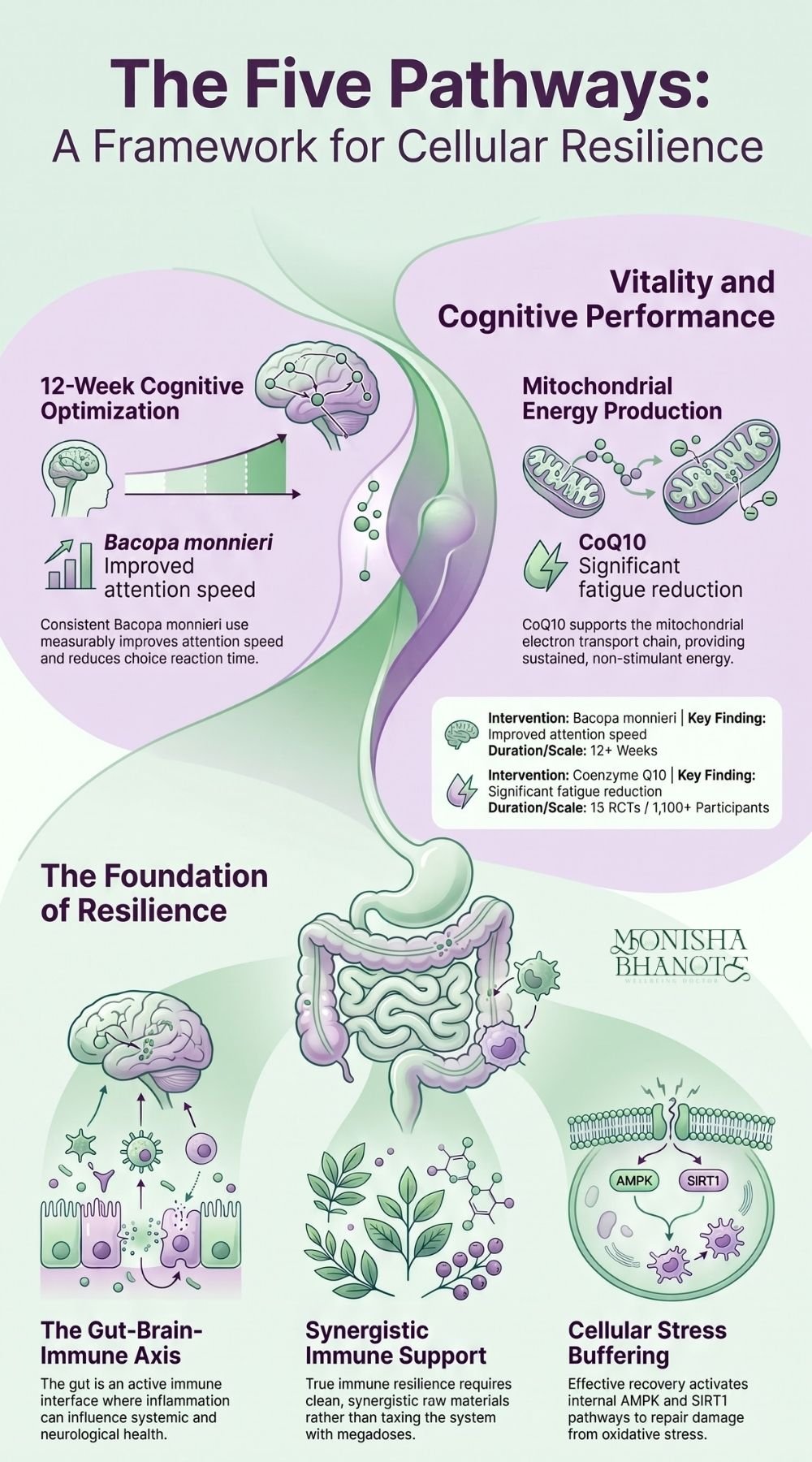
As I worked through my own recovery, I kept returning to the same question, turned over on those long mornings when nothing felt coordinated: what does the cellular machinery actually need, stripped of marketing noise? Not a separate bottle for every symptom, but coordinated support across the systems that were struggling in tandem. Over time, that question distilled into five pathways I now consider foundational to how the body builds resilience—digestion, immunity, focus, energy, and recovery.
Digestion
The gut is not a passive tube; it is a highly permeable interface between the outside world and your internal environment, and an active immune organ in its own right. Emerging research on the gut-brain-immune axis shows that intestinal inflammation and dysbiosis can influence systemic and even neurological inflammation, and that this communication runs in both directions.⁴ Supporting digestion isn't only about comfort after a meal—it's foundational to how calm or reactive the rest of your body's systems are.
Immunity
Because so much immune tissue lives in the gut, immune resilience and digestive health are inseparable. Chronic, low-grade inflammatory activation—the kind that follows injury, unmanaged stress, or autoimmune activity—asks a great deal of the immune system over time. Supporting immunity intelligently means giving the body clean, synergistic raw materials rather than isolated megadoses that create more work for an already taxed system.
Focus
Cognitive clarity is often the first thing to go under chronic inflammatory load, whether from injury, stress, or travel fatigue—I remember the particular frustration of losing a word mid-sentence, something that had never happened to me before. This is well-studied territory: a meta-analysis of nine randomized, placebo-controlled trials found that standardized Bacopa monnieri extract, taken consistently over twelve or more weeks, measurably improved speed of attention and reduced choice reaction time compared to placebo.⁵ The effect is not immediate or dramatic—it is the product of consistent, botanical support over time, which is precisely the point.
Energy
Fatigue is rarely a single-cause problem, but mitochondrial energy production is almost always part of the picture. A 2022 meta-analysis of thirteen randomized controlled trials involving over 1,100 participants found that Coenzyme Q10 supplementation produced a statistically significant reduction in fatigue scores compared to placebo, with longer treatment duration and higher doses associated with greater benefit.⁶ CoQ10 sits directly in the mitochondrial electron transport chain, which is precisely why sustained, non-stimulant energy support depends on it.
Recovery
Recovery is the pathway most people overlook until they are depleted—I certainly did. At the cellular level, this is about buffering oxidative stress: the accumulation of reactive byproducts that outpaces the body's natural antioxidant defenses. Botanicals studied for their role in cellular antioxidant signaling, such as resveratrol, appear to work in part by activating the AMPK and SIRT1 pathways, which support the cell's own stress-response and repair machinery rather than simply flooding the system with an isolated antioxidant.⁷ Recovery, done well, is quiet. You do not feel it directly so much as you notice its absence when it's missing.

Why Daily Consistency Beats Complex Intervention
One of the most persistent misconceptions in wellness culture is that transformation requires dramatic, sporadic intervention—a weekend cleanse, a stack of twenty pills on a bad day. Human biology does not respond to erratic bursts of effort. It responds to rhythm.
Your cells move through constant cycles of repair and turnover. Your gut microbiome remodels itself in response to steady daily inputs, not occasional ones. When supplementation is erratic, the body experiences what I think of as biochemical whiplash—never quite settling into a stable environment it can rely on. This is why a streamlined, daily ritual across all five pathways tends to outperform an aggressive but inconsistent one. As I write in my book, The Anatomy of Wellbeing, true longevity is built in the quiet, repeated moments of daily self-care, not in occasional heroics.
What to Look For: A Physician's Standard
If you are ready to audit your own cabinet, a few non-negotiables are worth holding every product to, regardless of brand.
Third-party verification. Look for independent testing seals or brands willing to share batch-specific Certificates of Analysis from accredited labs—this is the only real check against contamination and label inaccuracy in a category with minimal pre-market oversight.
Clean, plant-forward formulation. Synthetic binders, artificial colorings, and common allergens can quietly work against the very gut barrier you're trying to support.
Synergy over isolation. Whole-spectrum botanical matrices tend to outperform single isolated compounds at far lower doses, because plant compounds are often designed by nature to work in concert rather than alone.
What You Can Do Today
Gather every supplement you currently own and ask, honestly, why you're taking each one and whether you can point to a result.
Retire anything unverified, expired, or duplicative—especially isolated megadoses collected in a moment of frustration rather than a plan.
Map what remains against the five pathways: digestion, immunity, focus, energy, recovery. Notice where you're over-supported and where you're not supported at all.
Before your next trip, build a simple, portable ritual rather than packing your entire cabinet—travel is exactly when erratic supplementation does the most damage to consistency.
Give any new, streamlined routine six to eight weeks before judging it. Cellular rhythms respond to consistency, not to day-three impatience.
Where Travela Essentials Fits

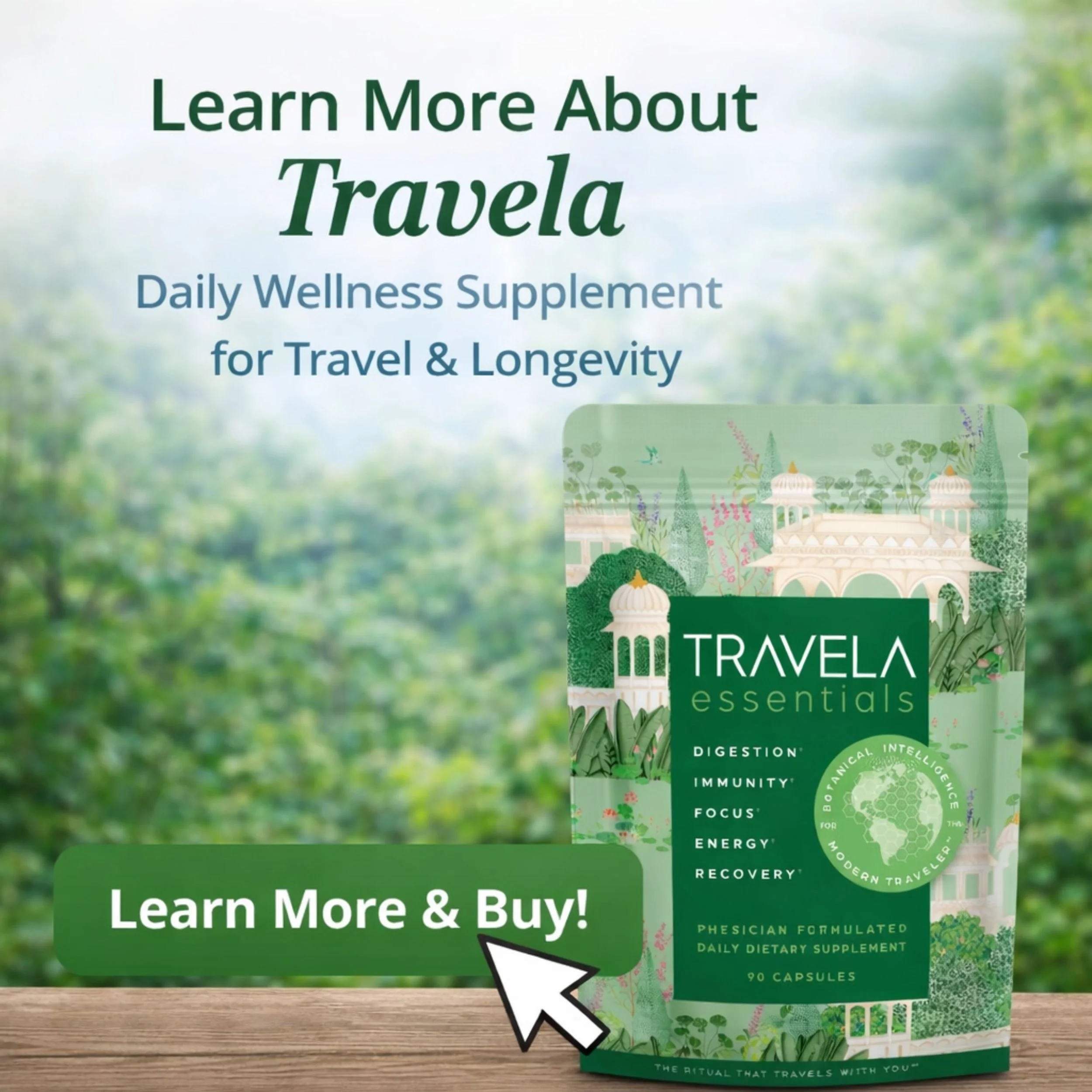
This is the exact clinical thinking behind Travela Essentials. It was never built as a replacement for a physician-directed protocol, and it was not built to be a hard sell—it was built because I lived the alternative, standing in front of my own cluttered counter, and I wanted something coherent to offer patients like Sarah instead of another isolated bottle.
Travela Essentials is architected around the same five pathways—digestion, immunity, focus, energy, and recovery—using whole-spectrum botanicals such as ginger, holy basil, magnesium bisglycinate, CoQ10, and schisandra, formulated to work in concert rather than in isolation, and manufactured with third-party testing behind it. It travels the way I once did, with fifteen pounds of glass and plastic in a single bag, distilled down to a ritual that actually fits in a carry-on.
I want to be honest about what to expect, because overpromising is its own kind of noise: the most meaningful changes are often what you stop noticing. Less afternoon bloat. Less travel fatigue. Less of that three o'clock fog. Fewer flare days. None of it arrives as a single dramatic before-and-after; it arrives the way my own recovery did—as a slow return of a baseline I'd almost forgotten was possible.
#CellCare Reflection

Sarah still has her tote bag. What's changed is what's inside it. When she came back for her follow-up, she set it on the table the same way—but this time, only a handful of bottles came out, and she didn't line them up with the same anxious precision. She looked, for the first time since I'd met her, unhurried.
Every capsule you take is a message sent to your cellular architecture. For a long time, mine was noise—well-intentioned, but scattered. Rebuilding it into something coherent didn't happen because I found a miracle ingredient. It happened because I finally asked what my body's systems actually needed, together, and stopped treating each symptom as its own emergency.
If your own cabinet has become a chore rather than a comfort, you don't need more. You need a plan that respects how interconnected your body already is. Start with one small, coordinated choice today—your cells are always listening, and they respond far better to a quiet, consistent message than to noise.



MAKE A DIFFERENCE BY SHARING THIS ARTICLE WITH OTHERS TO ENCOURAGE WELLBEING ⤵
References:
1. Malik, Shazia, Omar Alnaji, Mahnoor Malik, Teresa Gambale, Forough Farrokhyar, and Michel P. Rathbone. “Inflammatory Cytokines Associated with Mild Traumatic Brain Injury and Clinical Outcomes: A Systematic Review and Meta-Analysis.” Frontiers in Neurology 14 (2023): 1123407.
2. Wangler, Lynde M., and Jonathan P. Godbout. “Microglia Moonlighting after Traumatic Brain Injury: Aging and Interferons Influence Chronic Microglia Reactivity.” Trends in Neurosciences 46, no. 11 (2023): 926–940.
3. El Baassiri, Mahmoud G., Zachariah Raouf, Sarah Badin, Alejandro Escobosa, Chhinder P. Sodhi, and Isam W. Nasr. “Dysregulated Brain-Gut Axis in the Setting of Traumatic Brain Injury: Review of Mechanisms and Anti-Inflammatory Pharmacotherapies.” Journal of Neuroinflammation 21 (2024): 124.
4. Bostick, John W., Aubrey M. Schonhoff, and Sarkis K. Mazmanian. “Gut Microbiome-Mediated Regulation of Neuroinflammation.” Current Opinion in Immunology 76 (2022): 102177.
5. Kongkeaw, Chuenjid, Piyameth Dilokthornsakul, Pratchaya Thanarangsarit, Nanteetip Limpeanchob, and C. Norman Scholfield. “Meta-Analysis of Randomized Controlled Trials on Cognitive Effects of Bacopa monnieri Extract.” Journal of Ethnopharmacology 151, no. 1 (2014): 528–535.
6. Tsai, I-Chen, Chih-Wei Hsu, Chun-Hung Chang, Ping-Tao Tseng, and Ke-Vin Chang. “Effectiveness of Coenzyme Q10 Supplementation for Reducing Fatigue: A Systematic Review and Meta-Analysis of Randomized Controlled Trials.” Frontiers in Pharmacology 13 (2022): 883251.
7. Kohandel, Zeynab, Majid Darrudi, Kobra Naseri, Fariborz Samini, Michael Aschner, Mohammad Ali Pourbagher-Shahri, and Saeed Samarghandian. “The Role of Resveratrol in Aging and Senescence: A Focus on Molecular Mechanisms.” Current Molecular Medicine 24, no. 7 (2024).
The information on this website has not been evaluated by the Food & Drug Administration or any other medical body. We do not aim to diagnose, treat, cure or prevent any illness or disease. Information is shared for educational purposes only. You must consult your doctor before acting on any content on this website, especially if you are pregnant, nursing, taking medication, or have a medical condition. Our content may include products that have been independently chosen and recommended by Dr. Monisha Bhanote and our editors. We may earn a small commission if you purchase something mentioned in this article.
YOU MAY ALSO LIKE:




by Dr. Monisha Bhanote
✅ EVIDENCE-INFORMED REVIEWED ARTICLE