
Holy Basil, Bacopa & Gotu Kola: An Ayurvedic Trinity for Calm

“Lasting resilience begins with the daily conversations between your cells and the botanicals that support them.”
Marcus is fifty-two, and by every measure that matters on paper, he is thriving. He works in high finance, keeps a disciplined workout schedule, eats clean, and files his annual labs into a neat digital folder the way other people file taxes. He is the kind of man people admire from a distance — composed, capable, unbothered. But for eight months now, he has been waking at 3:07 AM with his heart pounding, wide awake before his body has any say in the matter, staring at a dark ceiling with the unsettling sense that something is wrong even though every metric he tracks insists otherwise.
He has tried the modern rituals of reasonable desperation: meditation apps narrated by soft-voiced strangers, CBD gummies in amber jars, melatonin that leaves him groggy but not restored. None of it has touched the pattern underneath. His wife has a simpler read on it. “You’re always on,” she tells him, not unkindly. He laughs it off. It lands anyway, because she is right.
What Marcus is experiencing is not garden-variety insomnia. It is a cortisol spike — an early surge of stress hormone that should rise gently with daylight but, in a chronically overburdened nervous system, arrives too sharply and too soon. In plain terms, his body has mistaken the dark for an emergency. By the time he is out of bed, his nervous system is already triaging a day that hasn’t started: a moved-up call, an unread board packet, a headline that lodged itself somewhere behind his sternum before he fell asleep.
The day that follows looks, from the outside, like discipline. Breakfast assembled with precision, eaten while scanning messages. Calls handled with composure that costs more than it shows. A workout that leaves him depleted rather than restored, because a body already running on stress chemistry doesn’t experience exercise as recovery — it experiences it as one more demand. By evening, a glass of wine offers the illusion of an exhale, though for a dysregulated nervous system, alcohol often behaves like a false off-switch, fragmenting sleep further rather than repairing it. And at 3:07 AM, the ritual returns.
When Marcus finally sat across from me, it wasn’t curiosity about herbs that brought him in. It was exhaustion, sharpened into honesty. “I don’t need a wellness speech,” he said. “I just want one night of uninterrupted sleep.” I respected that immediately, because beneath the skepticism was something I recognize in so many high-functioning patients: intelligent, disciplined people who have quietly mistaken high function for resilience.

Why the 3 AM wake-up is bigger than sleep
Most people assume the problem is insomnia. Sometimes it is. But in patients like Marcus, that 3 AM wake-up is usually the visible symptom of something larger: a hypothalamic-pituitary-adrenal, or HPA, axis that has lost its rhythm. Cortisol rises when it should be falling. GABA, one of the brain’s primary calming neurotransmitters, isn’t signaling clearly enough to escort the body into deep rest. The nervous system stays hypervigilant even when the room is silent and the day, technically, is over.
At the cellular level, this has real consequences. Mitochondria — the energy engines inside every one of your cells — are forced to keep producing output under conditions of incomplete recovery. Oxidative stress climbs. Inflammation simmers quietly. The gut microbiome, exquisitely sensitive to stress signaling, responds in kind. Over time, you don’t just feel tired. You become less adaptable — less able to meet the next demand without cost.
This is what I mean when I talk about #CellCare. Self-care, in its truest form, isn’t a candle or a bath. It is the deliberate work of creating cellular conditions where recovery becomes biologically possible again.

The botanical intelligence I almost walked past
Here is what I find myself circling back to, years into practicing medicine: I trained in a system that taught me to trust a molecule the moment it had a randomized controlled trial behind it, and to file centuries of plant-based observation under “anecdote” until proven otherwise. It took my own seasons of depletion — long call schedules, transatlantic travel, the particular fatigue of being tired and still unable to settle — to send me back to the Ayurvedic pharmacopeia I had studied years earlier and quietly set aside.
What surprised me wasn’t that the herbs worked. It was how precisely each one answered a different hour of the same depleted day, and how much clinical intelligence had simply been sitting there, unexamined, while I reached for more familiar tools first. I still ask myself, honestly, why it took this long to look closely at what these three plants — Holy Basil, Bacopa, and Gotu Kola — were actually doing at the level of the HPA axis, the neurotransmitter, the mitochondrion. The evidence had been accumulating quietly in the literature the whole time, waiting for someone to connect it to a patient like Marcus.
Holy Basil, the herb for a morning that treats itself like an emergency
The first herb I think of for someone like Marcus is Holy Basil, or Tulsi — in Ayurveda, “the elixir of life.” What I’ve observed clinically isn’t sedation, which would be useless for anyone with a demanding schedule. It’s modulation: mornings that stop arriving with a jolt, a body that becomes less likely to interpret every incoming demand as a five-alarm event.
An eight-week, randomized, placebo-controlled trial of a standardized Holy Basil extract, published in Frontiers in Nutrition, measured exactly this in adults dealing with chronic stress and disrupted sleep, and found meaningful improvements in perceived stress, mood, and sleep quality alongside reduced cortisol reactivity compared with placebo. The live translation matters more than the mechanism: the morning alarm quiets. You stop spending your first waking hour fighting your own chemistry.
For Marcus, Holy Basil becomes the herb of breakfast — not because breakfast is magical, but because the day needs a different opening note.

Bacopa, the herb that protects the mind you use to carry the day
If Holy Basil is about the alarm, Bacopa is about the wear that follows it. Marcus wasn’t worried about a dramatic failure in a meeting. He was worried about something quieter: that his edge was getting harder to access. He’d read a paragraph and realize nothing had landed.

Bacopa, traditionally known as Brahmi, has centuries of use in Ayurveda for memory and mental steadiness, and it is one of the more rigorously studied adaptogenic herbs in modern research. A 2025 randomized, double-blind, placebo-controlled trial published in Clinical Drug Investigation followed adults over twelve weeks on a standardized Bacopa extract. It is worth being precise about what it found: Bacopa did not outperform placebo on formal cognitive testing — verbal learning, attention, and working memory moved together in both groups. What it did produce was a measurable reduction in self-reported stress reactivity, along with less fatigue and stress after cognitively demanding tasks. That distinction is worth sitting with. The value here isn’t a memory boost. It’s resilience under load — the capacity to stay steady through the density of a modern workday, which is precisely what someone like Marcus is actually asking for.
For Marcus, Bacopa becomes the workday herb. Not stimulation. Preserved clarity.
Gotu Kola, the herb of the evening threshold
Gotu Kola is the herb I think of when someone can no longer cross the bridge from effort to ease. “I can sit on my own couch,” Marcus told me, “and still feel like I’m bracing for something.” That isn’t ordinary tiredness. That’s a nervous system that has forgotten how to trust the absence of demand.
Traditionally revered in Ayurveda for longevity and mental clarity, Centella asiatica’s active compounds — asiaticoside and madecassoside among them — have been linked in laboratory research to increased expression of brain-derived neurotrophic factor, or BDNF, a protein central to neuronal repair and adaptability, and to modulation of GABAergic signaling, the same calming pathway many sleep-supportive compounds target. In a clinical study of adults with generalized anxiety, a standardized Centella asiatica extract taken for sixty days produced significant reductions in anxiety and stress compared with baseline. I think of it less as turning the lights off and more as dimming them slowly enough that the body doesn’t resist.
For Marcus, Gotu Kola belongs in the evening ritual — the cue his wine never quite delivered.

You already trust plants. Meet the intelligence inside them
Many of the women and men I work with are already eating this way: plant-forward, intentional, thoughtful about what goes on the plate. If that’s you, I want to name something you may not have considered. Choosing plants at the table is one form of trusting botanical intelligence. It is not the same as engaging with that intelligence at the level of your nervous system.
Vegetables and legumes feed your cells. Holy Basil, Bacopa, and Gotu Kola speak to your cells — to the HPA axis, to GABA receptors, to mitochondria straining under incomplete recovery. It’s an easy blind spot, and an understandable one. Most of what we’re taught about plant-based living centers on macronutrients and fiber, not on the specific compounds inside adaptogenic herbs that interact directly with stress physiology. If you’ve already built a life around trusting what plants can do for your body, this is simply the next layer of that same trust, applied somewhere you likely haven’t looked yet.
The real power is in the trinity, not the isolated herb
Marcus’s problem was never only nighttime. It began at dawn, gathered force through the workday, and disguised itself in an evening glass of wine. That’s why single-note interventions so often disappoint — they try to solve a whole-day rhythm problem with a one-moment fix.
Picture the same day, supported differently. Morning begins with Holy Basil steadying the first cortisol surge before it can set the tone for everything that follows. The workday intensifies, as it always will, and Bacopa comes alongside — not as a stimulant, but as protection for the cognitive steadiness the day keeps demanding. Evening arrives, and Gotu Kola helps the nervous system cross the threshold most people try and fail to cross with alcohol.
That is synergy: not a checklist, but a living sequence that meets stress where it actually happens — in layers, across the full architecture of a day. This, to me, is CellCare in practice. Not chasing symptoms one at a time, but restoring rhythm at the level where rhythm is actually made.
What you can do today
You don’t need a diagnosis to start paying attention to this pattern. A few honest questions are enough: Do your mornings begin with a jolt? Does your workout restore you, or simply exhaust you more efficiently? Is your evening glass of wine actually relaxing you, or blurring the edges before a 3 AM wake-up returns?

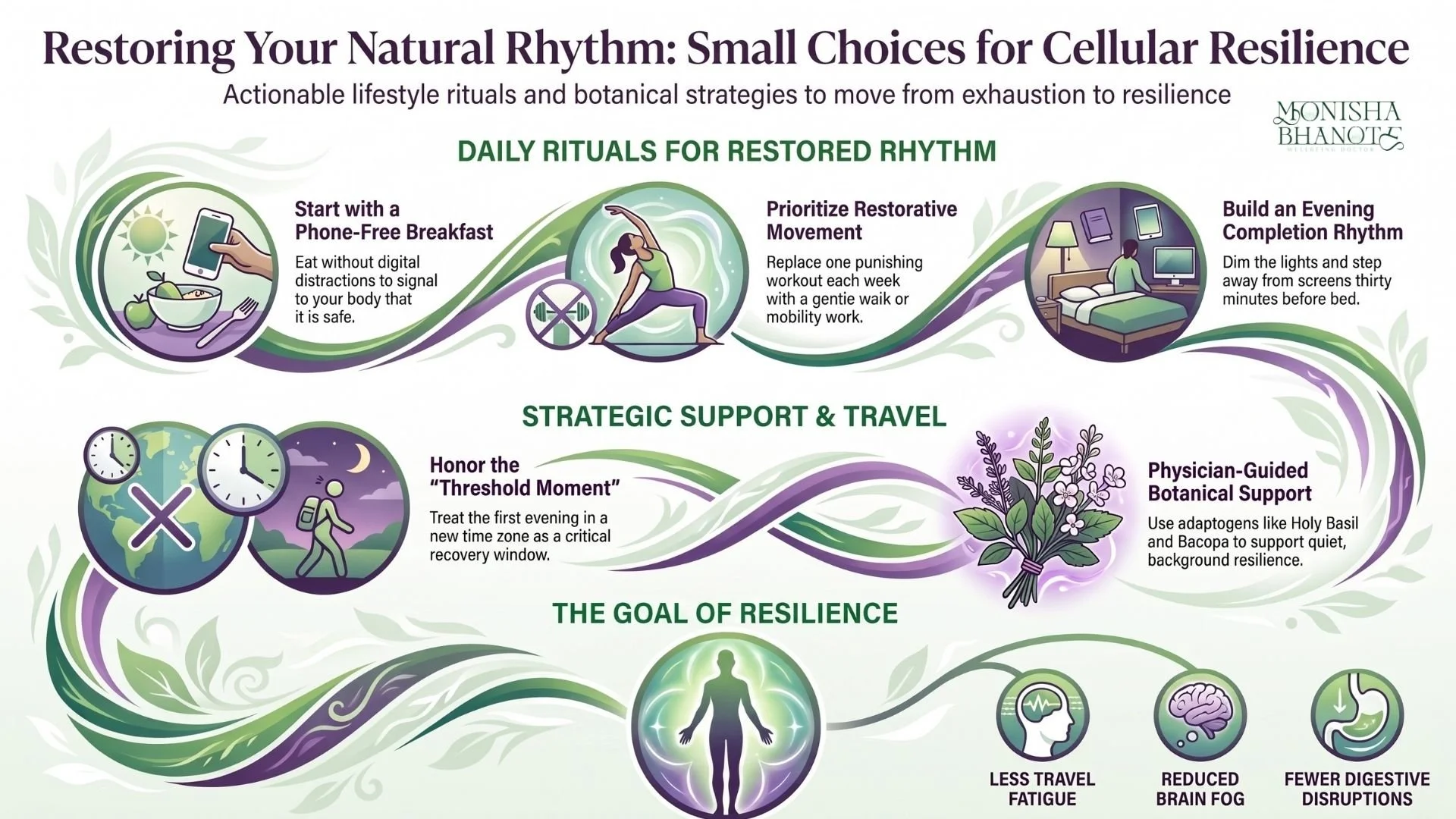
Eat breakfast without your phone, so your body gets an unambiguous cue that it is safe.
Let at least one workout each week be restorative rather than punishing — a walk, gentle mobility, time outside.
Build an evening rhythm that signals completion: dim the lights, step away from screens for the last thirty minutes, do something with your hands.
If you travel frequently, treat the first evening in a new time zone as a threshold moment, not an afterthought — your nervous system is taking its cues from what you do in that window.
If sleep support has failed you and you’re ready for something more precise, consider physician-guided botanical strategies that respect both Ayurvedic tradition and modern clinical evidence.
This is where a formulated approach like Travela Essentials™ can support the rhythm you’re building, rather than replace it. It isn’t a fix taken in isolation — it’s a daily ritual that travels with you, formulated around ingredients like Holy Basil, Bacopa, and Gotu Kola alongside other adaptogenic and cellular-support compounds. The honest expectation to hold is this: the most meaningful changes are often what you stop noticing. Less travel fatigue. Less digestive disruption after a long flight. Less brain fog by four in the afternoon. A little more resilience, quietly accumulating, in the background of an ordinary week.
#CellCare Reflection
Marcus didn’t come to see me because he’d fallen in love with herbs. He came because desperation had made him honest. That’s often how this work begins — not with inspiration, but with a body that finally insists on being heard.
If you recognize yourself in this story, let that recognition be the invitation. Cellular health isn’t built in a single ritual or a single supplement. It’s built in the accumulation of small, intentional choices — a breakfast without a phone, an evening that actually signals rest, a willingness to ask what your body has been trying to tell you at 3 AM.
Longevity isn’t a destination. It’s a rhythm, restored one honest choice at a time.

MAKE A DIFFERENCE BY SHARING THIS ARTICLE WITH OTHERS TO ENCOURAGE WELLBEING ⤵
References:
Jana, U., T. K. Sur, L. N. Maity, P. K. Debnath, and D. Bhattacharyya. “A Clinical Study on the Management of Generalized Anxiety Disorder with Centella asiatica.” Nepal Medical College Journal 12, no. 1 (2010): 8–11.
Lopresti, Adrian L., Stephen J. Smith, Alexandra P. Metse, and Peter D. Drummond. “A Randomized, Double-Blind, Placebo-Controlled Trial Investigating the Effects of an Ocimum tenuiflorum (Holy Basil) Extract (Holixer™) on Stress, Mood, and Sleep in Adults Experiencing Stress.” Frontiers in Nutrition 9 (2022): 965130.
Lopresti, Adrian L., and Stephen J. Smith. “The Effects of a Bacopa monnieri Extract (Bacumen®) on Cognition, Stress, and Fatigue in Healthy Adults: A Randomized, Double-Blind, Placebo-Controlled Trial.” Clinical Drug Investigation 45 (2025): 967–982.
Sari, Dwi Cahyani Ratna, Nur Arfian, Untung Tranggono, Wiwit Ananda Wahyu Setyaningsih, Muhammad Mansyur Romi, and Noriaki Emoto. “Centella asiatica (Gotu Kola) Ethanol Extract Up-Regulates Hippocampal Brain-Derived Neurotrophic Factor (BDNF), Tyrosine Kinase B (TrkB), and Extracellular Signal-Regulated Protein Kinase 1/2 (ERK1/2) Signaling in a Chronic Electrical Stress Model in Rats.” Iranian Journal of Basic Medical Sciences 22 (2019).
The information on this website has not been evaluated by the Food & Drug Administration or any other medical body. We do not aim to diagnose, treat, cure or prevent any illness or disease. Information is shared for educational purposes only. You must consult your doctor before acting on any content on this website, especially if you are pregnant, nursing, taking medication, or have a medical condition. Our content may include products that have been independently chosen and recommended by Dr. Monisha Bhanote and our editors. We may earn a small commission if you purchase something mentioned in this article.
YOU MAY ALSO LIKE:




by Dr. Monisha Bhanote
✅ EVIDENCE-INFORMED REVIEWED ARTICLE