The Gut-Heart Axis: What Your Microbiome Is Telling Your Cardiovascular System

“Your body is not a collection of separate systems. The gut nourishes the heart, the heart nourishes every cell, and your daily choices become part of that conversation.”
Renata sat in her car in the parking lot outside her doctor's office, rereading a printout she didn't fully understand. Borderline high LDL, it read. Early signs of fatty liver. Recommend dietary changes. She was fifty-two. She ran three miles most mornings. She hadn't eaten red meat in a decade, and she'd spent the last two years building a plant-forward kitchen she was genuinely proud of. What she felt, more than anything, was betrayed. Not by her body exactly, but by the story she'd been told about how this was supposed to work: eat clean, move your body, watch your numbers. She had done all three. And her liver was quietly building a problem she had no framework for interpreting.
What nobody had told Renata, and what almost nobody tells patients in a routine physical, is that her liver was never working alone. It has spent her entire life in constant conversation with a population of microorganisms living in her gut, trillions of them, and that conversation had been shaping her cholesterol and her blood pressure long before either number showed up on a lab report.
Renata's story is common enough that it barely counts as a story anymore. It's the woman who eats well and still gets a surprising number back from her physician. It's the traveler whose blood pressure creeps up on a trip, despite eating what feels like the same diet. It's the health-conscious professional who assumes cardiovascular risk is mostly about willpower and red meat, and who has never once been asked a question about their gut. The connection between the two systems, gut and heart, is not a fringe theory. It's an active, well-documented area of cardiovascular research, and it explains a great deal of what standard advice leaves unanswered.

Your Liver Isn't Making These Decisions By Itself
For decades, the story of cholesterol has been told as a plumbing problem: too much of it clogs the pipes. It's a simple, memorable image, and it's also incomplete. The real story starts further upstream, in the trillions of bacteria that live in the digestive tract and quietly influence how efficiently the liver processes fat.
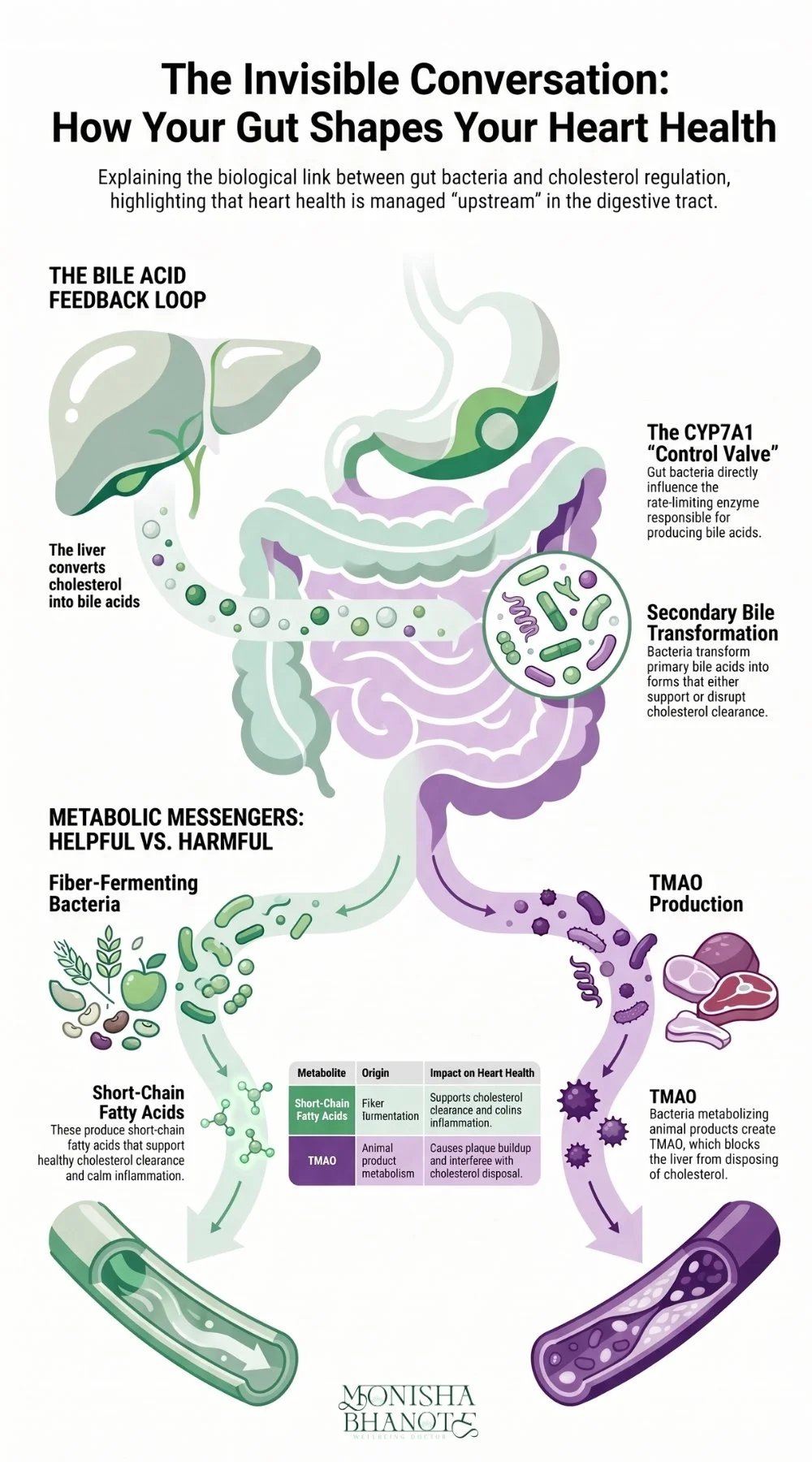
Here is the mechanism in plain terms. The liver converts cholesterol into bile acids to help digest fat, then reabsorbs most of those bile acids back into circulation to be reused. Gut bacteria intercept a portion of that process, transforming primary bile acids into secondary forms that either support or disrupt how efficiently cholesterol gets cleared from the body. Recent research into this dynamic has confirmed that the gut microbiota exerts both direct and indirect regulatory effects on the body's own cholesterol balance, largely through the metabolites it produces along the way.
Some of those metabolites work in your favor. Short-chain fatty acids, produced when gut bacteria ferment fiber, tend to support healthy cholesterol clearance and calm inflammation inside blood vessel walls. Others work against you. A compound called TMAO, formed when gut bacteria metabolize certain nutrients found predominantly in animal products, interferes with the body's ability to shuttle cholesterol back to the liver for disposal, and elevated levels have been associated with inflammation and plaque buildup inside artery walls.
It's worth naming how deliberate this system is. The liver's rate-limiting enzyme for bile acid production, a mouthful called CYP7A1, is directly influenced by which bacteria are dominant in the gut at any given time. A gut ecosystem rich in fiber-fermenting bacteria tends to favor efficient bile acid turnover and healthy cholesterol clearance. A gut ecosystem shaped by years of a low-fiber, high-saturated-fat pattern tends to favor the opposite: sluggish clearance, more circulating cholesterol, and a liver working harder than it should have to for the same result.
This is the part of the story that gets left out of a typical physical. Renata's borderline LDL wasn't only about what landed on her plate that week. It was the downstream signal of what her gut ecosystem had been doing behind the scenes, potentially for years, long before it registered as a number on a chart.
What Actually Raises LDL (And What Doesn't)
There's a persistent myth that eating cholesterol raises blood cholesterol, largely because it seems intuitive: cholesterol in, cholesterol up. The research tells a more specific story. A 2025 randomized cross-over trial published in the American Journal of Clinical Nutrition tracked participants across several controlled diets and found that dietary cholesterol itself showed no meaningful relationship to LDL levels, while saturated fat intake was significantly and positively correlated with rising LDL cholesterol. In other words, the egg on your plate is rarely the primary problem. What matters more is the company it keeps: the butter, the processed meat, the fried preparation.
Trans fat deserves its own mention, because it may be the more damaging actor of the two. One of the clearest studies on the subject, still cited decades later, found that trans fatty acids raised LDL cholesterol even more than saturated fat did, while simultaneously lowering protective HDL cholesterol, a double effect that saturated fat alone does not produce. Trans fats show up quietly in shelf-stable baked goods, certain coffee creamers, and fried fast food, often without announcing themselves clearly on a label.
None of this means the cholesterol content of food is irrelevant. It means the liver's own production, shaped heavily by what the gut microbiome is doing with saturated fat intake and inflammatory signaling, carries more weight in the final number than most people have been led to believe.
The Blood Pressure Lever Almost Nobody Names
If cholesterol has an underappreciated gut connection, blood pressure has one too, and it runs through a molecule most people have never heard mentioned outside a chemistry class: nitric oxide.
Nitric oxide is what allows blood vessels to relax and widen, which is a large part of what keeps blood pressure in a healthy range. The body produces some of it internally, but a meaningful amount comes from a pathway that starts with nitrate-rich vegetables, the kind many people already eat without knowing what the plant is doing for them once it reaches the gut. Oral and gut bacteria convert dietary nitrate into nitrite, and the body then converts that nitrite into nitric oxide, right where it's needed, inside the vessel wall.
A twelve-week randomized controlled trial conducted in the Netherlands put this to a real-world test. Researchers had adults with elevated blood pressure increase their intake of nitrate-rich vegetables over twelve weeks and found meaningful reductions in ambulatory blood pressure compared with a control group, an effect strong enough to register on continuous 24-hour monitoring rather than a single office reading. It's a striking finding, not because the vegetables involved are exotic, but because they usually aren't. The pathway is sitting in the produce aisle, waiting on a population of bacteria most people never think about.

What You Can Do Today
This was part of a working list of foods a nutritional biochemist I spoke with for the Gut Health & Longevity Summit walked me through, foods with real research behind them for supporting cholesterol and blood pressure through mechanisms like the ones above. A few worth knowing:

Citrus bergamot. Not the bergamot flavoring your Earl Grey, but a closely related citrus grown primarily in Calabria, Italy. A 2024 randomized, placebo-controlled trial found that a standardized bergamot extract taken daily for four months reduced total cholesterol by 8.8 percent and LDL cholesterol by 11.5 percent, with a modest rise in protective HDL alongside it. It's one of the more rigorously studied citrus compounds for lipid support.
Artichoke. Traditionally used to support liver and bile function, artichoke leaf extract has shown promise for cholesterol management, particularly in combination with bergamot for people who don't respond fully to bergamot on its own. Given the liver's central role in this entire story, it's a logical companion.
Psyllium. A soluble fiber that binds to bile acids in the digestive tract, which forces the liver to pull more cholesterol out of circulation to manufacture new bile acids. It's one of the most thoroughly established fiber interventions for cholesterol, inexpensive, and easy to fold into a morning routine.
Brazil nuts. Just one or two a day provide a meaningful dose of selenium, a mineral involved in the body's antioxidant defenses and thyroid function, both of which play supporting roles in lipid metabolism. Research on Brazil nuts and cholesterol specifically is mixed, but their contribution to selenium status and antioxidant activity is well established.
Barberry. A tart, ruby-red fruit used for centuries in traditional medicine and now being studied more formally for its effects on blood pressure and inflammation. The early research is promising, though larger human trials are still underway.
A few more from the same list earn a place for their traditional culinary role in supporting digestion and calm, even where the clinical research is thinner: black soybeans, lemon balm, and sumac, each with a home in cuisines that also happen to track with lower rates of cardiovascular disease. Turmeric, which WELLKULÅ has covered in depth elsewhere, plays a supporting role here too, through its effect on inflammatory signaling in the gut lining.
None of this requires an overhaul. It requires noticing that the produce aisle and the spice cabinet are already doing quiet, measurable work on your behalf. Most of these foods share a quality worth naming: they support the gut-heart axis from more than one direction at once, feeding the bacteria responsible for healthy bile acid turnover while also delivering compounds, like bergamot's flavonoids or artichoke's bitter constituents, that act directly on the liver. That overlap is exactly why a handful of consistent choices tend to outperform a single hero ingredient.

Where Ritual Meets Research
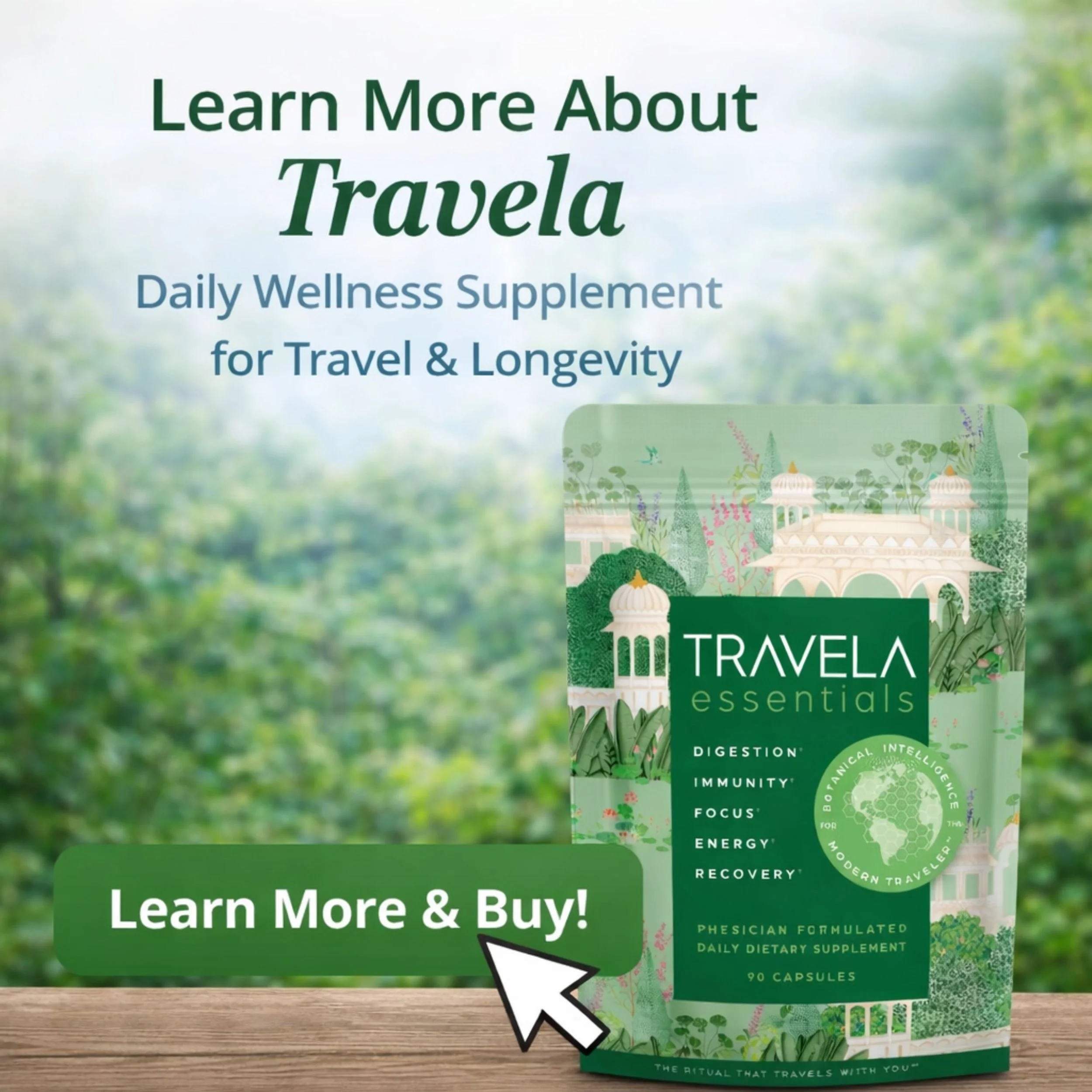
This is precisely the physiology I had in mind when I formulated Travela Essentials, because supporting the gut-heart axis was never about a single ingredient. It's about supporting the body's own communication system at several points along the same pathway, in the same way a well-run household needs more than one person paying attention to keep everything moving. One ingredient managing the liver's workload. One supporting the vessel's ability to relax. One protecting the lining those vessels depend on. That's the logic behind the formulation, and it's the same logic behind everything in this piece.

Schisandra, for the Liver
Schisandra is one of the ingredients I return to for this reason. It's a berry used for centuries in traditional Chinese medicine specifically for liver support, and while human clinical research is still developing, animal studies have shown it can meaningfully improve markers of liver fat and cholesterol handling. In one such study, Schisandra polysaccharide reduced serum triglycerides, total cholesterol, and LDL cholesterol while raising protective HDL cholesterol in a mouse model of fatty liver disease. That's animal-model evidence, not a guarantee of an identical effect in people, but it lines up logically with the liver's central role in everything this piece has walked through.
Magnesium Bisglycinate, for the Vessel
Magnesium bisglycinate supports the vessel side of the equation. A large 2025 meta-analysis pooling data from thirty-eight randomized controlled trials found that magnesium supplementation produced meaningful reductions in both systolic and diastolic blood pressure compared with placebo, with the largest effects seen in people already being treated for hypertension. Magnesium supports the same nitric oxide and vascular relaxation pathway that nitrate-rich vegetables activate, working from a different angle on the same target.
Resveratrol, for the Lining
Resveratrol rounds out the trio, protecting the vessel lining itself. A 2022 meta-analysis of seventeen randomized controlled trials found that resveratrol supplementation significantly improved flow-mediated dilation, a direct measure of how well blood vessels relax and expand, alongside reductions in a marker of vascular inflammation. Together, schisandra, magnesium, and resveratrol reflect the same physiology this entire piece has been built around: liver processing, vessel tone, and vessel protection, addressed as one connected system rather than three separate concerns.
I want to be honest about what a daily ritual like this can offer. It is not a replacement for what you eat most days, and it will not undo a diet built around trans fat and ultra-processed food. The most meaningful shifts tend to be the ones you stop noticing: less afternoon sluggishness, a blood pressure reading that holds steady after a stressful week, a lab result that moves in the right direction at your next physical instead of the wrong one. Travela Essentials was designed as a daily companion to that slower, quieter kind of change, not a substitute for it.
#CellCare Reflection

Renata's fatty liver notation wasn't a failure. It was information, arriving late, about a conversation her body had been having with itself for years. The gut and the heart were never separate systems. They were always talking to each other, through bile acids and short-chain fatty acids and nitric oxide, long before either organ made it onto a chart.
Cellular health rarely announces itself loudly. It shows up in the produce you choose without thinking twice, in the ritual you keep even on an ordinary Tuesday, in the quiet trust that your body is listening even when you can't yet see the results. You don't need to overhaul your life to support this axis. You need to start noticing that it exists, and that the small, consistent choices you're already capable of making are part of the conversation.


MAKE A DIFFERENCE BY SHARING THIS ARTICLE WITH OTHERS TO ENCOURAGE WELLBEING ⤵
References:
Abavisani, Mohammad, Seyed Mohammad Sajjadi, Negar Ebadpour, Sercan Karav, and Amirhossein Sahebkar. "Gut Microbiota–Cholesterol Crosstalk in Cardiovascular Diseases: Mechanisms, Metabolites, and Therapeutic Modulation." Nutrition & Metabolism 23, article 4 (2025).
Argeros, Z., X. Xu, B. Bhandari, K. Harris, R. M. Touyz, and A. E. Schutte. "Magnesium Supplementation and Blood Pressure: A Systematic Review and Meta-Analysis of Randomized Controlled Trials." Hypertension 82 (2025)
Carter, Sharayah, Alison M. Hill, Catherine Yandell, Lisa Wood, Alison M. Coates, and Jonathan D. Buckley. "Impact of Dietary Cholesterol from Eggs and Saturated Fat on LDL Cholesterol Levels: A Randomized Cross-Over Study." American Journal of Clinical Nutrition 122, no. 1 (2025)
Mensink, Ronald P., and Martijn B. Katan. "Effect of Dietary Trans Fatty Acids on High-Density and Low-Density Lipoprotein Cholesterol Levels in Healthy Subjects." New England Journal of Medicine 323, no. 7 (1990)
Mohammadipoor, Nazanin, Fatemeh Shafiee, Amirabbas Rostami, Mohammad Saeed Kahrizi, Hamidreza Soleimanpour, Majid Ghodsi, Mohammad Javed Ansari, Dmitry Olegovich Bokov, Behrooz Jannat, Erfan Mosharkesh, and Mohammad Sadegh Pour Abbasi. "Resveratrol Supplementation Efficiently Improves Endothelial Health: A Systematic Review and Meta-Analysis of Randomized Controlled Trials." Phytotherapy Research 36, no. 9 (2022)
Spina, Amelia, Fabio Amone, Vincenzo Zaccaria, Violetta Insolia, Anna Perri, Danilo Lofaro, Francesco Puoci, and Vincenzo Nobile. "Citrus bergamia Extract, a Natural Approach for Cholesterol and Lipid Metabolism Management: A Randomized, Double-Blind Placebo-Controlled Clinical Trial." Foods 13, no. 23 (2024)
van der Avoort, Cindy M. T., Dominique S. M. ten Haaf, Coen C. W. G. Bongers, Frederieke van Oorschot, Lex B. Verdijk, Luc J. C. van Loon, and Maria T. E. Hopman. "Increasing Nitrate-Rich Vegetable Intake Lowers Ambulatory Blood Pressure in (pre)Hypertensive Middle-Aged and Older Adults: A 12-Wk Randomized Controlled Trial." Journal of Nutrition 151, no. 9 (2021)
Wang, Chun-Mei, Rong-Shuang Yuan, Wen-Yue Zhuang, Jing-Hui Sun, Jin-Ying Wu, He Li, and Jian-Guang Chen. "Schisandra Polysaccharide Inhibits Hepatic Lipid Accumulation by Downregulating Expression of SREBPs in NAFLD Mice." Lipids in Health and Disease 15 (2016)
The information on this website has not been evaluated by the Food & Drug Administration or any other medical body. We do not aim to diagnose, treat, cure or prevent any illness or disease. Information is shared for educational purposes only. You must consult your doctor before acting on any content on this website, especially if you are pregnant, nursing, taking medication, or have a medical condition. Our content may include products that have been independently chosen and recommended by Dr. Monisha Bhanote and our editors. We may earn a small commission if you purchase something mentioned in this article.
YOU MAY ALSO LIKE:



by Dr. Monisha Bhanote
✅ EVIDENCE-INFORMED REVIEWED ARTICLE