
The Gut-Joint Axis: A New Way to Understand Chronic Joint Pain

“Your joints do not age in isolation. The health of your gut, the strength of your cellular environment, and the choices you make each day all shape how well your tissues repair, adapt, and move.”
Marguerite is fifty-eight and has run three miles most mornings for over a decade. Lately the last quarter mile takes negotiation. Her right knee, the one that carried her through two marathons in her thirties, has started announcing itself before her alarm does: a dull ache under the kneecap that shows up in the first hour she's upright, softens by noon, and returns like clockwork after forty minutes at her desk. Her orthopedist looked at the imaging, gave the nod doctors give when a diagnosis is routine, and said the sentence she's now heard from three different specialists. Wear and tear. Welcome to your fifties.
She eats well. Salad most days, salmon twice a week, wine only on weekends. So the ache confuses her, because if this were purely mechanical, cartilage grinding on cartilage after decades of miles, why does it flare in weeks she's under deadline pressure and quiet in weeks she isn't? Why did it ease, briefly and unexpectedly, during a retreat where she ate almost entirely plants for five days? Her surgeon had no theory for that. Most surgeons were never trained to look for one.

The Joint Was Never Sterile
I recently sat down with Dr. Scott Stoll, a sports and regenerative medicine physician who has treated Olympic athletes and competed on the U.S. Olympic bobsled team himself, for a conversation on the gut-joint axis. What he described reframed something both of us were taught in training and both of us, from opposite ends of the operating table, had come to doubt.
For most of modern orthopedic medicine, the joint space was considered sterile: a closed compartment with no living microbiome of its own. If bacteria ever turned up there, the assumption was contamination, not residency. That assumption hasn't held. Researchers sampling synovial fluid, the fluid that cushions and lubricates the joint, have repeatedly found bacterial DNA where textbooks said there should be none. A 2025 systematic review of synovial fluid microbiota studies found that eight of nine studies using modern sequencing methods detected bacterial signatures inside the joint itself, and the emerging consensus is that this joint-level microbial community tends to mirror the composition of the gut. That relationship now has a name in the research literature: the gut-joint axis.
This matters because it moves the conversation about arthritis away from a purely mechanical story, cartilage simply wearing thin over the years, toward a biological one. Your gut and your joints are in ongoing conversation, and the health of one shapes the health of the other long before an X-ray shows anything.
How a Distant Signal Becomes Local Pain
The mechanism runs in two directions at once. Locally, when the gut microbiome becomes dysbiotic, meaning the balance of bacteria shifts toward less favorable populations, some of that same imbalance appears to translocate toward the joint itself, where it can contribute to local inflammation and, over time, to cartilage erosion.
Systemically, the more far-reaching pathway starts with the gut lining. A healthy intestinal barrier keeps bacterial byproducts contained. An unhealthy one, weakened by a Western-style diet, chronic stress, alcohol, or certain medications, becomes measurably more permeable. Through that compromised barrier, a bacterial cell-wall component called lipopolysaccharide, or LPS, enters circulation. This is a well-documented phenomenon called endotoxemia, and research has directly linked elevated LPS in synovial fluid to more severe osteoarthritis findings, including greater bone spur formation and narrower joint space. Once in the bloodstream, LPS activates immune cells and switches on inflammatory signaling, including a master regulator called NF-κB, that reaches well beyond the gut and can inflame joint tissue that never had a direct injury.

The reverse is also true, and it's the more hopeful half of the story. A well-fed, diverse microbiome produces short-chain fatty acids, compounds like butyrate, propionate, and acetate, as byproducts of fermenting plant fiber. These circulate through the bloodstream, help maintain the integrity of the gut lining, and appear to help quiet the same inflammatory pathways that LPS switches on. The microbiome is not a passive bystander in joint health. It is actively voting, meal by meal, for either more inflammation or less.
The Loop That Keeps People Stuck
One detail from my conversation with Dr. Stoll stayed with me, because it explains why so many patients feel like they're doing everything right and still not improving. The medications most commonly used to manage joint pain, NSAIDs and repeated corticosteroid injections, are themselves associated with disruption of the gut microbiome. So a person in pain reaches for relief, that relief further destabilizes the gut, the gut destabilization feeds more systemic inflammation, and the joint pain that prompted the medication in the first place has less room to resolve. It isn't a failure of willpower or effort. It's an unaddressed feedback loop, and feedback loops respond to being interrupted upstream, not just managed downstream.
Untangling the Myths You've Heard at the Gym
Three claims come up constantly in conversations about joint pain, and the evidence on each is more specific than the folklore suggests. Nightshades. Tomatoes, peppers, and eggplant get blamed often and broadly, but the research doesn't support a universal effect. A meaningful subset of people may be genuinely sensitive to nightshades, but for most people, eliminating them does little compared to addressing the far larger drivers of joint inflammation: added sugar, refined carbohydrates, and heavy reliance on processed animal products.

Collagen supplements. This is one of the more persistent misunderstandings in the wellness world. Collagen, whether it comes from a powder or a store-bought broth, is a protein. Once you eat it, your digestive enzymes break it down into individual amino acids like they would any other protein, and your body absorbs those amino acids and decides where to use them. There is no mechanism by which swallowed collagen travels intact to your knee. What your joints actually need to build their own collagen is the raw material and the right conditions: adequate protein generally, vitamin C, copper, and, critically, the fiber and short-chain fatty acids that keep systemic inflammation quiet enough for repair to happen at all.
Ketogenic and carnivore diets. The short-term relief some people report is real and has a real mechanism. Removing carbohydrate pushes the body into ketosis, and the resulting ketone body beta-hydroxybutyrate has been shown in laboratory studies to suppress a specific inflammatory pathway called the NLRP3 inflammasome, which is implicated in osteoarthritis progression. That's the genuine, evidence-backed part of the story. Where it gets complicated is sustainability. These diets are, by design, very low in the fermentable fiber that feeds a diverse microbiome, and fiber is already the most under-consumed nutrient in the American diet: recent national data found fewer than one in ten adults meet the daily recommendation. A diet that removes fiber almost entirely is removing the exact raw material the gut needs to keep producing the short-chain fatty acids that protect joints over the long run.
What Actually Rebuilds Cartilage

If collagen supplements aren't doing the heavy lifting, what is? The research points toward polyphenols, the pigmented plant compounds found in berries, leafy greens, and spices like ginger and turmeric. These compounds have been shown to protect chondrocytes, the specialized cells that maintain cartilage, from oxidative damage, and to support fibroblasts, the cells responsible for laying down new connective tissue. Ginger in particular has clinical trial evidence behind it: a twelve-week randomized, placebo-controlled trial in older adults with knee osteoarthritis found that daily ginger powder measurably lowered inflammatory markers compared to placebo.
There is also a quieter, more overlooked piece of this: glutathione, the body's primary internal antioxidant. Cartilage relies heavily on glutathione to buffer the oxidative stress that mechanical loading and aging place on chondrocytes, and researchers studying osteoarthritis have specifically identified glutathione depletion as a key step in cartilage breakdown. Supporting your body's own glutathione production, through diet, sleep, and reduced toxic burden, is a more direct lever on joint resilience than most people realize.
And then there's sleep, which does more than rest the body. The hours between roughly eleven at night and six in the morning appear to carry the body's primary window for musculoskeletal repair, when growth hormone release supports tissue regeneration, before the second half of the night shifts toward clearing metabolic waste from the brain. Chronic pain and poor sleep tend to travel together, each making the other worse, which is one more reason the gut-inflammation-sleep triangle deserves more attention than it usually gets.

What You Can Do This Week
None of this requires an overhaul. It requires direction.
Widen your plate before you narrow it. Rather than eliminating foods on suspicion, add color and variety: a genuine range of vegetables and fruit across the week, not the same three each day. The fiber and polyphenols in that variety are doing the quiet, cumulative work of feeding the bacteria that keep inflammation in check.
Protect your sleep window like you would a client meeting. Consistency matters more than any single supplement, because that eleven-to-six window is when your body does its structural repair.

Move before the pain tells you to. Gentle, pain-free range of motion, even just a few minutes of mobility work at your desk, keeps tissue from stiffening into the fibrotic pattern that makes movement harder later.
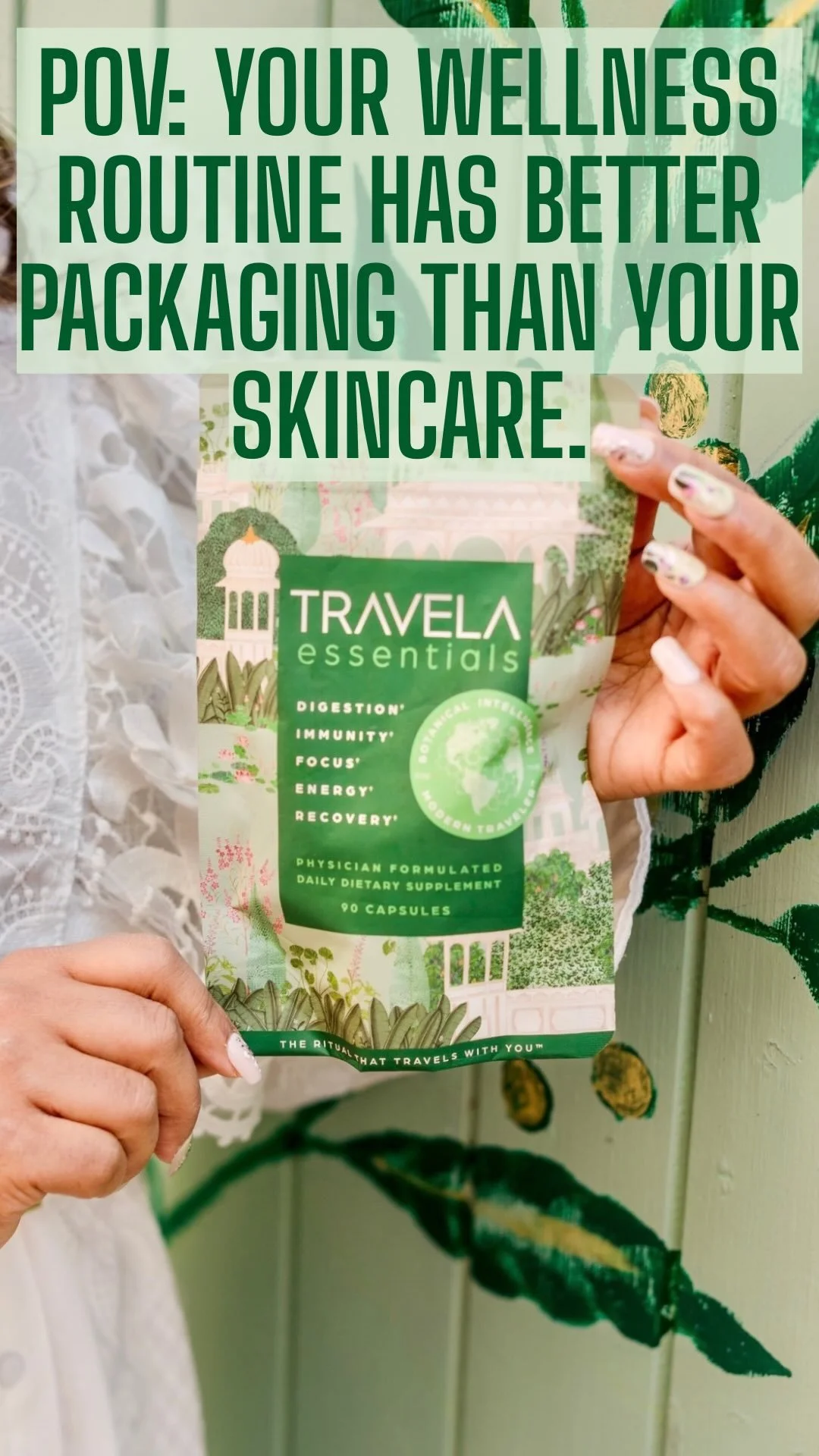
And if you travel often, or simply live at the pace most of our lives now demand, consider what's actually supporting your gut and your recovery on the days you can't control your meals. This is where a few specific botanicals earn their place, not as a fix, but as scaffolding. Ginger and glutathione, two of the compounds behind the anti-inflammatory and antioxidant mechanisms we just walked through, are part of what I formulated into Travela Essentials for exactly this reason: to give the gut and the tissues that depend on it consistent support, especially on the weeks when your diet can't be perfect. The changes worth noticing here are rarely dramatic. More often, it's what you stop noticing: less stiffness on travel mornings, less of that afternoon inflammatory dip, a body that recovers a little faster than it used to. A daily ritual that travels with you, quite literally, is often more powerful than an occasional intervention.
#CellCare Reflection

Marguerite's knee was never simply wearing out. It was reporting on a much larger conversation happening between her gut, her stress load, and her plate, one that started long before the ache did and will keep going long after it resolves. That's not a discouraging thought. It's an actionable one. Every joint that feels tired or inflamed today is still made of living tissue: chondrocytes, fibroblasts, and stem cells waiting for the right biological environment to do what they were built to do. You don't have to overhaul your life to change that environment. You have to feed it, rest it, and move it, a little more intentionally, starting with your next meal.
That is #CellCare in its most literal form: caring for the trillions of conversations happening inside you, joint included, one choice at a time.

MAKE A DIFFERENCE BY SHARING THIS ARTICLE WITH OTHERS TO ENCOURAGE WELLBEING ⤵
References:
Gilat, Ron, et al. "The Gut Microbiome and Joint Microbiome Show Alterations in Patients With Knee Osteoarthritis Versus Controls: A Systematic Review." Arthroscopy (2024).
Bardi, Elena, Daniele D’Arrigo, Chiara Pozzi, Andrea Gatti, Luca Bertolino, Alberto Favaro, Maria Rescigno, and Tommaso Bonanzinga. "Current Methods in Synovial Fluid Microbiota Characterization: A Systematic Review." International Journal of Molecular Sciences 26, no. 10 (2025): 4690.
Huang, Zhaohua, Thomas Stabler, Fang Pei, and Virginia B. Kraus. "Both Systemic and Local Lipopolysaccharide (LPS) Burden Are Associated with Knee Osteoarthritis (OA)." Osteoarthritis and Cartilage 24, no. 10 (2016): 1769–1775.
Wei, Zhentian, Feng Li, and Guofu Pi. "Association Between Gut Microbiota and Osteoarthritis: A Review of Evidence for Potential Mechanisms and Therapeutics." Frontiers in Cellular and Infection Microbiology 12 (2022): 812596.
Kim, Eun Ran, So Ra Kim, Wonhee Cho, Sang-Guk Lee, Soo Hyun Kim, Jin Hee Kim, et al. "Short Term Isocaloric Ketogenic Diet Modulates NLRP3 Inflammasome Via β-Hydroxybutyrate and Fibroblast Growth Factor 21." Frontiers in Immunology 13 (2022): 843520.
Kong, Ganggang, Jinyang Wang, Rong Li, Zhiping Huang, and Le Wang. "Ketogenic Diet Ameliorates Inflammation by Inhibiting the NLRP3 Inflammasome in Osteoarthritis." Arthritis Research & Therapy 24 (2022): 113.
American Society for Nutrition. "Most Americans Are Not Getting Enough Fiber in Our Diets." Presented at NUTRITION 2021 LIVE ONLINE, June 7, 2021.
Rondanelli, Mariangela, Federica Fossari, Viviana Vecchio, Clara Gasparri, Gabriella Peroni, Daniele Spadaccini, Antonella Riva, Giovanna Petrangolini, Giancarlo Iannello, Mara Nichetti, Vittoria Infantino, and Simone Perna. "Clinical Trials on Pain Lowering Effect of Ginger: A Narrative Review." Phytotherapy Research 34, no. 11 (2020): 2843–2856.
Naderi, Zahra, et al. "Effect of Ginger Powder Supplementation on Nitric Oxide and C-Reactive Protein in Elderly Knee Osteoarthritis Patients: A 12-Week Double-Blind Randomized Placebo-Controlled Clinical Trial." Journal of Traditional and Complementary Medicine 6, no. 3 (2016): 199–203.
Collins, Kelsey H., et al. "Glutathione as a Mediator of Cartilage Oxidative Stress Resistance and Resilience During Aging and Osteoarthritis." Connective Tissue Research 61, no. 1 (2020): 95–106.
The information on this website has not been evaluated by the Food & Drug Administration or any other medical body. We do not aim to diagnose, treat, cure or prevent any illness or disease. Information is shared for educational purposes only. You must consult your doctor before acting on any content on this website, especially if you are pregnant, nursing, taking medication, or have a medical condition. Our content may include products that have been independently chosen and recommended by Dr. Monisha Bhanote and our editors. We may earn a small commission if you purchase something mentioned in this article.
YOU MAY ALSO LIKE:



by Dr. Monisha Bhanote
✅ EVIDENCE-INFORMED REVIEWED ARTICLE