
The Simplest Way to Eat for a Healthier Gut: More Plants, Less Perfection

“Your microbiome does not need perfection. It needs variety, consistency, and the kind of nourishment you can return to again and again.”
Elena is one of my patients, and she is, by most standards, doing everything right. She has been vegan for three years. She reads labels. She has cut out the obvious offenders. So when her labs came back and I told her what was missing, she looked at me like I had asked her to run a marathon. “What's missing,” I told her, “is dark leafy greens. An abundance of them. Real diversity in your produce drawer.” She rolled her eyes. “That's just so much prep,” she said.
I understood exactly what she meant, because I hear it constantly, from patients and from my own community. Most of us already know plants are good for us. What stops us isn't a lack of information. It's the exhausting mental image of what “eating more plants” is supposed to look like: a produce haul, a knife, an hour of chopping, a recipe with eleven ingredients and a technique you've never heard of.
That image is wrong, and it's costing people their gut health. So let's replace it with a truer one.
There is also a quieter cost to chasing the perfect version of healthy eating: the stress of feeling like you're constantly falling short of it. Nervous system regulation and gut health are more connected than most people realize, and a low-grade, daily sense of dietary failure is its own kind of chronic stressor. Progress, not perfection, isn't just gentler. It's physiologically the better strategy.

Why “Eating More Plants” Feels Harder Than It Should
Most healthy-eating advice fails for the same reason: it assumes unlimited time, energy, and motivation, which none of us have on a Tuesday night. I recently hosted a live cooking session for the Gut Health & Longevity Summit with Chef AJ, who has eaten a whole-food, plant-exclusive diet for nearly five decades and has taught it professionally for more than two of them. Her operating philosophy matched exactly what I tell my own patients: “It has to be pretty easy... it's got to be sustainable.”
That's not a lowering of standards. It's an acknowledgment of how behavior actually works. A perfect meal you make once is nutritionally interesting. A good-enough meal you make fifty times a year is what changes your microbiome. Sustainability isn't the compromise version of health. It's the mechanism by which health happens at all.
The Only Number That Actually Matters: Plant Diversity

If you take one metric away from this article, make it this one: researchers with the American Gut Project, the largest citizen-science microbiome study ever conducted, found that people who ate more than thirty different plant foods a week had significantly more diverse gut microbiomes than people who ate ten or fewer, regardless of whether they identified as vegan, vegetarian, or omnivore.
Read that last part again, because it's the detail almost everyone misses. The diet label mattered far less than the variety within it. A vegan eating the same six plants on rotation had less microbial diversity than an omnivore eating twenty different plants a week. Diversity, not dogma, is what feeds a resilient gut.
Why Diversity Beats Restriction
Different plant fibers feed different bacterial species. A gut microbiome fed the same narrow set of fibers every day supports the same narrow set of microbes. A gut fed a wide rotation of fibers, resistant starches, and plant compounds supports a broader, more resilient community, one better equipped to produce short-chain fatty acids like butyrate, which nourish the cells lining your colon, help regulate inflammation, and are increasingly linked to metabolic and even cognitive health. Variety is not a nutrition trend. It's literally how you diversify the workforce living inside you.
What Actually Counts as “One Plant”
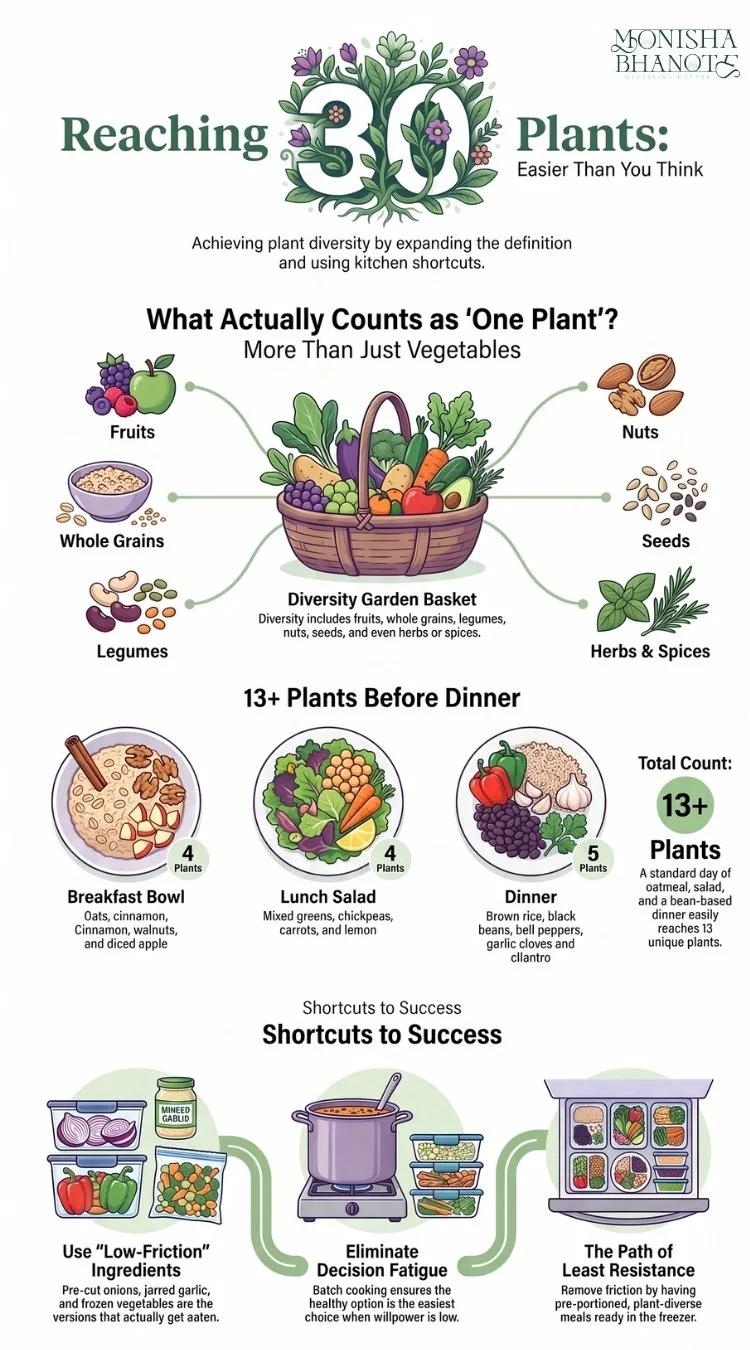
This is where most people undercount themselves into discouragement. A “plant” for diversity purposes includes vegetables and fruit, but also whole grains, legumes, nuts, seeds, and, importantly, herbs and spices. A cinnamon-dusted oatmeal with walnuts and a diced apple is already four or five plants before you've finished breakfast. You are almost certainly closer to thirty than you think.
Try counting one ordinary day the way a researcher would. Coffee doesn't count, but the oats, cinnamon, walnuts, and apple in your breakfast bowl do, that's four. A lunch salad with mixed greens, chickpeas, carrots, and a lemon-olive oil dressing adds four more, plus the herbs if you use them. A dinner of brown rice, black beans, bell peppers, garlic, and a handful of cilantro brings you to roughly thirteen unique plants before dinner is even finished, all from meals that required no special shopping trip and no unfamiliar technique. Multiply that kind of ordinary day across a week and thirty stops looking like a challenge and starts looking like a Tuesday.

Shortcuts Are Not Cheating
During our cooking session, Chef AJ made a comment that I want every one of my patients to hear: she is “all about shortcuts,” not perfection. Pre-cut onions. Pre-shredded cabbage. Garlic from a jar. Ginger from the frozen cube tray. Frozen artichoke hearts instead of the fresh, thistled version most people never learn to trim. None of it is a lesser version of healthy eating. It's the version that actually gets eaten.
There is real physiology behind this permission. When nutritious food requires less friction to prepare, you reach for it more often, and you reach for restaurant food and ultra-processed convenience food less often. The goal was never to prove you can julienne a carrot by hand. The goal is a colon that regularly encounters two dozen different plant fibers. A bag of pre-shredded cabbage gets you there just as well as a knife and twenty minutes you don't have.
The second piece of her philosophy is batch cooking: making a large quantity once, eating some now, and freezing the rest for later. A big pot of sauce, a batch of dressing, a tray of roasted vegetables portioned into containers. This isn't meal-prep culture for its own sake. It's a structural way of making sure the healthy option is also the easy option at 6 p.m. on a Wednesday, which is the only moment that actually determines what you eat.
Think of it as removing decision fatigue from the equation entirely. Willpower is a finite, depletable resource, and most poor food choices don't happen because someone doesn't know better. They happen at the exact moment that person is tired, hungry, and facing a decision they don't have the bandwidth to make well. A freezer with pre-portioned, plant-diverse meals removes that decision. The healthy choice stops requiring willpower and simply becomes the path of least resistance, which is exactly where you want it to sit.
One Meal Can Cover Half Your Week
Here's what struck me most while we cooked together. By the time we'd made a handful of dishes, from a four-ingredient dessert to an oil-free pesto to a vegetable-loaded noodle salad, we had used roughly twenty-five distinct plant ingredients in a single sitting. That's most of the way to a full week's diversity target, in one afternoon, without a single unfamiliar technique.
The mechanisms behind those ingredients are worth understanding, because they explain why diversity, not just “eating vegetables,” is doing the work:
Artichokes are among the richest food sources of inulin, a soluble fiber that resists digestion in the small intestine and travels intact to the colon, where it selectively feeds beneficial bacteria such as Bifidobacteria. Human intervention research on inulin-rich foods has shown measurable increases in these beneficial populations after regular intake.
Garlic and ginger both contain compounds under active research for their influence on gut bacterial composition. Garlic's fructans act as a fermentable fuel source for beneficial microbes, and while some of the strongest composition-shifting data so far comes from animal models rather than large human trials, the fiber-and-fermentation mechanism itself is well established.
Cruciferous vegetables like broccoli and purple cabbage contain glucosinolates, plant compounds that gut bacteria convert into isothiocyanates, including sulforaphane, one of the more extensively studied cancer-protective and anti-inflammatory phytochemicals we know of. Your microbiome doesn't just benefit from cruciferous vegetables. It actively participates in unlocking their benefits.
Cinnamon, meanwhile, does double duty as a flavor shortcut for reducing added sugar and as a metabolic ally in its own right. A meta-analysis of randomized controlled trials found that regular cinnamon intake meaningfully lowered fasting blood glucose in people with type 2 diabetes or prediabetes, alongside improvements in cholesterol markers, an especially relevant benefit for anyone managing blood sugar or metabolic health as they age.
None of these ingredients needed to be exotic or expensive. They needed to be varied.

What You Can Do Today
Keep one “no-prep” shortcut stocked at all times: pre-shredded cabbage, frozen chopped ginger, jarred garlic, or a bag of frozen mixed vegetables. Give yourself permission to use it.
Batch one sauce or dressing this week that you can rotate across three different meals, then freeze what you don't use.
Add one new plant food to your week that you don't currently eat: a bean you've never cooked, a green you've never bought, a spice sitting unused in your cabinet.
Season generously. Herbs and spices count toward your weekly plant total and add flavor complexity without added salt, sugar, or oil.
Stop tracking perfection and start tracking variety. The question isn't “was this meal clean?” It's “did this week include something new?”

A Daily Ritual That Travels With You
Plant diversity is the foundation, and it should always come first. But I'll be honest about where the gaps tend to show up: travel, back-to-back workdays, the weeks when even a shortcut recipe feels like one more task. Ginger is one of the ingredients I lean on most in exactly those moments, both in the kitchen and in Travela Essentials, our travel wellness formula, because of its long-studied role in easing digestive disruption and supporting a gut environment where fiber-fermenting bacteria can do their job well.
I don't want you to expect an immediate feeling from any of this, whether it's a meal or a supplement. The most meaningful changes in gut health are often what you stop noticing: the travel-related digestive disruption that used to derail your trip, the afternoon crash that used to follow a rich meal, the bloating that used to show up like clockwork. Travela Essentials was formulated as a daily ritual that travels with you, one layer in a larger lifestyle strategy that starts, always, with what's on your plate.
#CellCare Reflection

Every cell in your body is downstream of what feeds your gut microbiome, and your microbiome, in turn, is shaped meal by meal by the diversity you offer it. You don't need a perfect kitchen, a rare ingredient list, or a free weekend to change that. You need one new plant this week, a shortcut you stop feeling guilty about, and the willingness to let good enough, repeated often, outperform perfect, attempted rarely.
That is what intentional living actually looks like at the cellular level: not more discipline, but more diversity, chosen a little more often than yesterday.




MAKE A DIFFERENCE BY SHARING THIS ARTICLE WITH OTHERS TO ENCOURAGE WELLBEING ⤵
References:
McDonald, Daniel, Embriette Hyde, Justine W. Debelius, Jamie T. Morton, Antonio Gonzalez, Gail Ackermann, Alexander A. Aksenov, et al. "American Gut: an Open Platform for Citizen Science Microbiome Research." mSystems 3, no. 3 (2018): e00031-18.
Bouranis, John A., Laura M. Beaver, and Emily Ho. "Metabolic Fate of Dietary Glucosinolates and Their Metabolites: A Role for the Microbiome." Frontiers in Nutrition 8 (2021): 748433.
Allen, Robert W., Emmanuelle Schwartzman, William L. Baker, Craig I. Coleman, and Olivia J. Phung. "Cinnamon Use in Type 2 Diabetes: An Updated Systematic Review and Meta-Analysis." Annals of Family Medicine 11, no. 5 (2013): 452–459.
Ramnani, P., E. Gaudier, M. Bingham, P. van Bruggen, K. M. Tuohy, and G. R. Gibson. "Prebiotic Effect of Fruit and Vegetable Shots Containing Jerusalem Artichoke Inulin: A Human Intervention Study." British Journal of Nutrition 104, no. 2 (2010): 233–240.
The information on this website has not been evaluated by the Food & Drug Administration or any other medical body. We do not aim to diagnose, treat, cure or prevent any illness or disease. Information is shared for educational purposes only. You must consult your doctor before acting on any content on this website, especially if you are pregnant, nursing, taking medication, or have a medical condition. Our content may include products that have been independently chosen and recommended by Dr. Monisha Bhanote and our editors. We may earn a small commission if you purchase something mentioned in this article.
YOU MAY ALSO LIKE:



by Dr. Monisha Bhanote
✅ EVIDENCE-INFORMED REVIEWED ARTICLE