
Your Body Was Already Making the Hormone Everyone's Chasing

“What you feed your gut becomes part of the conversation between your microbiome and your cells, shaping resilience from the inside out.”
Elena had done everything right, or so it seemed on paper. Wake at six, thirty minutes on the treadmill, a green smoothie loaded with spinach, banana, and almond milk. Lunch was a salad from the spot near her office, dressed in olive oil and something citrusy. Dinner was salmon, more greens, maybe a small serving of rice. She had cut the processed food, watched her portions, done the things every wellness article told her to do.
And yet by three o'clock most afternoons, she was standing in front of the office vending machine, hand hovering, stomach hollow in a way that breakfast and lunch should have prevented. She wasn't just hungry. She was unsatisfied in a way that felt almost neurological, a static that no amount of "eating clean" seemed to quiet. She told me she felt like her appetite had a mind of its own, disconnected from anything she actually needed.
She'd started to wonder if something was wrong with her. She wasn't. What Elena didn't know is that her body already makes a hormone whose entire job is to answer exactly that kind of static. It's the same hormone behind the injectable drugs dominating headlines and pharmacy shelves right now. Her body wasn't broken. It was underfed in a very specific way, and the fix had less to do with willpower than with a piece of biology almost nobody explains clearly.

The Hormone You Already Make
GLP-1, or glucagon-like peptide-1, gets talked about almost exclusively as a prescription these days, something manufactured and injected. But GLP-1 is not new, and it is not synthetic in origin. It's a hormone your intestines have been producing your entire life, released by specialized cells called L-cells that line the wall of your gut.
Those cells are, in a sense, always listening. They respond to what arrives in the intestine: the sugars, the amino acids, the fats, and importantly, the byproducts of fiber fermentation. When gut bacteria break down fiber in the colon, they produce short-chain fatty acids, most notably acetate, propionate, and butyrate. These molecules bind to receptors on the surface of L-cells known as FFAR2 and FFAR3, and that binding is what triggers GLP-1 release into the bloodstream, where it eventually signals satiety. Propionate appears to be the most effective activator of this particular pathway, at least in the preclinical models where the mechanism was first mapped.
In other words, the hormone at the center of the current cultural conversation about weight and metabolism is one your gut has been quietly synthesizing with every fiber-rich meal you've ever eaten. The question worth asking isn't whether you have access to GLP-1. It's whether you're giving your gut the raw material it needs to make enough of it, and to make it well.

This distinction matters because it reframes the entire conversation. An injectable version of GLP-1 works by flooding the bloodstream with a synthetic analog that binds the same receptors your endogenous hormone does, whether or not your gut is doing any of the underlying fermentation work. It's effective, and for many people it's genuinely useful. But it also means the drug is compensating for a signal that could, in many cases, be strengthened from within. Your L-cells don't need to be replaced. They need to be fed.
Why the Signal Goes Quiet
Here is where it gets interesting, and where Elena's smoothie habit becomes relevant. Fiber's effect on the gut isn't only about how much of it you eat. It's about the physical form it arrives in.
When produce is blended into a smoothie or extracted into juice, its fiber matrix is disrupted before it ever reaches your gut. The seeds are pulverized, the cell walls are broken open, and the sugars that were bound up inside that structure become far more accessible for rapid absorption. Whole fruit tells a different story. In one controlled comparison, researchers gave healthy adults the same fruit, apples and blackberries, either whole or blended, and measured blood glucose afterward. Glucose levels rose significantly higher and faster after the blended fruit than after the whole fruit, largely because the intact fiber and seed structure in the whole fruit slowed how quickly its sugars entered the bloodstream. It's a small study, but it captures something worth sitting with: the same food, in a different physical form, produces a meaningfully different metabolic response.
Dr. Joel Fuhrman, a physician I hosted at my Gut Health and Longevity Summit, described this dynamic in a way that stayed with me. Digestion, he said, isn't only about what you eat, but about how quickly your body has to process it. A meal built around whole, fiber-intact foods releases its nutrients slowly, giving your gut time to do the fermentation work that produces short-chain fatty acids in the first place. Strip that fiber away, whether through juicing, refining, or simply choosing convenience over whole foods, and you remove much of the raw material your L-cells depend on.
This is likely part of what was happening with Elena's smoothie. It wasn't an unhealthy choice on its face. It was a fiber-diminished version of a healthy one, arriving too quickly to fully engage the system that was supposed to tell her brain she'd eaten enough.

The Gut-Brain Conversation
Not all fiber behaves identically once it reaches the colon, and the research on this is still evolving. A recent scoping review pulled together nearly fifty human trials testing individual dietary fibers against GLP-1 concentrations and subjective satiety, and the findings were more nuanced than a simple "eat more fiber" headline would suggest. Fermentable fibers, the kind found in legumes, mushrooms, oats, and certain resistant starches, tended to show the most consistent effects on both hormone levels and how full people actually reported feeling, likely because they enhance intestinal barrier integrity and support the microbial communities that do this fermentation work in the first place.

This is the gut-brain axis in its most literal form. It isn't a metaphor. It's a chemical relay: bacteria fermenting the fiber you ate hours earlier into molecules that bind receptors, trigger hormone release, and quite directly shape whether your brain believes you've had enough to eat. The research is still young, much of it drawn from small, short-term trials, so I'd resist any claim that a single food or supplement reliably flips this system on. What the evidence does support is a pattern, one where fiber diversity and a fermentation-friendly gut are consistently linked to a better-regulated appetite signal, even as the exact dose and timing are still being worked out.
Fiber Diversity and the Long-Lived Gut
There's a longer arc to this story too, one that extends well past any single meal. Research into the microbiomes of people who age well points to a consistent pattern: greater bacterial diversity, a stronger population of beneficial taxa, and a gut lining that holds its integrity over decades rather than degrading into chronic, low-grade inflammation. Fiber intake, alongside regular movement and a supportive microbial ecosystem, is one of the more actionable levers we have for encouraging that kind of long-lived gut profile.
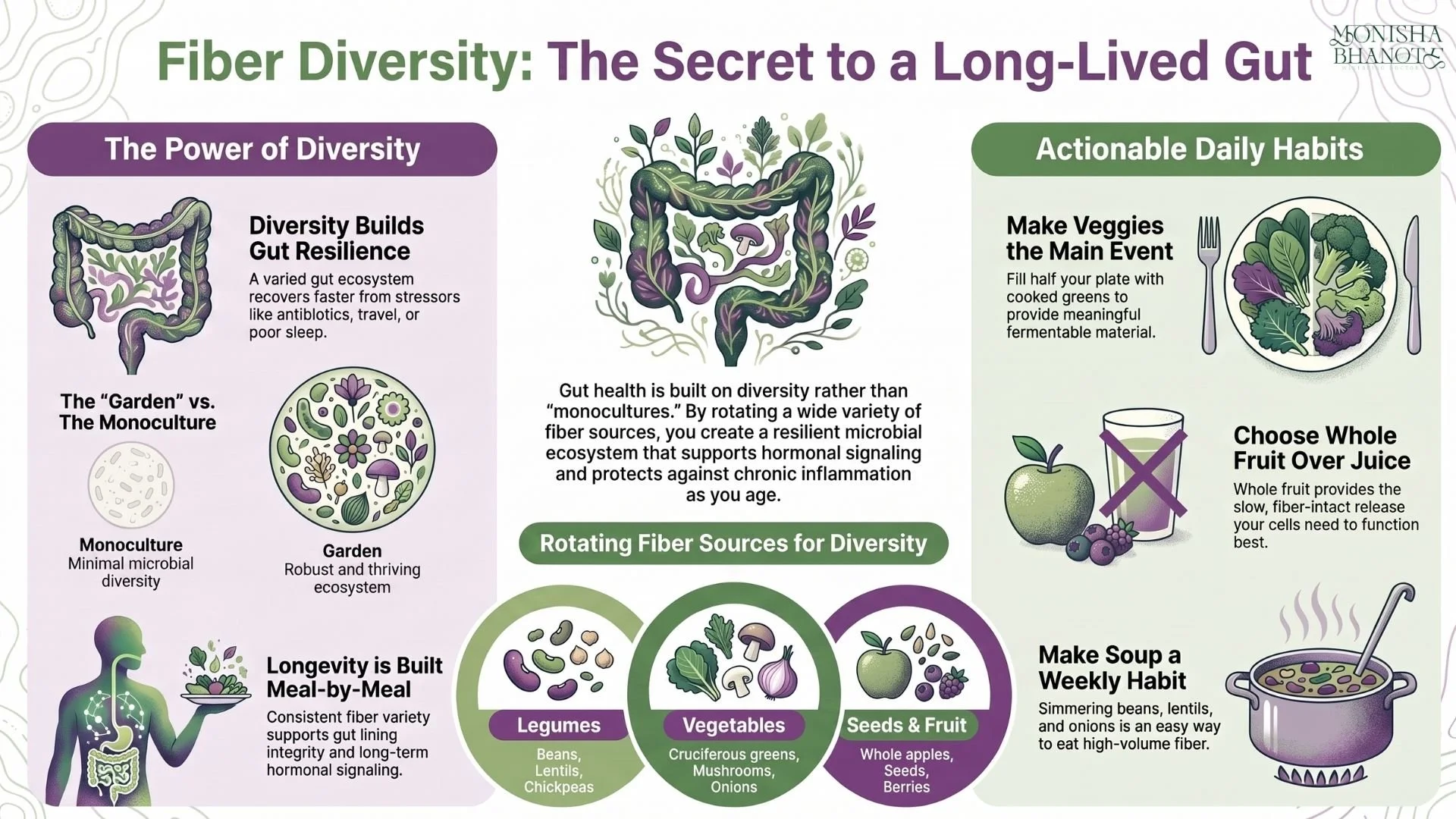
Fiber diversity, not just fiber quantity, appears to be what builds that resilience. A gut fed the same two or three fiber sources every day supports a narrower population of bacteria than one exposed to a rotating cast of legumes, cruciferous vegetables, mushrooms, and seeds. Every different fiber type feeds a slightly different set of microbes, and that variety is part of what keeps the gut-brain communication line, GLP-1 included, functioning well as we age.
Think of it less like a single ingredient you're trying to eat more of, and more like a garden you're trying to keep biodiverse. A monoculture is fragile. A varied ecosystem tends to bend without breaking when something stresses it, a course of antibiotics, a stretch of travel, a season of poor sleep. The same appears to be true of the bacteria living in your colon. Diversity is what gives that ecosystem, and by extension your hormonal signaling, room to recover when life inevitably gets in the way of eating perfectly.

What You Can Do Today
None of this requires an overhaul. It requires a shift in how you think about a handful of daily choices. None of them are dramatic on their own, but stacked together over weeks, they're the kind of pattern that tends to show up in how steady your energy feels by mid-afternoon.
Build one meal a day around a genuinely large volume of vegetables, not a garnish-sized side. A dinner plate that's half cooked greens gives your gut far more fermentable material to work with than a small side salad ever could.
Rotate your fiber sources instead of repeating the same few. A different bean, a different leafy green, a different seed each week feeds a broader range of bacteria than the same salad on repeat.
Choose whole fruit over juice or a blended smoothie most of the time. Smoothies aren't off-limits, but whole fruit gives your gut the slower, fiber-intact release your L-cells respond to best.
Make soup a weekly habit. A pot built from a rotation of lentils, beans, mushrooms, and onions is one of the easiest ways to eat a meaningful volume of fermentable fiber without much effort, and it keeps in the refrigerator for days.
Slow down at meals. Digestion begins with chewing, and thorough chewing gives your gut more time and surface area to do its fermentation work.

A Ritual That Travels With You
As your fiber intake shifts, especially if it's been low for a while, your gut needs a period of adjustment. This is where a daily ritual, rather than a single dramatic change, tends to serve people best. I built Travela Essentials around this idea: a formula that supports the cellular and digestive resilience your body needs while it's recalibrating, whether that recalibration is happening at home or thirty thousand feet in the air. Magnesium bisglycinate supports the kind of steady digestive comfort that makes a higher-fiber diet sustainable rather than something you abandon after an uncomfortable week. CoQ10 and PQQ support the mitochondrial energy your gut lining needs to keep pace with its own rapid cellular turnover. None of this happens overnight, and none of it should be sold to you as if it does. The most meaningful changes are often what you stop noticing: the afternoon crash that no longer shows up, the bloating after travel that quietly stops being a given, the hunger that finally starts making sense again.
#CellCare Reflection
Elena's body was never working against her. It was simply waiting for the raw material it needed to do what it was already designed to do. That's the quiet reframe at the center of #CellCare: so much of what we chase externally, hormones, interventions, quick recalibrations, our cells are already capable of producing when we feed them properly. Longevity isn't built in a single dramatic decision. It's built meal by meal, fiber source by fiber source, in the slow, unglamorous work of giving your gut what it's been asking for all along.
Today, that might look as simple as choosing the whole apple over the juice, or letting a pot of lentil soup simmer while you go about your evening. Small. Repeatable. And exactly the kind of choice your cells will remember.




MAKE A DIFFERENCE BY SHARING THIS ARTICLE WITH OTHERS TO ENCOURAGE WELLBEING ⤵
References:
de Jong, Jelle C. B. C., Milou G. W. Lentjes, Karleen F. Pietersma, Wilrike J. Pasman, Suzan Wopereis, and Femke P. M. Hoevenaars. "Dietary Fibers to Boost Endogenous GLP-1 Secretion and Satiety: A Scoping Review." Frontiers in Endocrinology 17 (2026): 1880500.
Psichas, A., M. L. Sleeth, K. G. Murphy, L. Brooks, G. A. Bewick, A. C. Hanyaloglu, et al. "The Short Chain Fatty Acid Propionate Stimulates GLP-1 and PYY Secretion via Free Fatty Acid Receptor 2 in Rodents." International Journal of Obesity 39 (2015): 424–29.
Wang, Yuxin, Jiaxin Liu, Kristin Verbeke, Naschla Gasaly Retamal, Renate Akkerman, Paul de Vos, et al. "Dietary Fiber and Glucagon-Like Peptide-1 Receptor Agonists in Obesity Management: Converging Mechanisms, Interactions, and Strategies for Durable Weight Control." Advances in Nutrition 17, no. 6 (2026): 100647.
Crummett, Lisa T., and Riley J. Grosso. "Postprandial Glycemic Response to Whole Fruit versus Blended Fruit in Healthy, Young Adults." Nutrients 14, no. 21 (2022): 4565.
Tseng, Ching-Hung, and Chun-Ying Wu. "From Dysbiosis to Longevity: A Narrative Review into the Gut Microbiome's Impact on Aging." Journal of Biomedical Science 32, no. 1 (2025): article 93. x.
The information on this website has not been evaluated by the Food & Drug Administration or any other medical body. We do not aim to diagnose, treat, cure or prevent any illness or disease. Information is shared for educational purposes only. You must consult your doctor before acting on any content on this website, especially if you are pregnant, nursing, taking medication, or have a medical condition. Our content may include products that have been independently chosen and recommended by Dr. Monisha Bhanote and our editors. We may earn a small commission if you purchase something mentioned in this article.
YOU MAY ALSO LIKE:





by Dr. Monisha Bhanote
✅ EVIDENCE-INFORMED REVIEWED ARTICLE