
The July Gut Reset: A Cellular Guide to Feeling Lighter This Summer

“The way your gut feels tomorrow is shaped by the choices that nourish it today.”
There is a particular quality of light that only exists in the last week of July. It falls across the bedroom floor just as you reach for your swimsuit, and in that brief glance in the mirror, you notice it: a little more fullness through the middle, a little less ease in your body than you felt back in May. Maybe it was the boardwalk gelato. Maybe it was the second glass of rosé, or the long dinners that drifted well past sunset. Or maybe it was simply summer doing what summer does best — loosening routines, extending evenings, inviting a little more indulgence into the day.
Before that moment becomes a referendum on your discipline, let’s pause. What you are feeling is rarely a failure of willpower. More often, it is physiology. Bloating is a biological conversation — a response from your gut, your microbiome, and the cells that line your digestive tract when meal timing shifts, hydration slips, sugar rises, and the nervous system spends too many days in go-mode. Your body is not betraying you. It is reporting back.
A summer gut reset, done well, is not about punishment, detox teas, or the false promise of waking up flatter by Monday. It is about restoring rhythm to an ecosystem. Your gut microbiome — the vast community of bacteria and other microbes living primarily in your intestines — is exquisitely responsive to the season you are living in. Long travel days, late meals, more cocktails, richer foods, less sleep, and hot weather all place pressure on that ecosystem. By late July, many people have shifted toward a microbial terrain that produces more gas, more water retention, and more low-grade inflammation. The visible result is the bloat you notice in the mirror. The real story is unfolding at the cellular level, and it is one your body is entirely capable of rewriting.

The Invisible Architecture of Bloating
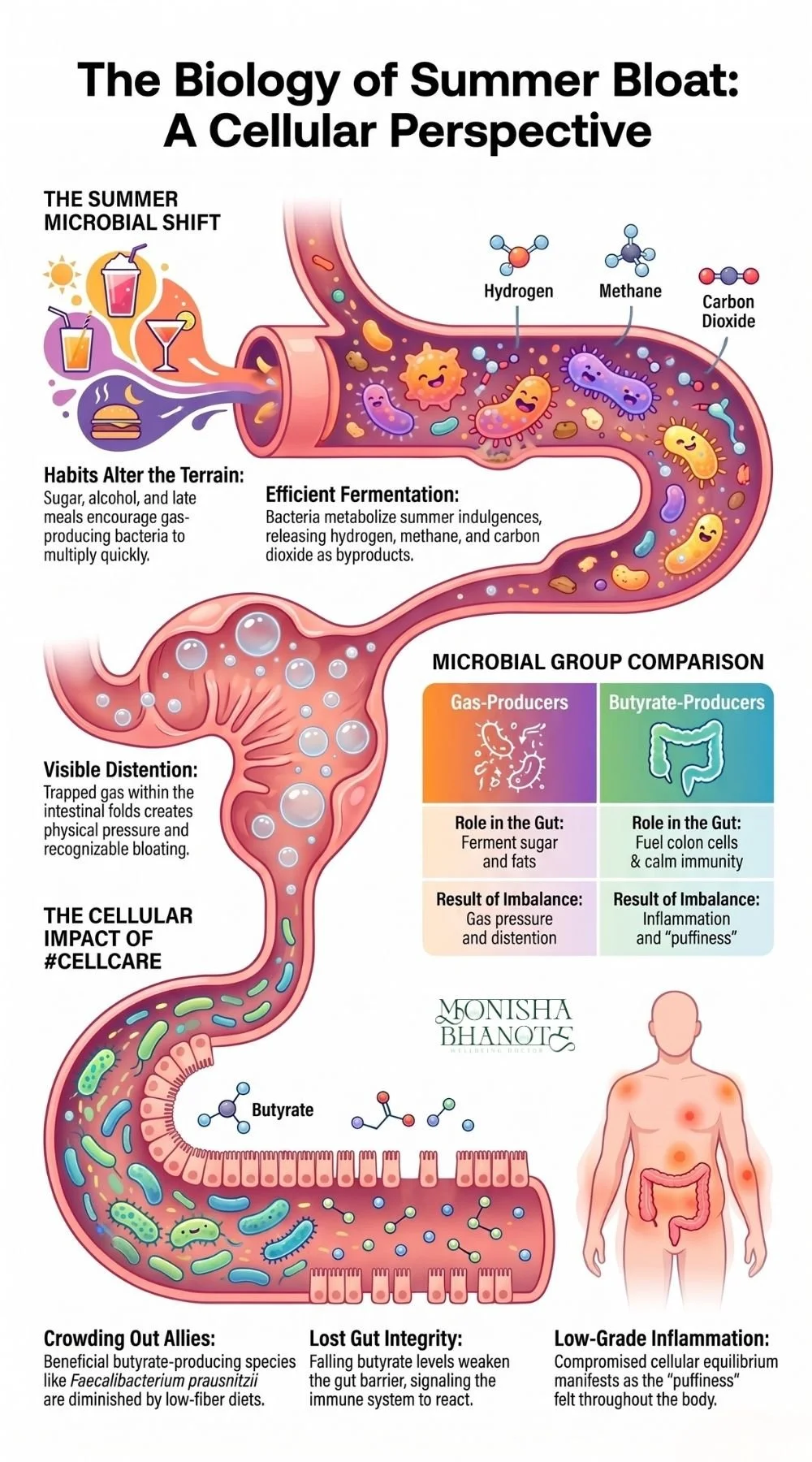
To understand why your swimsuit fits differently today than it did eight weeks ago, we have to look past the plate and into the microbial landscape doing the actual work of digestion. Bloating is rarely about the volume of food eaten five minutes ago; it is almost always about which bacteria are fermenting that food, and how. Your gut is a competitive environment where different microbial species vie for territory. When the diet shifts toward higher sugar and richer fats — the hallmarks of summer indulgence — certain gas-producing bacteria multiply quickly. These organisms are efficient fermenters, producing hydrogen, methane, or carbon dioxide as a natural byproduct of their metabolism. When that gas becomes trapped within the folds of the small or large intestine, it creates the physical pressure we recognize as visible distention and discomfort.
At the same time, the bacteria we think of as cellular allies — particularly the butyrate producers — often get crowded out. Species such as Faecalibacterium prausnitzii and Roseburia help generate butyrate, a short-chain fatty acid that serves as the preferred fuel source for the cells lining your colon. Butyrate is not simply fuel; it is a signaling molecule, instructing the gut barrier to stay intact and the immune system to stay calm. When beneficial microbes are underfed — because the diet has drifted away from fiber-rich plants and toward sugar, alcohol, and convenience foods — butyrate production tends to fall. The result can be a more permeable gut lining, more inflammatory signaling, and that familiar sense of puffiness that seems to settle in everywhere at once.
This is the essence of #CellCare. Your symptoms are rarely random. They are often the outward expression of a cellular environment that has, temporarily, lost some of its equilibrium — and equilibrium, unlike willpower, can be rebuilt.
What the Research Actually Shows
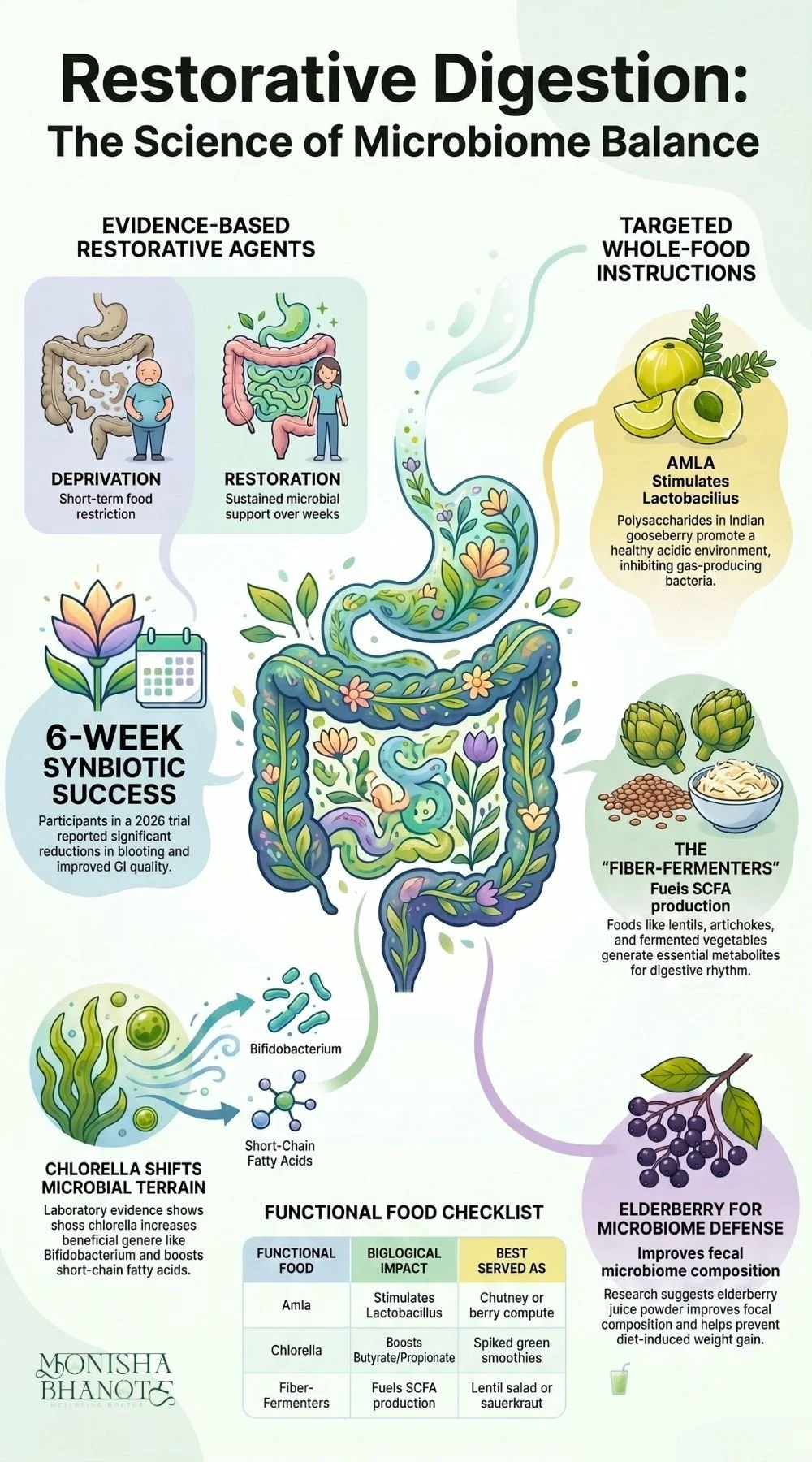
We are fortunate to be practicing at a moment when the research is catching up to what clinicians have long observed. In a large randomized, double-blind, placebo-controlled trial published in Nutrients in early 2026, researchers followed 350 otherwise healthy adults with self-reported bloating and indigestion over a six-week period. Participants who took a daily multi-species synbiotic experienced meaningfully greater improvement in gastrointestinal quality of life, along with reductions in bloating, gas, and abdominal discomfort, compared with placebo. It remains one of the largest trials of its kind conducted in a non-patient population, and its message is refreshingly undramatic: relief does not require deprivation. It requires restoring a more favorable microbial balance, sustained over weeks rather than days.
Separately, laboratory research using a controlled, pH-regulated gut fermentation model has shown that chlorella pyrenoidosa, the same nutrient-dense green algae popular in smoothies, can meaningfully shift the microbial terrain, increasing beneficial genera such as Faecalibacterium and Bifidobacterium while boosting production of short-chain fatty acids, including butyrate and propionate. This is laboratory evidence rather than a human clinical trial, but it offers a compelling, mechanistic case for real-food expressions of chlorella, a chlorella-spiked green smoothie blended with cucumber, mint, and kiwi after a weekend of heavier meals is a reasonable, low-risk way to put that science into practice.
Why Amla and the Fiber-Fermenters Matter Now
If you are feeling especially heavy this week, the deeper issue may be less about calories and more about fermentation. A 2025 study published in Frontiers in Nutrition examined the polysaccharides extracted from amla, also known as Indian gooseberry, or Phyllanthus emblica, and found that they selectively stimulated the growth of Lactobacillus species in laboratory fermentation models, alongside increased lactic acid production. That matters because Lactobacillus helps maintain a healthy acidic environment in the gut, making it a less hospitable terrain for the gas-producing overgrowth patterns that can leave you feeling tight and swollen.
Rather than treating amla as something abstract or medicinal, think of it as a food with a specific physiological purpose. A bowl of amla berry compote alongside breakfast, a tart amla chutney served with grilled vegetables, or a cooling amla preparation folded into summer fruit can all become part of a more intelligent seasonal table. The point is not perfection — it is giving your microbiome a different, more supportive set of instructions.
The same principle holds for what I call the fiber-fermenters: the foods that feed beneficial microbes and help them generate the metabolites you actually want more of. Fermented vegetables, lentils, beans, oats, artichokes, berries, bitter greens, chia, flax, and cooked-and-cooled potatoes all support bacteria that produce short-chain fatty acids and reinforce digestive rhythm. These are not glamorous fixes, which is precisely why they work so reliably. A forkful of sauerkraut with lunch, a salad layered with arugula and white beans, roasted asparagus with dinner, or full-fat yogurt topped with berries and a thread of elderberry syrup can do more for the microbiome than another round of restriction ever will.
On elderberry specifically: research in rodent models published in the Journal of Agricultural and Food Chemistry in 2024 found that elderberry juice powder helped prevent diet-induced weight gain and improved the composition of the fecal microbiome. Human trials on elderberry and bloating specifically are still emerging, but the existing evidence is consistent enough to make a spoonful of elderberry syrup drizzled over unsweetened yogurt or folded into chia pudding a sensible, low-stakes addition — not a miracle cure, simply one more useful instruction sent to your microbes.

Designing Your Digestive Rhythm
Give the Gut Its Housekeeping Window
To truly shift the needle before your next beach weekend or dinner reservation, we have to move from theory into rhythm. The most useful place to begin is a 12-hour overnight fast. This is not about eating less — it is about allowing the migrating motor complex, or MMC, to do its work. The MMC is a series of cleansing contractions that move through the small intestine between meals, almost like a housekeeping cycle for the gut. When you snack late into the evening and start eating again first thing in the morning, that cycle gets interrupted. A 2024 systematic review published in Nutrition Reviews, examining both human and animal studies, found that time-restricted eating patterns were consistently associated with favorable shifts in gut microbial diversity and composition. When you close the kitchen at 8 p.m. and eat breakfast at 8 a.m., you give digestion the space it needs to reset.
Hydrate Like the Gut Barrier Depends On It — Because It Does
Hydration matters just as much in summer. Even mild dehydration can change how the gut feels and functions. The mucus layer that protects the intestinal lining and houses beneficial microbes is largely water, so when you are under-hydrated after sun, travel, or alcohol, the gut becomes a less hospitable environment. If you tend to feel puffy after a hot day, your cells may simply be asking for more fluid, more minerals, and more consistency. Think beyond plain water if you need to: sparkling water with citrus, cucumber-mint water, chilled herbal tea, or mineral-rich broths can all help restore that internal terrain.
Let Movement Do the Digesting
Movement is one of the most underrated digestive tools available to us. A ten-minute walk after your largest meal can improve motility — the movement of food and gas through the digestive tract. You do not need a punishing workout; intense exercise right after eating can actually make digestion feel worse. What the body responds to beautifully is a gentle post-meal stroll, whether around the block, along the beach, or through the neighborhood after dinner. It is one of the simplest ways to reduce stagnation.
What You Can Do Today

Close the kitchen 12 hours before breakfast, and let the migrating motor complex do its quiet, nightly work.
Take a slow, ten-minute walk after your largest meal of the day.
Start one meal a day with a bitter green — arugula, radicchio, endive, or dandelion — to stimulate digestive secretions.
Add one fiber-fermenter and one fermented food to your plate daily: lentils, chia, berries, artichokes, sauerkraut, or full-fat yogurt.
Hydrate deliberately, especially after sun, travel, or alcohol — cucumber-mint water and mineral-rich broths count.
Fold in amla, chlorella, or elderberry as food, not medicine — a compote, a smoothie, a spoonful over yogurt.
If you use Travela Essentials, think of it simply as a companion to this same rhythm, a daily ritual that travels with you, not a replacement for it.

Returning to the Mirror with Agency
Let’s return to that scene in front of the mirror, the late-July light still pooling across the room. The swimsuit is still there, and so are you. But perhaps the story has changed. Instead of seeing a body that has failed you, you can recognize a highly responsive cellular system asking for rhythm, hydration, fiber, and a little less chaos. Bloating is not an identity. It is information — and information, unlike judgment, can always be acted on.
As the month draws to a close, consider this your invitation to step outside the all-or-nothing wellness script. No dramatic cleanse, no punishment — just a few well-chosen corrections: a 12-hour overnight fast, a walk after dinner, more water than wine, bitter greens before the meal, fermented vegetables on the plate, and foods like amla, elderberry, and chlorella woven into a vibrant summer table. Research suggests the microbiome can begin shifting within days. You are not trying to become a different person by August. You are simply giving your gut better conditions — and the body tends to respond faster than we expect.
#CellCare Reflection

This is how we practice #CellCare in real life. We listen to the body instead of arguing with it. We support the gut barrier instead of punishing it. We feed the microbes that help us feel clear and light, and we remember that wellness is not built in extremes — it is built in patterns, repeated gently, over time. Every cell in your gut lining is renewed in a matter of days; the environment you offer it today is already shaping the one you’ll feel next week. So put on the swimsuit. Walk toward the water.
Let your body be a place you live in, not a problem you are always solving.



MAKE A DIFFERENCE BY SHARING THIS ARTICLE WITH OTHERS TO ENCOURAGE WELLBEING ⤵
The information on this website has not been evaluated by the Food & Drug Administration or any other medical body. We do not aim to diagnose, treat, cure or prevent any illness or disease. Information is shared for educational purposes only. You must consult your doctor before acting on any content on this website, especially if you are pregnant, nursing, taking medication, or have a medical condition. Our content may include products that have been independently chosen and recommended by Dr. Monisha Bhanote and our editors. We may earn a small commission if you purchase something mentioned in this article.
YOU MAY ALSO LIKE:






by Dr. Monisha Bhanote
✅ EVIDENCE-INFORMED REVIEWED ARTICLE