
The Quiet War Inside You: A Physician's Guide to Cellular Protection

“Cellular resilience is built quietly, through the daily choices that help your body repair, adapt, and protect itself over time.”
Elena is forty-four, and by any conventional measure, she is doing everything right. She meal-preps on Sundays, favors salmon and greens over takeout, laces up for a run three mornings a week, and wears a sleep tracker that consistently reports “good” nights. So when her annual bloodwork comes back with a mildly elevated inflammatory marker and a fasting glucose that has crept upward despite no change in her weight, she is genuinely confused. “But I'm doing everything right,” she tells her doctor, and she means it. Nothing about her daily life looks like the picture of risk she has in her head.
Elena's experience is not a failure of willpower or discipline. It is a reflection of how chronic disease actually begins: not with a single dramatic event, but with a slow, invisible accumulation of cellular stress that predates any lab value, any symptom, any diagnosis. Long before disease has a name, it has a mechanism. And increasingly, physicians and researchers agree that mechanism starts inside the cell, in the constant, largely silent balance between oxidative stress and the body's capacity to counter it.
Understanding that balance, and learning to protect it deliberately, may be the single most important shift in how we think about prevention. This is not about fear. It is about clarity: knowing what is actually happening beneath the surface so you can meet it with intention, starting with the choices you already make every day.

The Invisible War: What Oxidative Stress Actually Is
Every cell in your body runs on a continuous chemical exchange. As mitochondria convert oxygen and nutrients into usable energy, they generate reactive oxygen species, or ROS, as a natural byproduct. In modest amounts, these molecules are not villains; they are messengers, helping regulate immune defense, cell signaling, and even the adaptive responses that make exercise and other healthy stressors beneficial. The body counters this normal production with an elaborate internal antioxidant defense system, and under ordinary circumstances, the two forces stay in equilibrium.
Oxidative stress is what happens when that equilibrium tips. Reactive oxygen species accumulate faster than the body's antioxidant defenses can neutralize them, and the excess begins to damage the structures that keep your cells functioning: lipid membranes, structural proteins, and DNA itself. Researchers now describe this imbalance not as a peripheral concern but as a central driver of disease, noting that oxidative stress arising from disrupted redox balance underlies a strikingly broad range of chronic conditions.
What has changed is not the existence of oxidative stress. Cells have generated and managed free radicals for as long as life has used oxygen. What has changed is the modern load: chronic psychological stress, disrupted circadian rhythms, processed food, environmental pollutants, and sedentary stretches layered day after day, often with little conscious recovery in between. It is this cumulative, largely invisible burden that makes cellular protection more relevant now than at almost any point in medical history.
From Cellular Stress to Chronic Disease
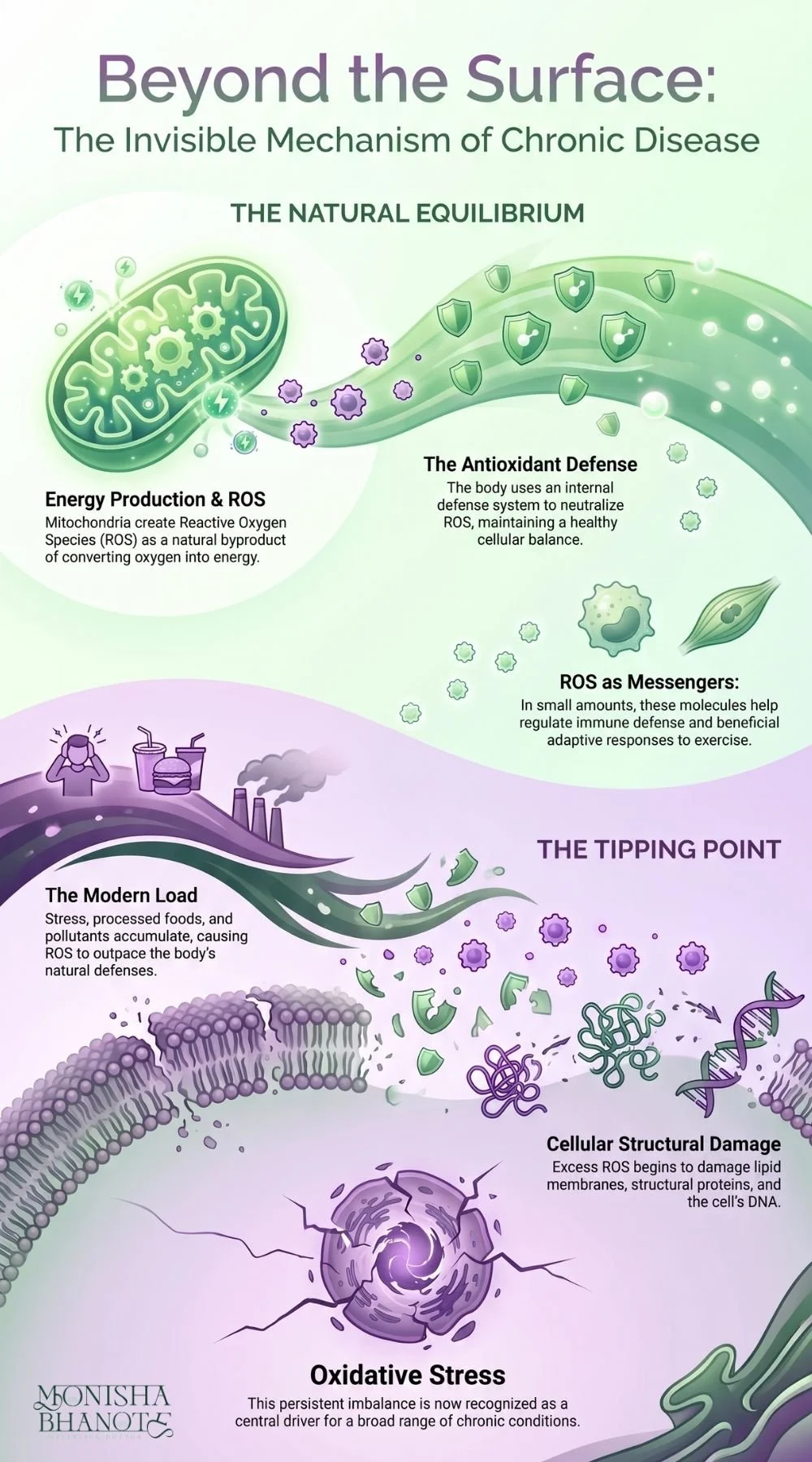
The connection between oxidative stress and chronic illness is not theoretical. Across cardiovascular disease, metabolic dysfunction, and neurodegenerative conditions, oxidative damage to proteins, lipids, and nucleic acids has been consistently identified as a mechanistic thread. In neurodegenerative disease specifically, reactive oxygen species that outpace the brain's antioxidant capacity contribute to neuroinflammation and progressive neuronal dysfunction, a pattern researchers describe across Alzheimer's, Parkinson's, and related conditions.
There is a second, closely related piece of this story: cellular senescence. As cells sustain oxidative damage over years and decades, some stop dividing altogether and enter a senescent state. Rather than dying off quietly, these senescent cells linger and secrete inflammatory signaling molecules, a phenomenon researchers call the senescence-associated secretory phenotype. The accumulation of these cells, and the low-grade, persistent inflammation they generate, is now recognized as a major contributor to cardiovascular aging, with recent reviews describing cellular senescence and this chronic inflammatory state, known as inflammaging, as tightly interlinked processes that compound with age.
This reframes what chronic disease actually is. It is rarely a single event. It is usually the visible endpoint of years of unaddressed cellular stress, quietly compounding beneath a person's awareness, the way Elena's mildly elevated markers reflected something that had been building long before her physical. The encouraging counterpoint is that because this process is cumulative, it is also interruptible. Every choice that reduces oxidative burden or strengthens antioxidant defense is a small deposit toward a different trajectory.
Lifestyle First: What Actually Moves the Needle
If oxidative stress accumulates through daily inputs, then daily inputs are also where meaningful protection begins. Before any conversation about targeted nutrients, the foundation is lifestyle: what you eat, how you move, how you sleep, and how you metabolize stress. None of this is about restriction or intensity. It is about consistency, the kind that compounds quietly in your favor the same way oxidative stress compounds against you.
Food as Cellular Defense
Color on your plate is not just an aesthetic; it is a biochemical strategy. Polyphenols, the plant compounds responsible for the deep hues in berries, leafy greens, olive oil, and tea, are consistently linked in the research to protection against oxidative stress-driven chronic disease. A recent review in Natural Product Research describes polyphenols as potent protectors against noncommunicable disease, noting their capacity to neutralize free radicals directly while also modulating inflammatory gene expression and supporting a healthier gut microbiome. This is one of the more elegant findings in nutritional science: the same foods that taste vivid are often doing quiet, mechanistic work at the cellular level.
In practice, this does not require a rigid protocol. Aim for variety and color across the week rather than perfection on any single day: berries at breakfast, a rotation of leafy greens, cruciferous vegetables a few times a week, and extra-virgin olive oil as your primary fat. The goal is cumulative exposure to plant compounds over time, not any one “superfood” moment.

Movement as Medicine
Here is where the story of oxidative stress becomes genuinely counterintuitive: exercise itself generates reactive oxygen species. A hard run or a strength session creates a real, measurable burst of oxidative activity in working muscle. Rather than being harmful, this acute stress is precisely what triggers the body's protective adaptation. Researchers call this mitohormesis: a controlled, beneficial dose of oxidative stress that stimulates the growth of new, healthier mitochondria and strengthens the body's own antioxidant defenses, particularly through activation of the Nrf2 signaling pathway. A comprehensive review on exercise-induced mitohormesis describes this as a central mechanism protecting skeletal muscle from age-related decline and extending functional healthspan.

The practical takeaway is reassuring rather than demanding: regular, moderate movement, most days of the week, does more to build cellular resilience than any single intense effort. Walking briskly, strength training twice weekly, and finding movement you will actually sustain outperforms sporadic extremes.
Sleep, the Nightly Repair Shift
Sleep is when much of the body's redox housekeeping happens. A 2024 review in Cellular and Molecular Neurobiology describes a bidirectional relationship between sleep and oxidative stress: wakefulness itself represents an oxidative challenge, particularly for the brain, and sleep appears to play a genuine protective role in clearing the reactive byproducts that accumulate during the day, in part through the activity of the same Nrf2 pathway engaged by exercise. Chronically shortchanging sleep does not just leave you tired; it narrows the window your cells have to recalibrate.
Protecting this window does not require perfection, just consistency: a regular wake time, a dark and cool bedroom, and a wind-down period free of screens in the final half hour before bed are simple, high-leverage habits that give your cells the recovery time this research points to.
Calming the Nervous System
Chronic psychological stress is not “all in your head” in any dismissive sense; it is a measurable cellular event. A 2025 clinical study in the Journal of Cosmetic Dermatology found that cortisol exposure produced a dose-dependent increase in oxidative DNA damage in human skin cells, alongside disrupted skin barrier protein synthesis, directly linking chronic stress hormone exposure to cellular-level damage. This is a vivid, visible example of a pattern researchers believe is occurring more broadly across tissues under sustained psychological stress.
Nervous system regulation, then, is not a soft add-on to cellular health; it is a direct lever. A few minutes of diaphragmatic breathing, a short walk without your phone, or a consistent wind-down ritual in the evening are not indulgences. They are measurable interventions in your own biochemistry.
Where Targeted Nutrients Reinforce the Work

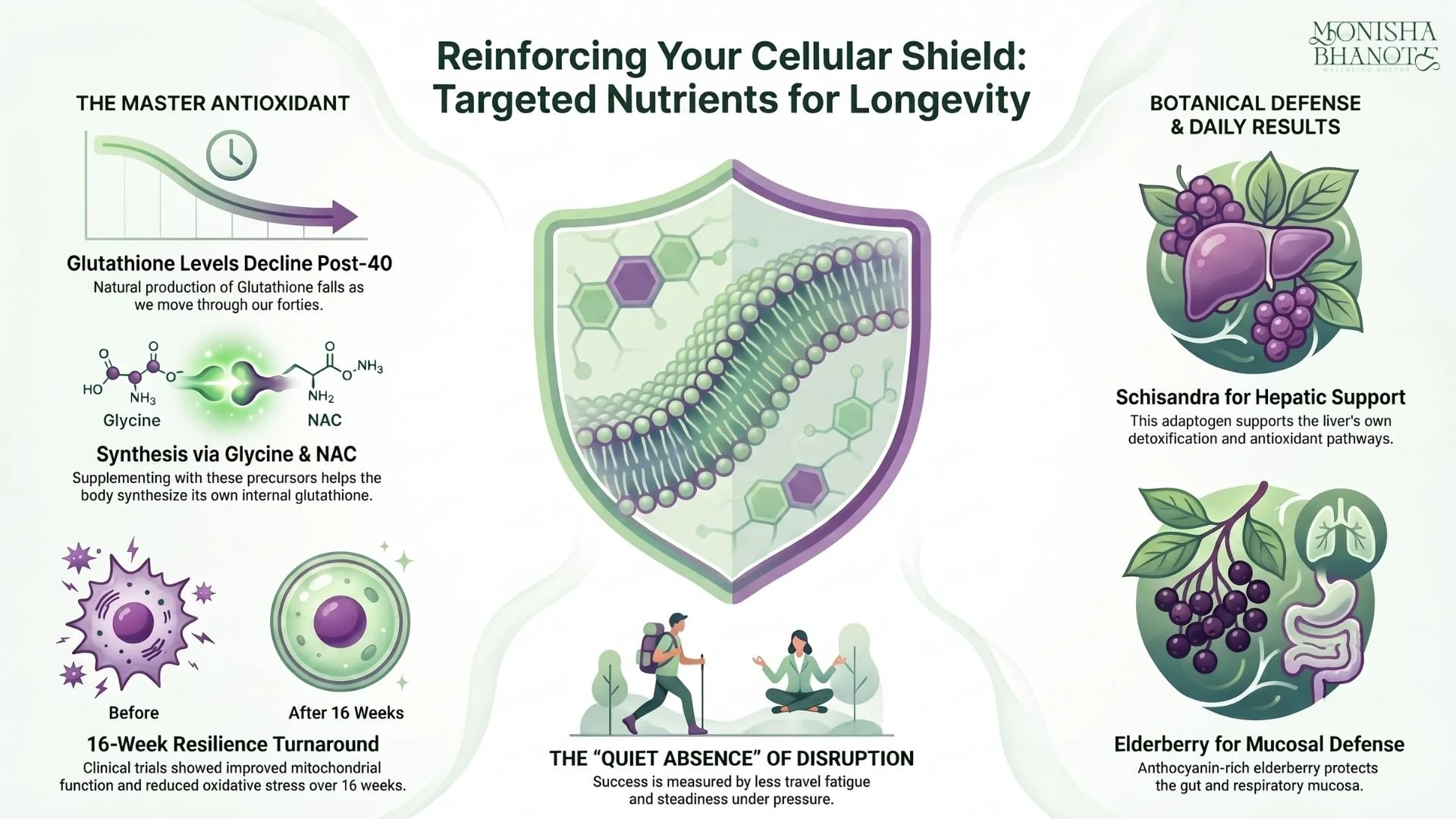
Lifestyle builds the foundation, but certain nutrients can meaningfully reinforce your body's own antioxidant machinery, particularly as endogenous production naturally declines with age. Glutathione, often called the master antioxidant, is synthesized in nearly every cell but its levels fall as we move through our forties and beyond. A randomized clinical trial published in the Journals of Gerontology found that supplementing older adults with glycine and N-acetylcysteine, precursors the body uses to synthesize its own glutathione, corrected age-related glutathione deficiency and improved markers of oxidative stress, mitochondrial function, and several other hallmarks of aging over sixteen weeks.
Botanicals play a complementary role. Schisandra chinensis has a long history of traditional use for hepatic and adaptogenic support, and modern research has begun to clarify how it may support the liver's own detoxification and antioxidant pathways. Elderberry, rich in anthocyanins, contributes to the body's outer layer of defense at the gut and respiratory mucosa. I explored the specific mechanisms behind all three of these, glutathione, Schisandra, and elderberry, in depth in The Cellular Shield, for readers who want to go further into that science.
This is the thinking behind the formulation of Travela Essentials: not as a substitute for the lifestyle foundation above, but as reinforcement for it, a daily ritual that travels with you. The most meaningful changes from supporting your cells this way are often the ones you stop noticing: less travel fatigue, less digestive disruption after a stressful week, a little more steadiness under pressure. That quiet absence of disruption is, in its own way, the clearest sign that something is working.

What You Can Do Today
You do not need to overhaul your life to begin protecting your cells. A few realistic starting points:
Add one more color to your plate at your next meal, a handful of berries, a leafy green, or a colorful vegetable you don't usually reach for.
Take a 20-minute walk today, ideally outdoors, as a starting dose of the protective stress your mitochondria respond to.
Set a consistent wake time this week, even on weekends, rather than focusing solely on hours slept.
Build in one deliberate pause today, a few minutes of slow breathing or a walk without your phone, before stress has a chance to compound.
If you take a supplement, look for one that reinforces these foundations rather than replacing them.
#CellCare Reflection
You will likely never feel oxidative stress directly. There is no ache, no obvious signal, no single moment that tells you your cells are under pressure. That is precisely what makes it worth understanding: the war is quiet, and so is the protection. Every plate of colorful food, every walk, every full night of sleep, every deliberate pause in a stressful day is a small, invisible deposit into your cellular resilience. Longevity is rarely built in dramatic moments. It is built in the accumulation of small, intentional choices, the same way disease accumulates in their absence.
Today, you get to choose which direction that accumulation moves.


MAKE A DIFFERENCE BY SHARING THIS ARTICLE WITH OTHERS TO ENCOURAGE WELLBEING ⤵
References:
Chong, Zhao Zhong, and Nizar Souayah. “Oxidative Stress: Pathological Driver in Chronic Neurodegenerative Diseases.” Antioxidants 14, no. 6 (2025): 696.
Davinelli, Sergio, Alessandro Medoro, Rosa Savino, and Giovanni Scapagnini. “Sleep and Oxidative Stress: Current Perspectives on the Role of NRF2.” Cellular and Molecular Neurobiology 44, no. 1 (2024): 52.
Kumar, Premranjan, Chun Liu, James Suliburk, Jean W. Hsu, Raja Muthupillai, Farook Jahoor, Charles G. Minard, George E. Taffet, and Rajagopal V. Sekhar. “Supplementing Glycine and N-Acetylcysteine (GlyNAC) in Older Adults Improves Glutathione Deficiency, Oxidative Stress, Mitochondrial Dysfunction, Inflammation, Physical Function, and Aging Hallmarks: A Randomized Clinical Trial.” Journals of Gerontology: Series A 78, no. 1 (2023): 75–89
Musci, Robert V., Karyn L. Hamilton, and Melissa A. Linden. “Exercise-Induced Mitohormesis for the Maintenance of Skeletal Muscle and Healthspan Extension.” Sports 7, no. 7 (2019): 170.
Pujos, Muriel, Cécile Chamayou-Robert, Marine Parat, Magali Bonnet, Sandra Couret, Alessia Robiolo, and Olivier Doucet. “Impact of Chronic Moderate Psychological Stress on Skin Aging: Exploratory Clinical Study and Cellular Functioning.” Journal of Cosmetic Dermatology 24, no. 1 (2025): e16634.
Shanmugam, Geetha. “Polyphenols: Potent Protectors Against Chronic Diseases.” Natural Product Research 39, no. 23 (2025): 6941–6943.
Zanders, Lukas, Denada Arifaj, Julian U. G. Wagner, and Stefanie Dimmeler. “Cellular Senescence, Inflammaging and Cardiovascular Disease.” Immunological Reviews 337, no. 1 (2026): e70084.
The information on this website has not been evaluated by the Food & Drug Administration or any other medical body. We do not aim to diagnose, treat, cure or prevent any illness or disease. Information is shared for educational purposes only. You must consult your doctor before acting on any content on this website, especially if you are pregnant, nursing, taking medication, or have a medical condition. Our content may include products that have been independently chosen and recommended by Dr. Monisha Bhanote and our editors. We may earn a small commission if you purchase something mentioned in this article.
YOU MAY ALSO LIKE:




by Dr. Monisha Bhanote
✅ EVIDENCE-INFORMED REVIEWED ARTICLE