
Which Wolf Are You Feeding? The Cellular Science of Gut-Brain Health

“A diverse plate cultivates a diverse microbiome, creating the foundation for clearer thinking, steadier energy, and lasting cellular resilience.”
It is 3:14 in the afternoon, and Priya has read the same paragraph of a client deck four times without absorbing a word of it. Her lunch, a very correct-looking grain bowl, sits half- finished on her desk. She did everything she was supposed to do this morning: the green smoothie, the twenty-minute walk, the eight hours of sleep she is fairly proud of. And yet here she is, foggy, faintly irritable, reaching for the second coffee she promised herself she would not have.
She has mentioned this to her doctor before. Bloodwork comes back normal. She is told, essentially, that she is fine. But fine is not what this feels like at 3pm on a Tuesday, and Priya has started to wonder if there is a version of this conversation that no one has had with her yet.
There is an old story, told in different forms across Cherokee tradition, about a grandfather explaining to his grandson that two wolves are fighting inside every person. One is fear, resentment, and despair. The other is patience, generosity, and joy. The grandson asks which wolf wins. The grandfather answers: the one you feed.
I think about this story constantly in clinical practice, because it turns out to be almost literally true of the ecosystem living in your gut right now.

The Forty Trillion Organisms Deciding How You Feel
Your gut is home to roughly forty trillion microorganisms, a community so dense and so metabolically active that researchers increasingly describe it as an organ in its own right. These microbes are not passive tenants. They manufacture compounds your brain depends on. Enterochromaffin cells lining your gut are responsible for producing the large majority, somewhere in the range of ninety to ninety-five percent, of the serotonin found anywhere in your body, a process the gut microbiome directly regulates. Related microbial pathways influence the availability of dopamine and GABA, the same neurochemicals that shape mood, motivation, and your baseline capacity for calm.
This is why "it's all in your head" has never been a satisfying answer for how someone actually feels. A meaningful share of the biochemistry behind mood is not manufactured in the head at all. It is manufactured a few feet lower, by an ecosystem that is, quite directly, a function of what you have been eating.
Here is where the wolf metaphor becomes useful rather than just poetic. The microbes that tend to dominate a gut fed on ultra-processed food, refined starch, and added sugar are associated with a thinner, more permeable gut lining and a more inflammatory internal environment. When that lining becomes more permeable, bacterial byproducts and inflammatory signals move more freely into circulation. Chronic low-grade inflammation of this kind is now understood as a significant contributor to depressive symptoms, not merely a bystander to them. The microbes that tend to dominate a gut fed on fiber-rich, whole plant foods do something close to the opposite: they produce short-chain fatty acids, compounds like butyrate that calm inflammation, strengthen the gut lining, and appear to support the nervous system directly.
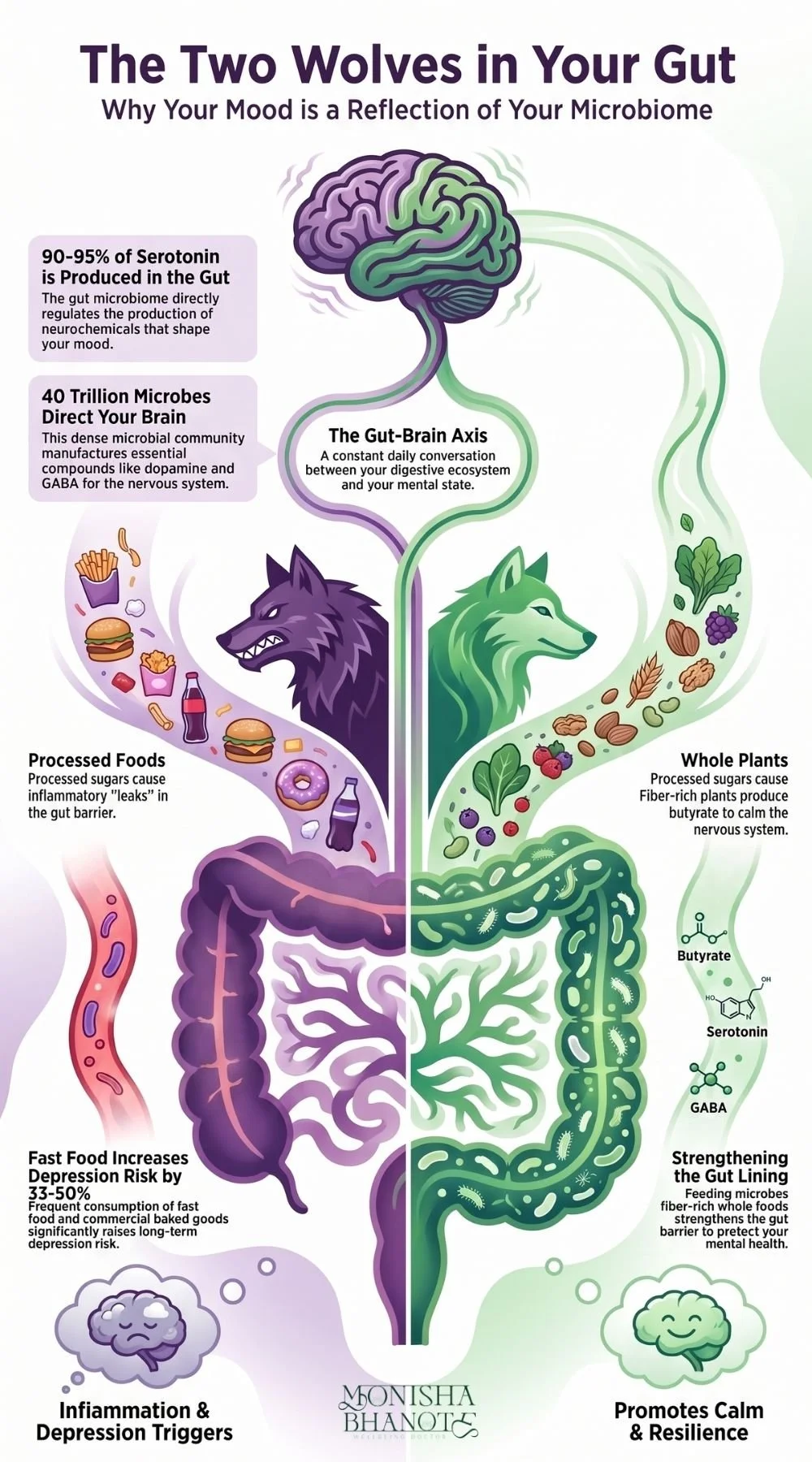
The research connecting this to real-world mood outcomes has become difficult to dismiss as coincidence. A large prospective study published in Public Health Nutrition followed nearly nine thousand adults with no prior depression diagnosis for an average of six years. Those with the highest fast-food consumption had a significantly greater risk of developing depression than those with the lowest, roughly a third higher in the most conservative comparison and closer to half again as high when combined with an earlier cohort from the same research group, and the risk rose in step with the amount consumed. Regular consumption of commercial baked goods carried a similarly elevated risk. Nobody is suggesting fast food alone explains a depression diagnosis. What the data suggest, more precisely, is that the food feeding your gut is quietly participating in a conversation with your nervous system every single day, whether or not you have ever thought of it that way.
What Your Brain Actually Runs On
There is a similarly striking finding from cognitive research, and I want to be precise about it, because a good statistic deserves an accurate citation. Researchers at Rush University in Chicago followed nearly a thousand older adults for close to a decade, tracking both their diets and their performance on annual cognitive testing. Those who ate roughly one daily serving of leafy greens, kale, spinach, collards, showed a rate of cognitive decline over that decade equivalent to being eleven years younger than those who rarely ate them at all, an association that held even after accounting for other lifestyle factors. The researchers traced much of the effect to specific nutrients concentrated in leafy greens: folate, lutein, and vitamin K.
Eleven years is not a rounding error. It is one of the more compelling arguments I know of for the idea that a head of kale is not a wellness accessory. It is closer to infrastructure.
The Fiber Gap Nobody Told You About
If the good bacteria in your gut run on anything, it is fiber, specifically the prebiotic fiber found exclusively in whole plant foods: vegetables, fruit, legumes, whole grains, nuts, and seeds. No fiber exists in any animal product, in refined oil, or in added sugar. Researchers estimate that ancestral human diets, in the regions studied, may have provided somewhere in the range of one hundred grams of fiber a day. The current average American intake is closer to fifteen grams, well under even the modest twenty-five to thirty grams recommended by most nutrition guidelines.
Read that gap again. We may be consuming, on average, roughly a seventh of what our biology evolved to expect. Every day that gap persists is a day the beneficial side of your microbiome is running on short rations while the sugar-loving, inflammation-associated microbes are, comparatively, having a wonderful time.
This is not a call for guilt, which is a spectacularly ineffective motivator and not a tool I use with my patients. It is simply useful to know precisely what you are working with.

Diversity Matters More Than Purity
One of the more genuinely surprising findings in recent microbiome science comes from the American Gut Project, one of the largest citizen-science microbiome initiatives ever conducted, drawing on stool and dietary data from thousands of participants across multiple countries. Researchers found that the single strongest dietary predictor of a diverse, resilient gut microbiome was not whether someone identified as vegan, paleo, low-carb, or omnivorous. It was simply the number of different plant foods in their weekly diet. Participants who ate more than thirty different plant foods a week had significantly more diverse microbiomes, and higher levels of protective short-chain fatty acid producing bacteria, than participants eating ten or fewer, regardless of which dietary philosophy they followed.
Thirty sounds like a lot until you realize herbs, spices, legumes, whole grains, nuts, seeds, and even coffee and tea count as distinct plant foods. A bowl of chili with three kinds of beans, tomato, onion, garlic, and a spoon of cumin and chili powder can easily contribute eight or nine on its own. The goal is not restriction. It is variety, which is a considerably more enjoyable assignment.

Think of your microbiome the way you might think of a rainforest rather than a single crop field. A rainforest with thousands of interacting species can absorb a drought, a fire, a disruption, because so many species are covering overlapping functions. A field of one crop cannot. The same logic governs the trillions of organisms currently deciding, in real time, how resilient your digestion, your immunity, and your mood are likely to be this week.
Why a Fermented Vegetable Can Outperform a Pill
Patients often ask me whether a probiotic capsule is the fastest way to address all of this. My honest answer is that it is rarely the most useful place to start. A probiotic pill delivers one thing: a defined set of live organisms, many of which do not survive stomach acid, and those that do arrive into a gut that may not have the fuel to keep them alive once they get there. Feeding a handful of new microbes without feeding the rest of the ecosystem tends to produce underwhelming results, and in patients I have tested with existing bacterial overgrowth, it can occasionally make things more uncomfortable rather than better.
Fermented foods work differently, because they deliver three things at once rather than one. They contain prebiotics, the fiber that feeds the whole community. They contain probiotics, the live cultures themselves. And they contain postbiotics, the beneficial compounds those cultures have already produced through fermentation, including short-chain fatty acids your gut lining can use immediately. A spoonful of live-culture sauerkraut or kimchi is, in that sense, a more complete meal for your microbiome than most capsules on the market, and it tends to be considerably more enjoyable at dinner.
This does not mean probiotic supplements are without value for specific, physician-guided circumstances. It means that for most people, most of the time, the more reliable lever is what is already sitting in the international aisle of a well-stocked grocery store.

What You Can Do Today
Add one new plant food today. Not remove, add. A handful of walnuts, a spoon of ground flax, a sprig of fresh herbs on something that did not have any. Each one is a distinct signal to a different population of microbes.
Put something green on your plate at more than one meal. Even a modest, near-daily serving of leafy greens is associated with meaningfully slower cognitive aging, and it is one of the simplest habits to build into an existing routine.
Keep a batch of something fermented in the refrigerator. Sauerkraut, kimchi, or plain yogurt with live cultures, added the way you would use a condiment, not a supplement regimen.
Notice your afternoon pattern. If 3pm regularly brings fog or a sugar craving, that is frequently your gut microbiome sending a very specific signal about what it has and has not been fed that day.
Batch-cook a base of legumes and whole grains on a slower day. Having cooked lentils, beans, or quinoa on hand removes the single biggest obstacle most people report, which is not motivation, it is time.

A Ritual That Travels With You
For the weeks when a farmer's market and a well-stocked kitchen are not realistic, whether because of travel, a demanding season at work, or simply a Tuesday that got away from you, I think of daily rituals as scaffolding rather than substitution. This is where Travela Essentials fits into the picture for the patients and readers who use it: not as a replacement for feeding your microbiome well, but as a companion to that effort on the days it is hardest to do. Formulated with ingredients like magnesium bisglycinate and methylated B12 to support nervous system resilience, and PQQ and CoQ10 to support the mitochondrial demands of travel and stress, it is designed as a daily ritual that travels with you rather than a fix for a day that has already gone sideways. The honest way I describe its effect to patients is this: the most meaningful changes are often what you stop noticing. Less fatigue. Less digestive disruption three days into a trip. Less of that specific brain fog that used to show up like clockwork.
#CellCare Reflection

Every meal is a small, private act of stewardship over an ecosystem that, in turn, is quietly shaping how clearly you think and how steadily you feel. That is not a burden. It is closer to a form of agency most of us were never told we had. You do not need to eat perfectly today. You need to feed one more good microbe than you did yesterday, and let that ecosystem do what forty trillion organisms, working in your favor, are extremely good at doing.
Which wolf you feed next is entirely up to you, starting at your very next meal.



MAKE A DIFFERENCE BY SHARING THIS ARTICLE WITH OTHERS TO ENCOURAGE WELLBEING ⤵
References:
Gershon, Michael D., and Jan Tack. "The Serotonin Signaling System: From Basic Understanding to Drug Development for Functional GI Disorders." Gastroenterology 132, no. 1 (2007): 397–414.
Sánchez-Villegas, Almudena, Estefanía Toledo, Jokin de Irala, Miguel Ruiz-Canela, Jorge Pla-Vidal, and Miguel A. Martínez-González. "Fast-Food and Commercial Baked Goods Consumption and the Risk of Depression." Public Health Nutrition 15, no. 3 (2012): 424–432.
Morris, Martha Clare, Yamin Wang, Lisa L. Barnes, David A. Bennett, Bess Dawson-Hughes, and Sarah L. Booth. "Nutrients and Bioactives in Green Leafy Vegetables and Cognitive Decline: Prospective Study." Neurology 90, no. 3 (2018): e214–e222.
McDonald, Daniel, Embriette Hyde, Justine W. Debelius, James T. Morton, Antonio Gonzalez, Gail Ackermann, Alexander A. Aksenov, et al. "American Gut: An Open Platform for Citizen Science Microbiome Research." mSystems 3, no. 3 (2018): e00031-18.
Morris, Martha Clare, Denis A. Evans, Christy C. Tangney, Julia L. Bienias, and Robert S. Wilson. "Associations of Vegetable and Fruit Consumption with Age-Related Cognitive Change." Neurology 67, no. 8 (2006): 1370–1376.
The information on this website has not been evaluated by the Food & Drug Administration or any other medical body. We do not aim to diagnose, treat, cure or prevent any illness or disease. Information is shared for educational purposes only. You must consult your doctor before acting on any content on this website, especially if you are pregnant, nursing, taking medication, or have a medical condition. Our content may include products that have been independently chosen and recommended by Dr. Monisha Bhanote and our editors. We may earn a small commission if you purchase something mentioned in this article.
YOU MAY ALSO LIKE:






by Dr. Monisha Bhanote
✅ EVIDENCE-INFORMED REVIEWED ARTICLE