
Your Bone Marrow Isn't Just Making Blood. It's Running Your Immune Clock

“Bone marrow is more than where blood cells begin. It's where resilience is continually renewed..”
She arrived at my office polished in the way so many exhausted women are: hair done, calendar full, smile fully intact, body quietly protesting underneath. Her complaint didn't sound dramatic. She was tired — not the kind of tired weekend fixes. She felt foggy by early afternoon. She caught every cold her grandchildren brought home, and every virus circulating through airport terminals. At one point she said something I hear often in my practice, and it may be one of the quietest, saddest sentences in medicine: that this is simply what happens now. Not because it's irrational, but because it's usually spoken right before someone accepts a story about aging that is far too small for what their body is actually telling them.
I listened to the way years in pathology and integrative medicine teach you to listen — for the pattern beneath the symptom. Fatigue is rarely only fatigue. Brain fog is rarely only brain fog. A string of inconvenient infections is rarely bad luck. Usually, these are fragments of one message, written in the language of immune resilience, inflammatory signaling, and the quiet intelligence of the nervous system.
I asked about stress, and she laughed the resigned laugh people give when stress has become part of their identity. I asked about digestion, and she admitted her gut had felt "off" for months — more bloating, less ease, meals that no longer landed the way they used to. We talked about sleep, travel, recovery, and the rhythm of her days. Somewhere in the space between her answers, a picture began to form that had nothing to do with the brain alone, or the gut alone, or the adrenal mythology so much of wellness culture still clings to.
I found myself thinking about her bones.
Not the visible drama of bones — not fractures or density scans — but the hidden world sealed inside them. We tend to picture the skeleton as architecture: beams and scaffolding, an elegant frame that carries us from room to room, decade to decade. But bone is not only structure. It is a habitat. Inside the honeycombed interior of the pelvis, sternum, spine, and long bones lives a soft, vascular, metabolically active landscape — one where stem cells decide what kind of immune system you will have tomorrow, where inflammatory signals are sorted, and where your future resilience is quietly negotiated. Bone marrow isn't background tissue. It may be one of the most consequential interiors in the human body. P.S. Have I mentioned, I actually have a Bone and Soft tissue fellowship, so when I tell you I’ve looked inside your bones, I have looked deep into their cellular structure.

The Marrow Is a Dispatch Center, Not a Factory Floor
For decades, medicine treated bone marrow as mechanical — essential, but largely a factory floor producing red cells, white cells, and platelets, keeping the body's logistics moving. That view is outdated. Newer research paints something far more interesting: the marrow behaves less like a factory and more like a dispatch center, in constant dialogue with distant organs. It doesn't merely manufacture cells. It senses context, adjusts output, responds to stress, and broadcasts its state to the rest of the body.
This is the foundation of what I call CellCare — the belief that understanding how you feel requires looking at the cellular environment shaping your entire system. Not only which organ is speaking the loudest, but which hidden network may be directing the conversation.

What a 2024 Discovery Revealed About Aging and Immunity
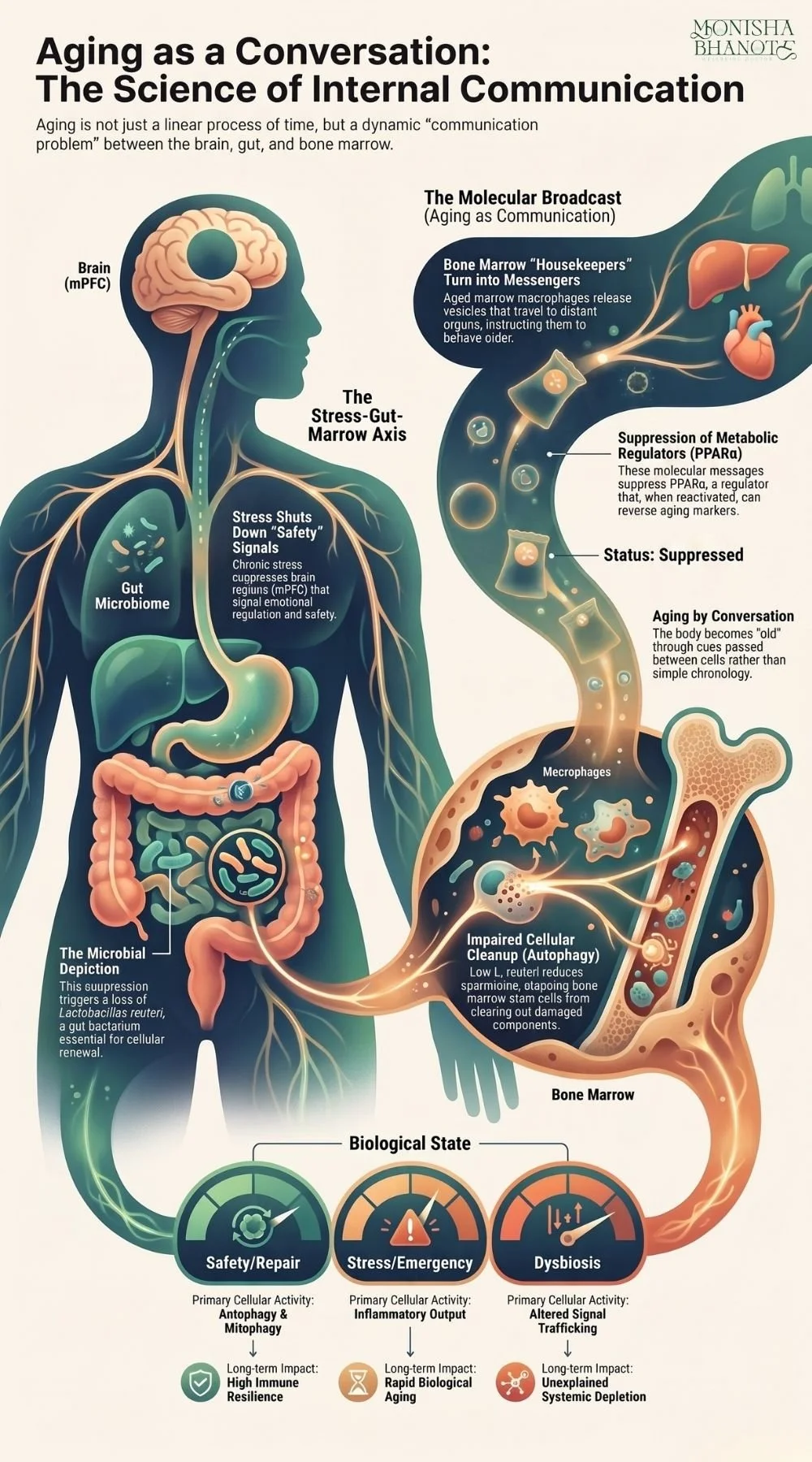
One of the more striking findings arrived in 2024, when researchers publishing in Nature Aging described how immune cells inside the marrow — bone marrow macrophages — change with age. In youth, these cells act as part housekeeper, part sentry, deciding what gets cleared and what gets tolerated in the local cellular environment. With age, the researchers found, these macrophages begin releasing extracellular vesicles — tiny membrane-bound parcels — into circulation. Inside those parcels travel microRNAs capable of altering gene activity in distant tissues, including the liver. Two of these molecular messengers were found to suppress a metabolic regulator called PPARα, effectively instructing other organs to behave older. The researchers went a step further, showing that restoring PPARα activity helped reverse markers of tissue aging in older mice, and that in a large human cohort, use of a medication that activates this same pathway tracked with lower rates of age-related disease.
This is the part I wish more people understood about aging: it isn't only a local accumulation of years. It's also a communication problem. Cells age, but they also inform on one another — passing cues, altering the tone of the entire system. The body can become old by conversation as much as by chronology.
When I explain this to patients, I often watch a flash of recognition cross their face. They've lived this phenomenon long before they had language for it — the sense that one rough season seemed to age everything at once. The skin is a little duller. The energy is a little flatter. The immune system is a little less forgiving. The science suggests this isn't imagined. It may reflect an actual shift in the body's internal broadcasting.
The Stress-Gut-Marrow Conversation
Then there is stress — a word so overused it sounds too soft for what it actually does. We talk about stress like emotional weather: a hard week, too many emails, one more sleepless night. Biologically, chronic stress is an event. It changes neural tone, redirects resources, and modifies gut chemistry. It teaches the body to live in anticipation rather than repair.
A study published this year in Cell Stem Cell traced this with remarkable precision through what researchers now call the brain-gut-bone marrow axis. I find the phrase useful because it restores a sense of continuity — a reminder that the body isn't a set of separate departments, but one ecosystem where perception, digestion, immunity, and regeneration are braided together.
Working across several mouse models, the research team — based at Sun Yat-sen University — showed that chronic psychological stress suppressed activity in two brain regions involved in emotional regulation and the nervous system's sense of safety: the medial prefrontal cortex and the periaqueductal gray. That suppression rippled outward through the nervous system into the gut, where it triggered a loss of Lactobacillus reuteri, a beneficial bacterium with a surprisingly sophisticated role in this story.
L. reuteri helps support the body's production of spermidine, a naturally occurring compound involved in cellular renewal. Spermidine matters because it fuels autophagy — the process by which cells clear out damaged components and maintain internal order. In hematopoietic stem cells, the cells inside the marrow that generate our blood and immune cells, this housekeeping function is essential. These stem cells must remain poised for decades — quiescent when necessary, regenerative when called upon — without accumulating damage. That balance depends in part on mitophagy, a specialized form of cellular cleanup that clears worn-out mitochondria. In stem cells, mitochondria aren't just energy sources; they are arbiters of fate. A stem cell burdened by damaged mitochondria is one less able to renew, adapt, and generate a resilient immune system.

So when chronic stress depletes L. reuteri, spermidine falls, and autophagy in hematopoietic stem cells becomes impaired, the consequences are not theoretical. The marrow becomes less elegant at self-maintenance. The immune system being assembled there becomes less robust. This may be one reason a person under prolonged strain feels not only emotionally frayed, but biologically porous — more vulnerable to infection, slower to rebound, older than their years in ways they can sense but not always explain.
This is also why so many patients tell me some version of the same story: "I was fine until that year." The year of caregiving. The year of divorce. The year of nonstop flights and hotel food. The year sleep fell apart. We imagine these seasons affect us only through mood or memory, but the body records them more literally — in microbial shifts, inflammatory bias, and altered immune choreography. The marrow remembers the life around it.
A Microbial Bridge Between Brain, Bone, and Gut
A third piece of this puzzle arrived through a 2026 review in Frontiers in Endocrinology, which described what its authors call the brain-bone-gut axis — a bidirectional regulatory network the researchers frame as a microbial bridge. I find that phrase useful because it explains why so many modern health complaints travel in clusters. A person rarely has digestive issues, or bone changes, or cognitive fog, or immune fragility in true isolation. Often these are linked by shared signaling pathways — inflammatory cytokines, microbial metabolites, neuroimmune crosstalk, and changes in tissue permeability and repair.
When gut ecology becomes disrupted — a state called dysbiosis, where the microbial community loses balance — the consequences don't stop at the intestinal wall. Dysbiosis has been linked to neuroinflammation, altered immune cell trafficking, and changes in bone remodeling. It can shift what the marrow is asked to produce. In inflammatory states, the body often prioritizes immediate defense over long-term regeneration — adaptive in a genuine crisis, but not sustainable as a way of life.
This distinction matters because so many high-functioning people spend years in a kind of physiological emergency without ever naming it. They are competent, productive, outwardly well. They eat the salad, answer the email, board the plane, make the deadline. But internally, their biology may be defaulting to increasingly defensive choices: less repair, more inflammatory output, less cellular cleanup, more wear. Over time, this can feel like unexplained depletion — when the explanation has been there all along, hidden in the marrow, the microbiome, and the nervous system's ongoing assessment of whether the world feels safe enough for repair.
What You Can Do Today
Once you understand that your marrow is listening — to inflammatory cues, microbial metabolites, and nervous system tone — daily life starts to look different. The afternoon crash stops feeling like a character flaw. The recurring winter illness stops feeling random. None of this requires an elaborate overhaul. It asks for a handful of consistent, unglamorous rituals that help your marrow do what it already knows how to do.
Regulate your nervous system before you try to fix anything else
A body that never exits vigilance cannot prioritize renewal. Ten minutes of slow, extended-exhale breathing, a short walk without your phone, or simply naming what's stressing you out loud to another person all send the nervous system a genuine signal of safety — the precondition for repair, not a luxury after it.
Feed the microbes that feed your marrow
Fermented foods, fiber diversity, and polyphenol-rich plants support the same microbial ecosystem that helps sustain Lactobacillus reuteri and spermidine production. This doesn't require perfection. It requires consistency. A gut fed well most days is more resilient than one optimized occasionally.
Protect your recovery windows like they're non-negotiable
Sleep is when hematopoietic stem cells, mitochondria, and immune memory do their maintenance work. Treating a consistent bedtime and wind-down ritual with the seriousness modern culture usually reserves for achievement is one of the most direct ways to support marrow health.
Travel without losing ground

Travel disrupts sleep, gut rhythm, and stress load all at once, which is exactly why frequent travelers often notice their immune system and energy suffer first. Building small, repeatable rituals around travel — hydration, movement, consistent meal timing, and nervous-system-supportive practices — helps protect the very systems this research points to.
This is where a daily ritual like Travela Essentials fits into a larger lifestyle strategy, not as a stand-in for it. The formulation was built around ingredients that speak the same biological language this article has been describing. Astragalus, for instance, has been studied for its influence on marrow signaling: a 2024 study found that astragalus polysaccharide helped modulate the Hippo/TERT pathway and supported hematopoietic recovery in an animal model of bone marrow failure. Resveratrol has been shown in laboratory research to activate SIRT1 and help preserve the self-renewal capacity of bone marrow–derived stem cells. CoQ10, PQQ, and glutathione support the mitochondrial maintenance this article keeps returning to — the same cellular housekeeping that determines whether a stem cell can renew itself cleanly or not.
None of this promises anything immediate, and it would be a disservice to suggest otherwise. The most meaningful changes are often what you stop noticing: less travel fatigue, less digestive disruption, less brain fog, less reactivity to the ordinary stress of a full life. Travela Essentials was designed as a daily ritual that travels with you — a small, consistent input into a system that is, by its nature, always listening.

#CellCare Reflection

I think often of bones as vaults, and marrow as the quiet keeper inside them. We tend to imagine vitality as something visible — a glow in the skin, a number on a tracker, a burst of productivity. But real resilience is usually quieter. It is built in tissue we will never see in a mirror, maintained by loops of communication we are only beginning to understand.
By the end of that visit, my patient and I were no longer talking about "just stress" or "just aging." We were talking about biology as biography — about how life gets translated into tissue, and how that tissue can be tended with precision and care. There is real relief in naming the actual problem. There is dignity in understanding that your symptoms belong to a pattern, and that the pattern can be influenced.
So the next time your energy feels borrowed, or your immune system seems less forgiving than it used to be, consider that the answer may not be on the surface. It may be in the marrow — in the messages traveling from macrophages to organs, from gut microbes to stem cells, from brain circuits to the deepest architecture of renewal. Change the message, and the body often changes its response. The story isn't over simply because you are tired. In many cases, it is just becoming visible.
If this is the first time you've thought about your bone marrow as part of your immune story, it won't be the last. Explore more #CellCare rituals for nervous system regulation and gut resilience, or join the #CellCare newsletter to keep this conversation going.




MAKE A DIFFERENCE BY SHARING THIS ARTICLE WITH OTHERS TO ENCOURAGE WELLBEING ⤵
The information on this website has not been evaluated by the Food & Drug Administration or any other medical body. We do not aim to diagnose, treat, cure or prevent any illness or disease. Information is shared for educational purposes only. You must consult your doctor before acting on any content on this website, especially if you are pregnant, nursing, taking medication, or have a medical condition. Our content may include products that have been independently chosen and recommended by Dr. Monisha Bhanote and our editors. We may earn a small commission if you purchase something mentioned in this article.
YOU MAY ALSO LIKE:





by Dr. Monisha Bhanote
✅ EVIDENCE-INFORMED REVIEWED ARTICLE