The Molecule Your Gut Makes at Every Meal, and What It Means for Your Heart

“Every plant you eat carries a message. Your microbes translate it, your cells respond, and resilience is built in the conversation.”
Renata orders the same thing three mornings a week: two eggs over easy, a side of smoked salmon, and a green juice she counts as her vegetables for the day. She lifts weights on Tuesdays and Thursdays, runs the loop around the reservoir on Saturdays, and has never smoked a cigarette in her life. When her last physical came back with a mildly elevated inflammatory marker, she was almost offended. She eats well. She moves her body. On paper, she is the picture of someone who has this handled.
What Renata’s ten-minute appointment didn’t have time to explain is that her body has been having a private conversation for years, one that has little to do with willpower and everything to do with the trillions of microscopic residents living in her gut. Every time she eats eggs, salmon, or the occasional steak, those residents get to work. Depending on which bacteria show up to that particular meal, the work they do can either support her heart or quietly work against it.
The molecule at the center of that conversation has a name cardiologists have only been able to measure for about a decade: TMAO, or trimethylamine N-oxide. It is made by your own gut bacteria, from completely ordinary food, and a growing body of research shows it can influence the very process that leads to heart attacks and strokes.

Your Gut Bacteria Are Reading Your Plate Before Your Heart Ever Feels It
For most of modern cardiology’s history, the gut and the heart were treated as separate territories, one belonging to gastroenterology, the other to cardiology, with little reason for the two specialties to compare notes. That started to change when researchers at the Cleveland Clinic, led by Dr. Stanley Hazen, ran a metabolomics screen on the blood of patients with cardiovascular disease, searching for small molecules that might explain why some people develop dangerous plaque despite normal cholesterol and a reasonable diet.
What they found was TMAO. In a landmark 2011 study published in Nature, Hazen’s team showed that this single gut-bacteria-derived compound predicted cardiovascular risk in an independent clinical cohort, and that feeding it directly to mice accelerated the formation of atherosclerotic plaque. It was not a passive marker sitting quietly in the bloodstream. It appeared to be an active participant in the disease process itself, a genuinely new mechanism hiding inside a system doctors thought they already understood.
How an Ordinary Breakfast Becomes a Cardiovascular Signal
The chemistry, stripped of jargon, works like this. Certain nutrients, choline (abundant in egg yolks and dairy), L-carnitine (abundant in red meat), and phosphatidylcholine, are digested by specific strains of gut bacteria and converted into a compound called trimethylamine, or TMA. That TMA travels to the liver, where an enzyme family called flavin monooxygenases oxidizes it into TMAO, which then circulates through the bloodstream and reaches the artery wall.

Once there, follow-up research from the same Cleveland Clinic team showed TMAO does measurable damage. It upregulates the scavenger receptors on immune cells that drive foam cell formation, the first visible step in an atherosclerotic plaque. It promotes inflammatory signaling in the cells lining blood vessels. In a separate line of research, it was shown to make platelets more reactive, raising the risk of the kind of clot that triggers a heart attack or stroke.
A 2013 study published in the New England Journal of Medicine added a layer of precision to this picture: the researchers fed healthy volunteers two hard-boiled eggs and watched their TMAO levels rise in real time, then confirmed that people with the highest TMAO after this challenge also carried the greatest long-term cardiovascular risk. That same year, a companion study in Nature Medicine isolated L-carnitine specifically, the compound concentrated in red meat, and found that people who habitually ate meat produced far more TMAO from a carnitine challenge than long-term vegans and vegetarians did, evidence that this is not simply about what you eat once, but about which bacterial populations your gut has learned to keep.
This is, in a sense, the cellular story of the plate. What you eat consistently over years selects for a certain community of gut bacteria, and that community decides, meal by meal, how much of this proatherogenic compound enters your circulation. It is a slow, cumulative process, not unlike the way arterial plaque itself tends to build over decades rather than days.
The Fish Paradox
Here is where the story resists a tidy conclusion, and where a magazine-cover nutrition takeaway would do readers a disservice. Fish and shellfish are conventionally framed as protective for the heart, largely on the strength of their omega-3 content, and that framing is not wrong. But certain species, particularly deep-water fish like cod, along with processed fish products, carry meaningful amounts of TMAO directly in their tissue, independent of anything your gut bacteria do.
A 2022 study from the Cleveland Clinic group measured this directly: after a single meal of cod or fish sticks, circulating TMAO rose significantly in healthy volunteers, though levels returned to baseline within a day. Salmon produced a smaller rise. The researchers were careful not to recommend avoiding fish altogether. Their conclusion was narrower and more useful: for anyone already managing cardiovascular risk, species selection matters, and not all fish behave the same way inside the body.
This is less a reason for alarm than a reason for nuance, the kind of nuance that gets lost when nutrition science gets compressed into a single headline. The most consistent, well-supported driver of chronically elevated TMAO remains the pairing of red meat and egg yolk eaten as a daily habit, not the occasional piece of fish.

What Changes the Equation
The more encouraging half of this research is that TMAO production is not fixed. It responds, sometimes within weeks, to the composition of what you eat.

A 2025 clinical study published in Nutrients put previously low-adherence eaters on a Mediterranean-style diet for just four weeks and measured a significant drop in plasma TMAO, alongside improvements in cholesterol and liver markers.Separately, the landmark American Gut Project, a citizen-science analysis of thousands of participants’ microbiomes led by researchers at the University of California, San Diego, found that people who ate more than thirty different plant foods in a week carried a meaningfully more diverse gut microbiome than those eating ten or fewer, regardless of whether they identified as vegan, vegetarian, or omnivore. Diversity of plant intake, not adherence to any single diet label, was the strongest predictor.
There is also early, laboratory-stage evidence pointing to specific compounds within the Mediterranean pattern. Cleveland Clinic researchers identified a molecule called DMB, naturally present in cold-pressed olive oil, balsamic vinegar, and red wine, that inhibited the bacterial enzyme responsible for converting choline into TMA in animal models, without disrupting the surrounding microbiome the way an antibiotic would. Separately, laboratory research on resveratrol, the plant compound found in the skin of grapes and in berries, showed it could reduce TMAO-driven arterial changes in mice by reshaping the gut microbial community itself and supporting the liver’s bile acid pathways. Both findings are animal-model research, not yet confirmed in large human trials, but they point toward the same conclusion the clinical diet studies already support: the foods and plant compounds that build a diverse, fiber-fed microbiome tend to be the same ones associated with a lower TMAO burden.
What You Can Do Today
None of this calls for an overnight overhaul, and it does not require memorizing a list of forbidden foods. A few realistic shifts, practiced consistently, are what the research actually supports:
Let plants outnumber animal protein on your plate most days of the week. Herbs, spices, and aromatics count toward your total plant diversity, so a dinner built around a base protein, three vegetables, and a fresh herb garnish is doing more for your gut than it looks like on paper.
If eggs are part of your routine, treat the yolk the way you might treat a rich sauce: welcome, but not the daily default. A few yolk-forward mornings a week, balanced with plant-based protein on the others, changes the input your gut bacteria are working with.
Reach for extra virgin olive oil and real balsamic vinegar as your everyday dressing. It is a small, sensory ritual, whisked together in under a minute, that also happens to align with the Mediterranean pattern shown to lower TMAO in clinical research.
Notice how your body feels after a week of eating this way. Many of my patients describe it not as a dramatic shift, but as an absence: less bloating after dinner, steadier energy through the afternoon, fewer of the low-grade aches they had stopped questioning.

A Daily Ritual That Travels With You

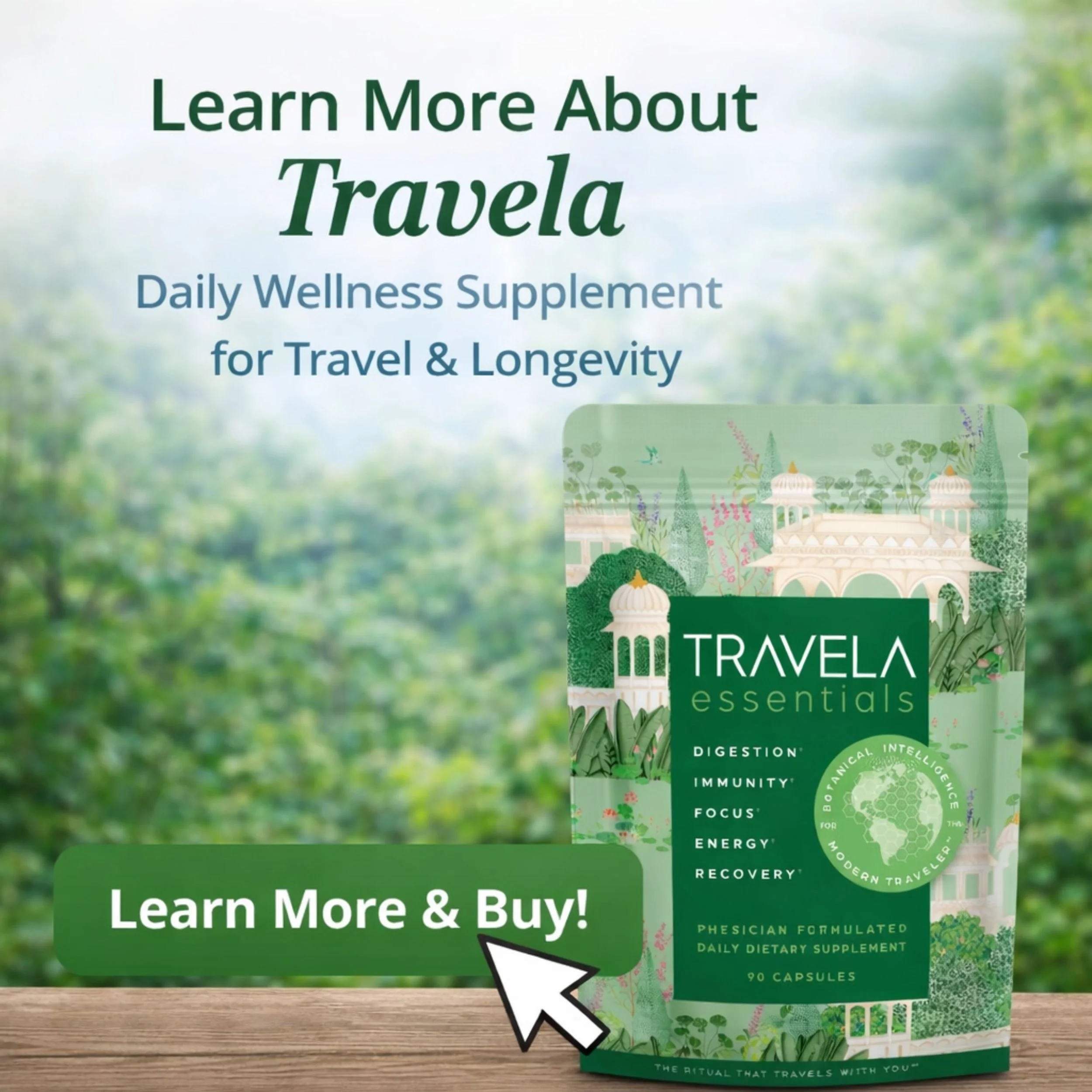
This is also where I think about the role of a well-formulated daily ritual, one that supports the same gut ecosystem your diet is already working to diversify. Travela Essentials was built around this principle: cellular resilience is built from the ground up, meal by meal and day by day, and the ingredients that support it should work with your biology, not promise to override it.
Resveratrol, one of the core compounds in the Travela digestion pathway, is included for exactly the reason described above: early research suggests it interacts with the gut microbiome in ways that may support a healthier metabolic environment, alongside its long-studied role as a polyphenol antioxidant. It is not a substitute for the dietary pattern that the clinical research actually supports, and it is not framed as one. It is a companion to it, part of a broader rhythm that includes what you eat, how you move, and how consistently you show up for your own cellular health.
The most meaningful changes are often what you stop noticing. Less travel fatigue after a long flight. Less digestive disruption after a week of eating out. A steadier baseline you no longer have to think about, built quietly, one plant-diverse plate at a time.
#CellCare Reflection

Your gut and your heart have been in conversation since long before medicine had the tools to listen in. Every meal is a message, translated by trillions of bacterial residents into a molecule that either protects your arteries or works against them. You do not need to overhaul your life to change that conversation. You need to widen your plate, season it with real olive oil and balsamic vinegar, and let plant diversity become a quiet, consistent habit rather than an occasional effort.
That is what #CellCare has always meant to me: not a single dramatic act of wellness, but the accumulated wisdom of small, cellular-level choices, made daily, in favor of the body you intend to keep living in for a very long time.
MAKE A DIFFERENCE BY SHARING THIS ARTICLE WITH OTHERS TO ENCOURAGE WELLBEING ⤵
References:
Wang, Zeneng, Elizabeth Klipfell, Brian J. Bennett, Robert Koeth, Bruce S. Levison, Brandon DuGar, Ariel E. Feldstein, et al. “Gut Flora Metabolism of Phosphatidylcholine Promotes Cardiovascular Disease.” Nature 472, no. 7341 (2011)
Seldin, Marcus M., Yonghong Meng, Hongxiu Qi, Weifei Zhu, Zeneng Wang, Stanley L. Hazen, Aldons J. Lusis, and Xia Shih. “Trimethylamine N-Oxide Promotes Vascular Inflammation Through Signaling of Mitogen-Activated Protein Kinase and Nuclear Factor-κB.” Journal of the American Heart Association 5, no. 2 (2016)
Zhu, Weifei, Jill C. Gregory, Elin Org, Jennifer A. Buffa, Nilaksh Gupta, Zeneng Wang, Lin Li, et al. “Gut Microbial Metabolite TMAO Enhances Platelet Hyperreactivity and Thrombosis Risk.” Cell 165, no. 1 (2016): 111–124.
Tang, W. H. Wilson, Zeneng Wang, Bruce S. Levison, Robert A. Koeth, Earl B. Britt, Xiaoming Fu, Yuping Wu, and Stanley L. Hazen. “Intestinal Microbial Metabolism of Phosphatidylcholine and Cardiovascular Risk.” New England Journal of Medicine 368, no. 17 (2013)
Koeth, Robert A., Zeneng Wang, Bruce S. Levison, Jennifer A. Buffa, Elin Org, Brendan T. Sheehy, Earl B. Britt, et al. “Intestinal Microbiota Metabolism of L-carnitine, a Nutrient in Red Meat, Promotes Atherosclerosis.” Nature Medicine 19, no. 5 (2013)
Wang, Zeneng, W. H. Wilson Tang, Thomas O’Connell, Erwin Garcia, Elias J. Jeyarajah, Xinmin S. Li, Xun Jia, Taylor L. Weeks, and Stanley L. Hazen. “Circulating Trimethylamine N-oxide Levels Following Fish or Seafood Consumption.” European Journal of Nutrition 61, no. 5 (2022)
Deniz, Melike Şeyma, and Murat Baş. “Short-Term Mediterranean Dietary Intervention Reduces Plasma Trimethylamine-N-Oxide Levels in Healthy Individuals.” Nutrients 17, no. 19 (2025): 3135.
McDonald, Daniel, Embriette Hyde, Justine W. Debelius, James T. Morton, Antonio Gonzalez, Gail Ackermann, Alexander A. Aksenov, et al. “American Gut: An Open Platform for Citizen Science Microbiome Research.” mSystems 3, no. 3 (2018)
Wang, Zeneng, Adam B. Roberts, Jennifer A. Buffa, Bruce S. Levison, Weifei Zhu, Elin Org, Xiaoming Gu, et al. “Non-lethal Inhibition of Gut Microbial Trimethylamine Production for the Treatment of Atherosclerosis.” Cell 163, no. 7 (2015)
Chen, Ming-liang, Long Yi, Yong Zhang, Xi Zhou, Li Ran, Jining Yang, Jun-dong Zhu, Qian-yong Zhang, and Man-tian Mi. “Resveratrol Attenuates Trimethylamine-N-Oxide (TMAO)-Induced Atherosclerosis by Regulating TMAO Synthesis and Bile Acid Metabolism via Remodeling of the Gut Microbiota.” mBio 7, no. 2 (2016)
The information on this website has not been evaluated by the Food & Drug Administration or any other medical body. We do not aim to diagnose, treat, cure or prevent any illness or disease. Information is shared for educational purposes only. You must consult your doctor before acting on any content on this website, especially if you are pregnant, nursing, taking medication, or have a medical condition. Our content may include products that have been independently chosen and recommended by Dr. Monisha Bhanote and our editors. We may earn a small commission if you purchase something mentioned in this article.
YOU MAY ALSO LIKE:



by Dr. Monisha Bhanote
✅ EVIDENCE-INFORMED REVIEWED ARTICLE