1,000 Ways to Use Turmeric: The Golden Root That Built a Culture of Longevity

“Longevity grows from daily rituals that nourish your gut, calm inflammation, and support your cells.”
There is a distinct, indelible ritual that happens the moment you slice into a fresh rhizome of turmeric. The aroma rises immediately: earthy, pungent, slightly peppery, carrying the scent of sun-baked soil and ancient rain. Within seconds, your fingertips are stained a brilliant, sunburst amber, a vivid reminder that this root does not merely season food. It claims it.
I think of a patient I once counseled after a long stretch of international travel: three countries in ten days, five time zones, meals eaten standing up in airport lounges. She arrived in my office not with a single dramatic complaint, but with the quiet accumulation of small ones. Joints that ached without explanation. A digestive rhythm that had gone quiet, then chaotic. A fatigue that no amount of coffee could touch. Nothing was acutely wrong, and that was precisely the problem. Her cells were asking for maintenance, not rescue.
What I gave her that day was not a prescription. It was a spice tin. Specifically, turmeric, and a conversation about what her grandmother likely already knew.
This is a story I hear in some version nearly every week, in different bodies, different accents, different flight itineraries. The details shift, but the underlying pattern rarely does: a high-functioning person doing everything right on paper, still waking up feeling like their own cells are working against them. What I have come to understand, both as a physician and as someone who studies pathology at the cellular level, is that this feeling is data. It is your body's way of reporting on trillions of tiny transactions happening beneath conscious awareness, in the mitochondria, in the gut lining, in the immune cells patrolling your bloodstream. And few single ingredients speak to that cellular conversation as fluently, or as gently, as turmeric.

Haridra: The Golden Goddess of Ayurveda
Long before Western clinical trials mapped molecular pathways, grandmothers across South Asia stood in sunlit kitchens doing what generations before them had perfected. They reached instinctively for the spice tin, measured out a pinch of turmeric, cracked a kernel of black pepper, and folded both into a warm meal. They did not need a microscope to know that something profound was happening. They had observation, lineage, and the quiet wisdom of thousands of years.
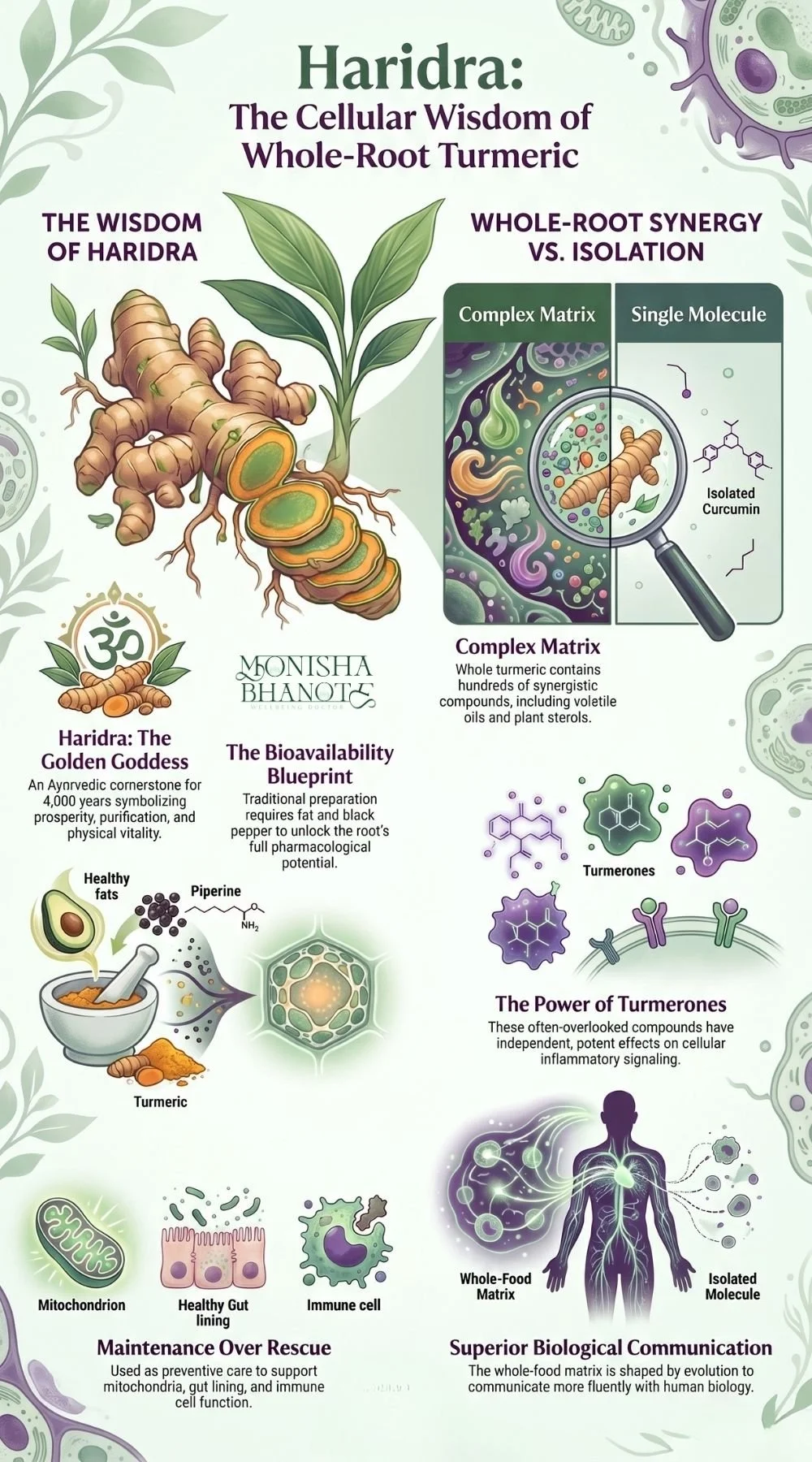
Curcuma longa, a perennial herbaceous plant in the ginger family, Zingiberaceae, has served as an Ayurvedic cornerstone for over four millennia — not merely as a culinary spice, but as sacred medicine. In ancient Vedic tradition it was revered as Haridra, the golden goddess, symbolizing prosperity, purification, and physical vitality. It was pressed into poultices for wounds, brewed into teas to clear the respiratory tract, and woven into daily life as a pillar of preventive care.
What makes this history worth pausing on is not nostalgia. It is precedent. Long before anyone could name a metabolic pathway, an entire subcontinent of home cooks had already run a multi-generational, real-world trial on how to prepare this root for maximum effect: always with fat, almost always with black pepper, rarely raw and alone. That pattern was not superstition. It was applied pharmacology, discovered the slow way, through attention rather than assay.
Whole-Root Wisdom vs. Isolated Curcumin
Traditional medicine never treated turmeric as a single, isolated chemical. Modern reductionist science often attempts to isolate one active constituent, curcumin, and study it in a sterile vacuum. But nature rarely works so linearly. Curcuma longa is a complex, whole-food botanical matrix containing hundreds of synergistic compounds: volatile oils, turmerones, polysaccharides, and plant sterols that work in concert. When you consume the whole root, you are engaging with a botanical architecture shaped by evolution to communicate with human biology, not a single molecule working alone.
This distinction matters more than it might first appear. A growing body of pharmacology research has noted that curcumin in isolation behaves almost like a different substance than curcumin delivered within the whole turmeric matrix, differently absorbed, differently metabolized, and differently tolerated. The turmerones alone, largely overlooked in early curcumin-only research, are now understood to have their own independent effects on inflammatory signaling. In other words, the whole root was never a less sophisticated version of the extracted compound. It was the original, and still arguably the more complete, formulation.
The Science Pivot: Why the Tradition Was Right All Along
While our ancestors relied on intuition and ritual, modern science has spent the last several decades catching up to what the kitchen already understood.
The Gut-First Molecule
For years, pharmacologists puzzled over a clinical paradox: curcumin has notoriously low systemic bioavailability when ingested alone. It is rapidly metabolized and cleared by the liver. Recent research has reframed this limitation entirely. Curcumin is fundamentally a gut-first molecule. A 2025 review in Frontiers in Microbiology on curcumin's role in gut microbiota modulation found that the compound is capable of promoting a shift from pathogenic to beneficial bacterial populations, with the majority of unabsorbed curcumin accumulating directly in the colon, where it can act locally on the microbiome even without ever entering systemic circulation.¹ A companion 2025 study in the Journal of Agricultural and Food Chemistry used an in vivo model to trace how gut bacteria transform native curcumin into a cascade of bioactive metabolites, confirming that the microbiome itself is a primary engine of turmeric's downstream benefits.² In plainer terms: turmeric does not need to flood your bloodstream to matter. It needs to reach your gut, where your own microbial community does much of the metabolic work.

The Piperine Synergy: A 2,000 Percent Boost
Why did traditional cooks always insist on adding black pepper to turmeric dishes? Modern pharmacokinetics offers the vindication. Black pepper contains an alkaloid called piperine, which temporarily inhibits glucuronidation, the metabolic pathway that otherwise tags curcumin for rapid elimination. In a landmark 1998 study published in Planta Medica, researchers found that co-administering piperine with curcumin increased curcumin's bioavailability in human volunteers by 2,000 percent, with no adverse effects reported.³ The ancients did not guess. They observed a real biological truth, generations before anyone could explain why.
Fat Solubility and the Lipid Matrix
Turmeric is profoundly lipophilic, meaning it loves fat. In a water-only environment, curcumin struggles to dissolve or cross intestinal membranes efficiently. When traditional recipes call for cooking turmeric in coconut oil or another plant fat, they are building a lipid delivery vehicle. Dietary fats stimulate bile acid secretion, which emulsifies turmeric's active compounds and helps carry them through the intestinal wall.
Cellular Signaling: Taming the Inflammatory Fire
At the microscopic level, chronic, low-grade inflammation is the quiet driver behind modern fatigue, metabolic sluggishness, and accelerated cellular aging. Turmeric acts on master molecular switches inside our cells. Foundational pharmacology research has described how its constituents downregulate NF-κB, the protein complex that controls inflammatory gene expression, and inhibit COX-2 and 5-LOX enzymes, dampening inflammatory cascades through the same pathways targeted by many synthetic anti-inflammatories.⁴ A broader review in Foods similarly concluded that curcumin's antioxidant and anti-inflammatory actions operate through multiple, overlapping cellular mechanisms rather than a single pathway.⁵ This is the essence of #CellCare: protecting mitochondrial efficiency and cellular integrity through consistent, low-grade support, not dramatic intervention.
It helps to picture NF-κB the way you might picture a building's fire alarm system. In a genuine emergency, you want it loud, fast, and impossible to ignore. The trouble in modern chronic disease is not that this alarm exists. It is that it has started going off at low volume, constantly, in response to things that are not actual fires: a poor night's sleep, an inflammatory meal, unmanaged stress, a disrupted gut lining. Turmeric does not disable the alarm system. It helps recalibrate its sensitivity, so the signal is reserved for genuine threats rather than firing on a low, chronic loop that quietly erodes tissue over years.
Longevity and the Nervous System: The Wider Circuit
Cellular inflammation rarely stays contained to a single system, which is part of why turmeric's research footprint spans so many seemingly unrelated areas: joint comfort, metabolic health, cognitive clarity, even mood regulation. The gut and the nervous system share a dense, bidirectional communication network, often called the gut-brain axis, and a gut environment that is less inflamed tends to produce a nervous system that is less reactive. This is not a claim that turmeric treats anxiety or depression, which are complex conditions requiring proper clinical care. It is a more modest and better-supported claim: that reducing the baseline inflammatory load your gut carries removes one contributor to a dysregulated stress response, which is precisely why so many people report feeling calmer, not just physically lighter, when gut-supportive rituals become consistent.
A Thousand Small Rituals: Vegan Ways to Bring Turmeric Into Daily Life

You do not need to overhaul your life to invite the golden root into it. The beauty of turmeric is its versatility. What follows is not an exhaustive list. It is a starting map. Once you understand the underlying principles, fat, heat, and black pepper, you will find your own thousand ways, one meal at a time.
Morning Rituals
Blend a half-inch knob of fresh turmeric root, or a teaspoon of high-quality organic powder, into a green smoothie with avocado, baby spinach, wild blueberries, flaxseed, and a pinch of black pepper. The fat from the avocado and flaxseed does double duty here, supporting satiety and acting as the lipid carrier turmeric needs to be properly absorbed. On mornings that call for something sharper, press fresh turmeric, ginger, lemon, and green apple into a wellness shot that wakes up digestion before your first meal. If you take your coffee with a plant milk, a quarter teaspoon of turmeric and a whisper of black pepper stirred in before frothing turns an ordinary cup into a small, deliberate act of cellular care.
Savory Foundations
Turmeric is the quiet workhorse of longevity cooking. Toss roasted cauliflower, sweet potato, or chickpeas in olive oil, sea salt, cumin, and a generous hand of turmeric before roasting until caramelized. Stir it into simmering red lentil dal, vegetable broth, or fragrant basmati rice, where it blooms in the hot oil at the start of cooking rather than being added at the end. Build a marinade from grated turmeric, garlic, lemon juice, and cold-pressed olive oil for tofu or tempeh before grilling; the antioxidants help buffer the oxidative stress that high heat cooking can generate. A soup finished with a spoonful of coconut milk and a swirl of turmeric transforms a simple vegetable broth into something that reads, and functions, like restorative medicine.
Evening Rituals
Simmer unsweetened almond or full-fat coconut milk with freshly grated turmeric, a pinch of cracked black pepper, a cardamom pod, and a slice of fresh ginger for a vegan golden milk. Sweeten, if you like, with a small spoonful of maple syrup. As it warms, the aroma alone begins to shift the nervous system out of sympathetic drive and toward restorative rest. Sip slowly, an hour before sleep, away from screens, treating the ten minutes it takes to prepare as part of the ritual's value, not an inconvenience on the way to it.
Ferments and Elixirs
For a shelf-stable apothecary remedy, blend high-potency turmeric powder with maple syrup or soft date paste into a smooth golden paste, and stir a small spoonful into warm tea when your immune resilience feels tested. For something more ambitious, try lacto-fermented turmeric: thin slices of raw root submerged in a sea salt brine with mustard seed and chili. Fermentation predigests the root's compounds, creating a probiotic-rich, bioavailable preparation that supports the gut microbiome in ways raw spice alone cannot.
On the Road: Turmeric for Wellness Travel
Travel disrupts the very systems turmeric supports: circadian rhythm, gut motility, and inflammatory load, all at once. A few small habits make the ritual portable rather than optional. Pack whole turmeric capsules or a travel tin of the powder alongside a small container of ground black pepper, since piperine's absorption benefit does not travel with the plain spice alone. Order lentil, chickpea, or vegetable dishes at airport restaurants when you see turmeric or curry listed on the menu; they are often the least processed option available and double as a gut-supportive choice mid-itinerary. And if a kitchen and a blender are simply not part of the day, a formulated travel companion that already contains turmeric alongside its traditional absorption partners removes the guesswork entirely, which is precisely the role Travela Essentials was designed to play.
That is seven categories and close to twenty preparations, and none of them touch the hundreds of smaller, quieter ways turmeric finds its way into a life lived with intention: a finishing drizzle of turmeric-infused olive oil, a golden tahini dressing, a pinch stirred into oatmeal, a rice pilaf turned celebratory with nothing more than color and warmth. The number in the title was never meant to be counted. It was meant to describe a relationship with a plant that renews itself daily, for as long as you keep reaching for it.

From Kitchen to Cellular Consistency
There is an undeniable, grounding joy in grating fresh turmeric and simmering golden milk on a quiet evening. Food is our first pharmacy, and culinary practice is a sacred act of self-preservation.

Yet let us be honest about the realities of modern life. Between demanding professional obligations, frequent travel, and high-output schedules, very few of us grate and simmer raw root every single day. We might manage a golden milk on a peaceful Sunday, but by Wednesday afternoon our routines are often compromised by airport lounges, conference room lunches, and hurried dinners.
This is precisely where a physician-formulated approach becomes useful, not as a replacement for the ritual, but as its bridge. Travela Essentials was built around this exact gap: turmeric alongside its traditional companions, including black pepper's active compounds for absorption, ginger, and other cellular-resilience botanicals, formulated to travel with you when the kitchen is not an option. The goal was never to promise an overnight transformation. The most meaningful changes are often what you stop noticing: less travel fatigue, less digestive disruption, less brain fog, a nervous system that feels a little less reactive to the next delayed flight. It is a daily ritual designed to travel with you, built on the same principle your grandmother's spice tin already understood.
I want to be precise about what this means and does not mean. A formulated supplement is not a substitute for the sensory, unhurried practice of cooking with the whole root when you have the time for it. It is a way of extending that same underlying philosophy, consistent cellular support through traditional botanicals, into the days when a full kitchen simply is not available to you. The patient I mentioned earlier did not abandon her turmeric habit when she traveled again three months later. She packed for it. That, more than any single recipe, is the shift I am usually hoping for.
What You Can Do Today
Add a pinch of black pepper any time you cook with turmeric. The piperine synergy is real, and it costs nothing.
Cook turmeric in a plant fat, such as olive oil or coconut oil, rather than adding it to water alone.
Choose one ritual from above, not all of them, and build it into a single recurring moment in your week.
If you travel frequently, pack a small jar of turmeric-maple paste or a travel-friendly cellular support formula for the days a full kitchen isn't within reach.
Notice, rather than chase, the absence of symptoms. Cellular resilience shows up as quiet, not fanfare.
#CellCare Reflection

Every cell in your body is rebuilt from what you feed it, one choice at a time. Turmeric is not a miracle and it is not a hack. It is a four-thousand-year-old conversation between a root and the human body, one that modern science is only now learning to translate. The invitation is not to overhaul your life by tomorrow morning. It is to slice into a fresh rhizome once, notice the amber stain on your fingertips, and let that small, sensory ritual remind you that longevity is built cell by cell, meal by meal, in the quiet consistency of what you choose today.




MAKE A DIFFERENCE BY SHARING THIS ARTICLE WITH OTHERS TO ENCOURAGE WELLBEING ⤵
References:
Chowanadisai, Winyoo, Kathryn A. Bauerly, Eskouhie Tchaparian, Alice Wong, Gino A. Cortopassi, and Robert B. Rucker. “Pyrroloquinoline Quinone Stimulates Mitochondrial Biogenesis through cAMP Response Element-Binding Protein Phosphorylation and Increased PGC-1α Expression.” Journal of Biological Chemistry 285, no. 1 (2010): 142–152.
Rucker, Robert, Winyoo Chowanadisai, and Masahiko Nakano. “Potential Physiological Importance of Pyrroloquinoline Quinone.” Alternative Medicine Review 14, no. 3 (2009): 268–277.
Numaguchi, Tomoe, Mai Nakamura, Tomoyo Koshizawa, Nur Syafiqah Mohamad Ishak, and Katsuyuki Hashimoto. “Dietary Pyrroloquinoline Quinone and Spermidine in Healthy Longevity: Targeting the Hallmarks of Aging.” Frontiers in Aging 7 (2026): 1791853.
Zhao, C., B. Wu, H. Sui, et al. “The Effects of Pyrroloquinoline Quinone and Nicotinamide Mononucleotide Supplementation on Interoception Following Acute Exhaustive Exercise: A Randomised, Double-Blind, Placebo-Controlled Study.” Scientific Reports 16 (2026): 5408.
Shiojima, Yoshiaki, et al. “Efficacy and Safety of a Novel Dietary Pyrroloquinoline Quinone Disodium Salt on Muscle Strength and Physical Function in Healthy Volunteers: A Randomized, Double-Blind, Placebo-Controlled Study.” Journal of Functional Foods (2024).
Shiojima, Yoshiaki, et al. “Effect of Dietary Pyrroloquinoline Quinone Disodium Salt on Cognitive Function in Healthy Volunteers: A Randomized, Double-Blind, Placebo-Controlled, Parallel-Group Study.” Journal of the American Nutrition Association 41, no. 8 (2022): 796–809.
The information on this website has not been evaluated by the Food & Drug Administration or any other medical body. We do not aim to diagnose, treat, cure or prevent any illness or disease. Information is shared for educational purposes only. You must consult your doctor before acting on any content on this website, especially if you are pregnant, nursing, taking medication, or have a medical condition. Our content may include products that have been independently chosen and recommended by Dr. Monisha Bhanote and our editors. We may earn a small commission if you purchase something mentioned in this article.
YOU MAY ALSO LIKE:




by Dr. Monisha Bhanote
✅ EVIDENCE-INFORMED REVIEWED ARTICLE