
ADHD in Women: Why Focus Gets Harder in Midlife and What Help

“Your attention reflects biology, not character. Structure, movement, sleep, and nourishment can help support focus through midlife.”
Claire keeps three lists. One lives on her phone, one sits on a legal pad by the coffee maker, and the third runs in her head while she showers. At forty-eight, she leads a regional team at a hospital system, has two kids in college, and hosts Thanksgiving every year for eleven people. Ask anyone who knows her, and they will tell you she is the most organized woman they have ever met.
From the inside, it has always cost her more. The quarterly report a colleague finishes in an afternoon takes Claire three evenings. She opens the file, answers four emails, reorganizes a drawer, and returns an hour later with one paragraph written. She has always called this procrastination and assumed it was a discipline problem she would eventually outgrow.
Lately it has gotten worse. Last month she walked into a meeting and could not retrieve the name of a man she has worked beside for six years. She found her car keys in the refrigerator. During a presentation, a word slipped away mid-sentence, and she stood there smiling while it refused to come back. Her friends say it is perimenopause. Her doctor, in a twelve-minute visit, agreed and suggested more sleep.
Nobody has asked Claire whether focus was ever easy. Or whether a woman who spent thirty years building systems to hold her attention in place might have had ADHD all along, and midlife is simply when those systems stopped being enough.

The Diagnosis That Arrives Decades Late
ADHD still carries the image of a ten-year-old boy who cannot stay in his seat. That image is accurate for some children, and it has kept millions of girls and women out of view.
At the Gut Health & Longevity Summit, I sat down with Dr. Melissa Mondala, who is double board-certified in family medicine and lifestyle medicine, with fellowship training in integrative medicine and psychiatry, and co-founder of Dr. Lifestyle Clinic in Newport Beach. Boys, she told me, tend to be identified in grade school. Women are more often diagnosed in their thirties, and many wait much longer.
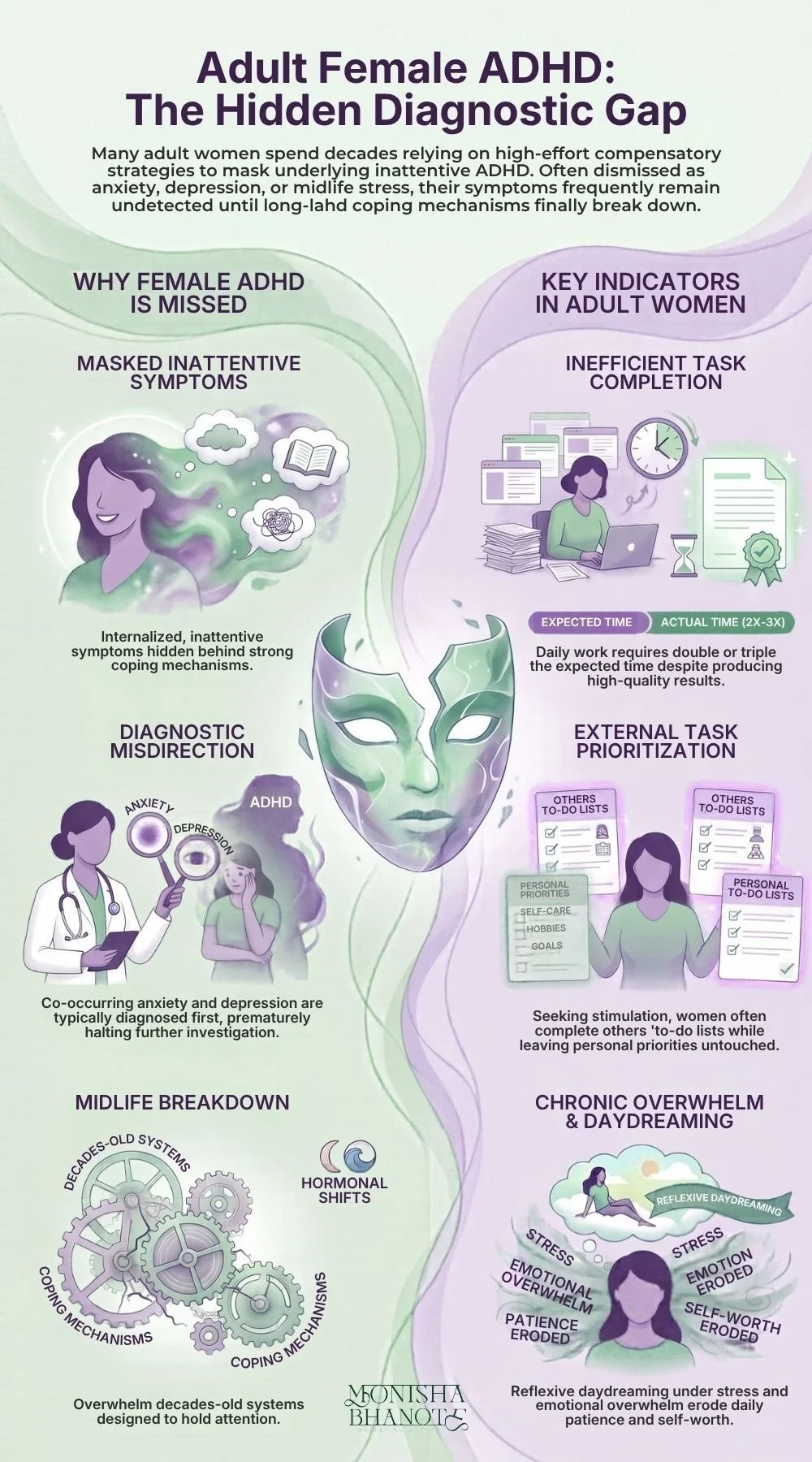
An expert consensus statement from the UK ADHD Partnership explains why women are missed so often. Girls and women more frequently show the inattentive, internalized side of ADHD. They develop compensatory strategies that mask their symptoms. And the anxiety and depression that so often travel alongside ADHD tend to be diagnosed first, which can end the investigation there.
In an adult woman, these are the signs worth paying attention to:
Constant daydreaming, often reflexive under stress, that she does not recognize as unusual
Procrastination on nearly everything, large or small, day after day
Work that takes double or triple the expected time, even when the result is excellent
Finishing everyone else's tasks while her own sit untouched
Emotional overwhelm that makes patience with herself, and others, hard to find
That fourth sign stays with me. So many of the women I care for are brilliant at finishing other people's to-do lists. Often that is generosity. Sometimes it is also a brain reaching for the more stimulating task.
Why Perimenopause Turns Up the Volume
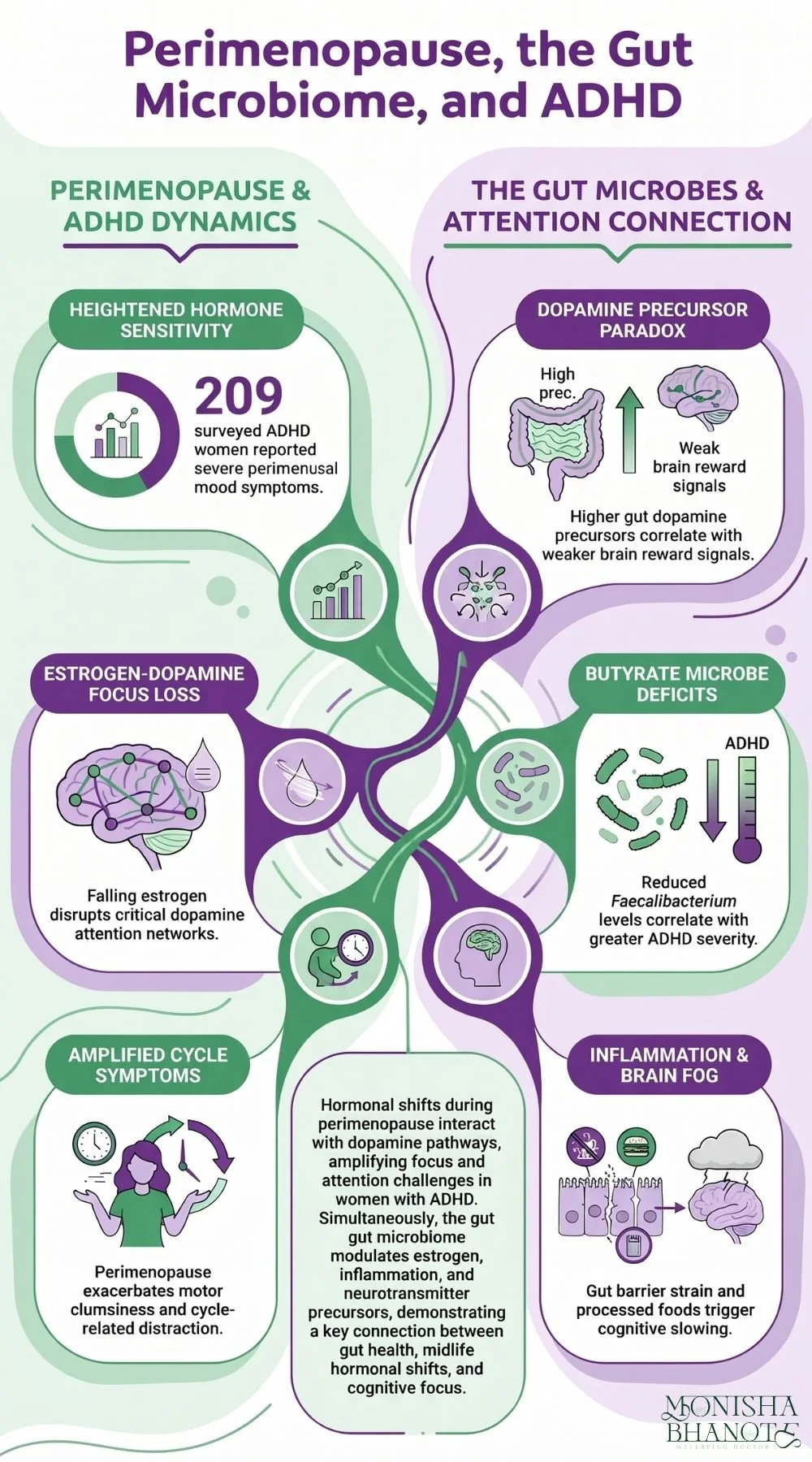
Estrogen influences how dopamine is made, released and received in the brain, and dopamine sits at the center of the reward and attention networks that ADHD affects. When estrogen begins its uneven decline in perimenopause, a brain that has always worked hard to hold focus loses some of its support. Your gut plays a part here too, since the microbiome helps regulate how much estrogen circulates, something I explored in Your Gut Is Writing Your Estrogen Story.
Researchers in the Netherlands surveyed 209 women with ADHD about hormone-related mood symptoms across their lives. They found high rates of premenstrual dysphoric symptoms and postpartum depression, and more severe symptoms during the menopause transition than reported in women from the general population. The study relied on self-report and memory, so it raises a question more than it settles one. It also mirrors what I see in practice.
One story from our conversation captures it: a creative entrepreneur in her late thirties with ADHD began physically dropping things in the days before her period, cups, keys, her phone. As her hormones shifted toward perimenopause, it happened more often, and her focus moved with her cycle.
Perimenopause can cause brain fog on its own. Still, if attention has felt effortful your whole life and midlife has made it dramatically harder, that history deserves a clinician who will assess for ADHD specifically.
What Your Gut Has to Do With Your Attention
The research here is young, and it is promising. A large share of the body's serotonin is produced in the gut, and in mice, specific gut bacteria regulate how much gets made. Gut microbes also shape immune signals that reach the brain. If the gut-brain connection is new to you, it is worth starting there.
Two human studies stand out to me. In 2017, Dutch researchers compared the gut bacteria of 19 adolescents and adults with ADHD with 77 controls. The ADHD group carried more Bifidobacterium, with greater predicted capacity to produce phenylalanine, a building block of dopamine. As a pathologist, I find the next detail the most compelling: on brain imaging, more of this microbial activity was linked to a weaker reward-center response during reward anticipation, a hallmark of ADHD. More dopamine raw material in the gut did not mean a stronger reward signal in the brain.
A year later, a study of 51 untreated children with ADHD found lower levels of Faecalibacterium, a genus prized for producing butyrate, the short-chain fatty acid that helps maintain the gut lining and quiet inflammation. The less Faecalibacterium a child carried, the more severe the symptoms their parents reported. Butyrate producers run on fiber, which most of us still eat too little of, as I wrote in Are You Getting Enough Fiber?
Both studies are small, and neither proves that bacteria cause symptoms. Diet shapes the microbiome, and ADHD shapes diet, so the arrow can point either way. What they do show is that the gut and the attention system are in conversation, and we influence that conversation every day at the table.
Inflammation is part of that conversation. When processed food, stress and poor sleep strain the gut barrier, cognitive slowing often follows. Inflammatory marker studies specific to ADHD are still mixed, but the link between systemic inflammation and brain fog is one I watch for in every patient.

Food That Supports a Focused Brain
Food does not replace an assessment, or medication when it is needed. It changes the terrain everything else works on.
Eat the Whole Pattern
In a Spanish case-control study of 120 children and adolescents, low adherence to a Mediterranean-style diet was strongly associated with an ADHD diagnosis. Children with ADHD ate less fish, fruit and vegetables, and more sugar, soda and fast food. That cannot establish cause, but it points toward a colorful, fiber-rich plate, exactly what feeds Faecalibacterium. It doesn't need to be perfect, either. More plants, less perfection is the place to start.
Bitter greens like arugula are an easy addition. Blend a handful into a smoothie with nut butter and tropical fruit, or toss it into a watermelon mint salad.
Omega-3s, Measured
A 2018 meta-analysis of randomized trials found that omega-3 supplementation modestly improved ADHD symptom scores in children and adolescents, and that young people with ADHD had lower blood levels of EPA and DHA than their peers. A follow-up trial from the same group added an important nuance. High-dose EPA improved attention most in youth who started with the lowest EPA levels, while those who started high did slightly worse on impulsivity.
That is why testing your omega-3 status with your provider before choosing a dose makes sense. For plant-based eaters, algae-based EPA and DHA are the direct source, alongside daily flax, chia and sesame seeds.
Magnesium and the Minerals Behind Dopamine
Magnesium is a cofactor in the pathways that produce dopamine and norepinephrine. A 2019 meta-analysis of observational studies found lower serum magnesium in children with ADHD than in controls. Leafy greens, beans, lentils and pumpkin seeds are the foundation, and pumpkin and sesame seeds bring zinc as well.
Turn the Package Over
The strongest evidence involves synthetic food dyes. In a randomized, double-blind UK trial, a drink with common artificial colors and the preservative sodium benzoate increased hyperactive behavior in 3-year-olds and 8- to 9-year-olds from the general population. A meta-analysis estimated that roughly 8 percent of children with ADHD may have symptoms related to synthetic colors.
Emulsifiers deserve a look too. In mice, carboxymethylcellulose and polysorbate-80 thinned the gut's protective mucus layer and promoted low-grade inflammation. I covered the bigger picture in What Ultra-Processed Foods Are Actually Doing to Your Gut Microbiome. A good rule of thumb: two or three ingredients on the label is a win.

Movement, the Lever People Skip
Of every lifestyle change we discussed, exercise has the strongest evidence, ahead of nutrition, and it is the one people like least.
A meta-analysis of eight randomized trials in children with ADHD found that aerobic exercise had a moderate to large effect on attention, and improved hyperactivity, impulsivity, anxiety and executive function. Adult research is thinner, but sustained cardio raises dopamine and norepinephrine, the same messengers stimulant medications act on.
Aim for about thirty minutes of aerobic movement, three to five times a week, with your heart rate up and held there. A brisk walk, a bike ride, pickleball. Strength training protects bone in midlife, and cardio still belongs in the week.
Sleep That Starts on Time
Trouble falling asleep is one of the most common complaints in ADHD. A meta-analysis of sleep studies in adults found that those with ADHD took noticeably longer to fall asleep and slept less efficiently when measured by wrist actigraphy.
Even one rough night can produce inattention and low mood that look a lot like ADHD. Layer that over true ADHD, add the night sweats and 3 a.m. waking of perimenopause, and it is clear why so many women in midlife feel they have lost their edge. The basics matter: a steady bedtime, a cool dark room, screens down an hour before bed, caffeine done by early afternoon.
What You Can Do Today
Start a pattern log. Note how long tasks take and where your mind drifts. Ask your partner, a sibling or a trusted coworker what they have noticed over the years. Clinicians call this collateral information, and it can shorten a diagnosis that otherwise takes years.
Ask for an ADHD-specific assessment. Anxiety and depression screening covers different ground. A clinician trained in adult ADHD can guide you to the right testing.
Track your cycle alongside your focus. If attention dips before your period or has dropped sharply in perimenopause, bring that record to your appointment.
Add bitter greens and seeds. A handful of arugula, a spoonful of ground flax or chia, pumpkin seeds over a salad.
Read labels. Skip synthetic dyes and long lists of emulsifiers when you can.
Move with your heart rate up. Thirty minutes, three to five times a week, outdoors when possible.
Make the holidays your starting line. Sign the family up for a Thanksgiving turkey trot, walking or running together, and put a lentil soup or a tofu roast on the table.

A Daily Ritual That Travels With You
Everything above comes first. Assessment, food, movement and sleep are the foundation, and no supplement replaces them or treats ADHD.
I formulated Travela Essentials to support the cellular resilience beneath a steady brain, especially when travel, deadlines and hormones all press at once. Three of its ingredients speak to this conversation.
Magnesium bisglycinate is magnesium bound to glycine, a well-absorbed form that is gentle on digestion, and it supports the enzymes that make dopamine and norepinephrine. In a double-blind trial in older adults with insomnia, magnesium shortened the time to fall asleep and improved sleep efficiency.
Turmeric brings curcumin, among the most studied anti-inflammatory plant compounds. In an 18-month placebo-controlled trial of adults aged 50 to 90 without dementia, a bioavailable curcumin improved memory and attention scores.
Ginger works alongside it. A meta-analysis of sixteen randomized trials found that ginger lowered CRP and TNF-alpha, two markers of systemic inflammation.
The formula also includes Bacopa, the Ayurvedic herb long used for memory.
The most meaningful changes are often what you stop noticing. The 3 p.m. slump. The restless hour before sleep. The scattered, wired-and-tired feeling after a long flight, which I wrote about in The Nervous System Reset Your Gut Needs When You Travel. Over weeks and months, a daily ritual that travels with you becomes one more way of keeping your cells, and your attention, supported.
#CellCare Reflection

I hope Claire's story ends with relief: finally understanding why the work she loves has always cost her more, and having a plan that makes it cost a little less.
If her story felt familiar, please hear this. Needing more structure, movement, sleep and support was never a character flaw. Your attention runs on the same biology as every other system in your body. It responds to what you eat, how you move, how you sleep and the microbes in your gut, and each of those daily choices is a conversation with your cells. That is the heart of cellular resilience.
Start with one. Lace up for a walk this week. Put a handful of greens on tonight's plate. Write down what you notice. Small, consistent acts of #CellCare are how resilience is built, one ordinary day at a time.

MAKE A DIFFERENCE BY SHARING THIS ARTICLE WITH OTHERS TO ENCOURAGE WELLBEING ⤵
References:
Aarts, Esther, Thomas H. A. Ederveen, Jilly Naaijen, Marcel P. Zwiers, Jos Boekhorst, Harro M. Timmerman, Sanne P. Smeekens, et al. 2017. "Gut Microbiome in ADHD and Its Relation to Neural Reward Anticipation." PLoS One 12 (9).
Abbasi, Behnood, Masud Kimiagar, Khosro Sadeghniiat, Minoo M. Shirazi, Mehdi Hedayati, and Bahram Rashidkhani. 2012. "The Effect of Magnesium Supplementation on Primary Insomnia in Elderly: A Double-Blind Placebo-Controlled Clinical Trial." Journal of Research in Medical Sciences 17 (12).
Cerrillo-Urbina, A. J., A. García-Hermoso, M. Sánchez-López, M. J. Pardo-Guijarro, J. L. Santos Gómez, and V. Martínez-Vizcaíno. 2015. "The Effects of Physical Exercise in Children with Attention Deficit Hyperactivity Disorder: A Systematic Review and Meta-Analysis of Randomized Control Trials." Child: Care, Health and Development 41 (6).
Chang, Jane Pei-Chen, Kuan-Pin Su, Valeria Mondelli, and Carmine M. Pariante. 2018. "Omega-3 Polyunsaturated Fatty Acids in Youths with Attention Deficit Hyperactivity Disorder: A Systematic Review and Meta-Analysis of Clinical Trials and Biological Studies." Neuropsychopharmacology 43 (3).
Chang, Jane Pei-Chen, Kuan-Pin Su, Valeria Mondelli, Senthil Kumaran Satyanarayanan, Hui-Ting Yang, Yi-Ju Chiang, Hui-Ting Chen, and Carmine M. Pariante. 2019. "High-Dose Eicosapentaenoic Acid (EPA) Improves Attention and Vigilance in Children and Adolescents with Attention Deficit Hyperactivity Disorder (ADHD) and Low Endogenous EPA Levels." Translational Psychiatry 9 (1).
Chang, Jane Pei-Chen, Kuan-Pin Su, Valeria Mondelli, and Carmine M. Pariante. 2021. "Cortisol and Inflammatory Biomarker Levels in Youths with Attention Deficit Hyperactivity Disorder (ADHD): Evidence from a Systematic Review with Meta-Analysis." Translational Psychiatry 11 (1).
Chassaing, Benoit, Omry Koren, Julia K. Goodrich, Angela C. Poole, Shanthi Srinivasan, Ruth E. Ley, and Andrew T. Gewirtz. 2015. "Dietary Emulsifiers Impact the Mouse Gut Microbiota Promoting Colitis and Metabolic Syndrome." Nature 519 (7541): 92–96. https://doi.org/10.1038/nature14232. [Preclinical: mouse model.
Díaz-Román, Amparo, Raziya Mitchell, and Samuele Cortese. 2018. "Sleep in Adults with ADHD: Systematic Review and Meta-Analysis of Subjective and Objective Studies." Neuroscience and Biobehavioral Reviews 89: 61–71.
Dorani, Farangis, Denise Bijlenga, Aartjan T. F. Beekman, Eus J. W. van Someren, and J. J. Sandra Kooij. 2021. "Prevalence of Hormone-Related Mood Disorder Symptoms in Women with ADHD." Journal of Psychiatric Research 133.
Effatpanah, Mohammad, Mahdi Rezaei, Hosein Effatpanah, Zeynab Effatpanah, Hamed Kord Varkaneh, Seyed Mohammad Mousavi, Somaye Fatahi, Giulia Rinaldi, and Rezvan Hashemi. 2019. "Magnesium Status and Attention Deficit Hyperactivity Disorder (ADHD): A Meta-Analysis." Psychiatry Research 274.
Jiang, Hai-yin, Yuan-yue Zhou, Guo-ling Zhou, Yu-chuan Li, Jing Yuan, Xiao-he Li, and Bing Ruan. 2018. "Gut Microbiota Profiles in Treatment-Naïve Children with Attention Deficit Hyperactivity Disorder." Behavioural Brain Research 347: 408–13.
McCann, Donna, Angelina Barrett, Alison Cooper, Debbie Crumpler, Lindy Dalen, Kate Grimshaw, Elizabeth Kitchin, et al. 2007. "Food Additives and Hyperactive Behaviour in 3-Year-Old and 8/9-Year-Old Children in the Community: A Randomised, Double-Blinded, Placebo-Controlled Trial." The Lancet 370 (9598): 1560–67.
Morvaridzadeh, Mojgan, Siavash Fazelian, Shahram Agah, Maryam Khazdouz, Mehran Rahimlou, Fahimeh Agh, Eric Potter, Shilan Heshmati, and Javad Heshmati. 2020. "Effect of Ginger (Zingiber officinale) on Inflammatory Markers: A Systematic Review and Meta-Analysis of Randomized Controlled Trials." Cytokine 135: 155224.
Nigg, Joel T., Kara Lewis, Tracy Edinger, and Michael Falk. 2012. "Meta-Analysis of Attention-Deficit/Hyperactivity Disorder or Attention-Deficit/Hyperactivity Disorder Symptoms, Restriction Diet, and Synthetic Food Color Additives." Journal of the American Academy of Child and Adolescent Psychiatry 51 (1).
Ríos-Hernández, Alejandra, José A. Alda, Andreu Farran-Codina, Estrella Ferreira-García, and Maria Izquierdo-Pulido. 2017. "The Mediterranean Diet and ADHD in Children and Adolescents." Pediatrics 139 (2).
Small, Gary W., Prabha Siddarth, Zhaoping Li, Karen J. Miller, Linda Ercoli, Natacha D. Emerson, Jacqueline Martinez, et al. 2018. "Memory and Brain Amyloid and Tau Effects of a Bioavailable Form of Curcumin in Non-Demented Adults: A Double-Blind, Placebo-Controlled 18-Month Trial." American Journal of Geriatric Psychiatry 26 (3): 266–77.
Yano, Jessica M., Kristie Yu, Gregory P. Donaldson, Gauri G. Shastri, Phoebe Ann, Liang Ma, Cathryn R. Nagler, Rustem F. Ismagilov, Sarkis K. Mazmanian, and Elaine Y. Hsiao. 2015. "Indigenous Bacteria from the Gut Microbiota Regulate Host Serotonin Biosynthesis." Cell 161 (2): 264–76.
Young, Susan, Nicoletta Adamo, Bryndís Björk Ásgeirsdóttir, Polly Branney, Michelle Beckett, William Colley, Sally Cubbin, et al. 2020. "Females with ADHD: An Expert Consensus Statement Taking a Lifespan Approach Providing Guidance for the Identification and Treatment of Attention-Deficit/Hyperactivity Disorder in Girls and Women." BMC Psychiatry 20: 404.
The information on this website has not been evaluated by the Food & Drug Administration or any other medical body. We do not aim to diagnose, treat, cure or prevent any illness or disease. Information is shared for educational purposes only. You must consult your doctor before acting on any content on this website, especially if you are pregnant, nursing, taking medication, or have a medical condition. Our content may include products that have been independently chosen and recommended by Dr. Monisha Bhanote and our editors. We may earn a small commission if you purchase something mentioned in this article.
YOU MAY ALSO LIKE:



by Dr. Monisha Bhanote
✅ EVIDENCE-INFORMED REVIEWED ARTICLE