
Gut Health and Anxiety: How the Gut-Brain Connection May Affect Your Mood

“Calm is not created in the mind alone. It is cultivated throughout the body, one nourishing signal at a time.”
Elena had started keeping a small bag of ginger candies in her purse. She told herself it was for the plane, for the jet lag, for the three cross-country flights she took most months for work. But the nausea did not wait for takeoff anymore. It showed up before client calls. It showed up at four in the morning, when she woke with her heart going and her stomach in a knot she could not explain. Her doctor ran bloodwork. Everything came back normal. Her sleep tracker told her she was getting seven hours a night, technically, but she woke up more tired than when she lay down. Nobody used the word anxiety. Elena did not use it either. She used words like off, and wired, and just tired, I guess.
This is one of the most common and least recognized presentations of anxiety I see, both in my own patients and in the women who write to me after a talk. It rarely announces itself. It shows up as a stomach that will not settle, a mind that will not quiet at night, a low hum of dread that gets filed under stress and lifestyle rather than named for what it actually is. People like Elena tend to be high-functioning and self-aware in every other part of their lives, which is exactly what makes this so disorienting. She could read a room, close a deal, and manage a team through a crisis, but she could not explain why her own body felt like it was bracing for one all the time.
And increasingly, the research suggests that if we want to understand where that hum comes from, we need to stop looking only at the brain and start looking at the gut.

What the Gut-Brain Axis Actually Is
For most of modern medicine, mental health was treated as something that happened exclusively above the neck. Anxiety was framed as a brain chemistry problem, treated with a brain chemistry solution. But a growing body of research, including the work of Harvard-trained psychiatrist and nutritional psychiatry pioneer Dr. Uma Naidu, is reversing the direction of that conversation. The gut and the brain develop from the same tissue in early embryonic life, and they never fully stop communicating, connected by a physical line of communication called the vagus nerve.
The Vagus Nerve: A Two-Way Line

The vagus nerve runs from the brainstem down through the chest and into the abdomen, carrying signals in both directions. For a long time, the working assumption was that this communication mostly ran downward, that stress and anxiety in the brain produced the stomach ache. What the research now shows is that the traffic runs the other way just as often, and quite possibly more. Signals originating in the gut, shaped by what you eat, how inflamed your gut lining has become, and which bacterial populations are thriving in your microbiome, travel up the vagus nerve and influence mood, stress reactivity, and cognitive clarity.
Where Serotonin Is Actually Made
Here is the detail that tends to stop people mid-sentence when I explain it. An estimated ninety percent of the body’s serotonin, the neurotransmitter most closely associated with mood regulation, is produced not in the brain but in the gut, largely by enterochromaffin cells that line the digestive tract. Research published in the journal Cell found that specific gut bacteria are directly responsible for stimulating this production; remove those bacteria, and serotonin output drops (Yano et al. 2015). This is not a minor detail. If most of your serotonin is manufactured on-site in your digestive tract, then the health of that tract is not a side note to your mental health. It may be one of its primary authors.
This reframes a question I remember from my own medical training. Selective serotonin reuptake inhibitors, the most commonly prescribed class of anti-anxiety and antidepressant medication, work by allowing more serotonin to circulate in the body. But if the gut is where the majority of that serotonin originates, a medication alone, without any attention to the gut environment producing it, is treating only half of the system.
Researchers have also begun mapping which specific bacterial populations tend to shift in people who struggle with anxiety. Lower levels of certain Lactobacillus and Bifidobacterium species show up consistently in the research on anxious populations, and both genera are known to support the gut lining and to participate in calming, GABA-related signaling. This is one reason nutritional psychiatrists increasingly ask about diet before reaching for a prescription pad, not instead of medication when it is needed, but alongside it. And it is worth naming a real limitation in the system: most U.S. hospitals still do not have an insurance-approved gut microbiome test, which means this conversation often has to start with food and lifestyle, because the diagnostic tools most people assume exist simply are not part of routine care yet.

When the Microbiome Falls Out of Balance
The gut is home to roughly a hundred trillion microorganisms, collectively known as the microbiome, and they are not passive tenants. They ferment fiber into short-chain fatty acids that calm inflammation and help maintain the integrity of the gut lining. They educate the immune system, a large share of which resides in gut-associated tissue. And they participate directly in the production and regulation of neurotransmitters, including serotonin and gamma-aminobutyric acid, or GABA, the brain’s primary calming chemical.
When that microbial balance shifts, a state researchers call dysbiosis, the downstream effects reach further than digestion. Anxiety and depression are now understood to carry a significant inflammatory component, and a gut thrown off balance by chronic stress, poor sleep, or a diet heavy in ultra-processed food becomes a reliable source of that inflammation.
Inflammation and the HPA Axis
Here is the mechanism in plain terms. An inflamed, imbalanced gut activates the hypothalamic-pituitary-adrenal axis, the body’s central stress-response system, the same system responsible for the cortisol surge you feel before a hard conversation or a turbulent flight. When the gut is contributing extra inflammatory signaling to that system, the HPA axis runs hotter than it should, and the result can feel exactly like generalized anxiety, even when nothing in a person’s external circumstances has actually changed.

Why Anxiety Often Hides
One of the more sobering patterns to emerge from recent research is how often anxiety fails to identify itself. The Lancet published a global analysis showing that cases of anxiety disorders rose by an estimated twenty-six percent worldwide during the first year of the COVID-19 pandemic (Santomauro et al. 2021), building on an already substantial baseline: an estimated 284 million people globally were living with an anxiety disorder even before that increase (James et al. 2018). Yet many of those people would not describe themselves as anxious. Anxiety hides under poor sleep. It hides under nausea, under a tight chest people attribute to reflux, under the vague sense that something is off that never quite resolves into a diagnosis. Depression and brain fog tend to announce themselves more clearly. Anxiety, especially the kind rooted in gut inflammation, tends to whisper instead.
The Ultra-Processed Food Problem
What you eat plays a direct role in which side of this cycle your gut lands on. When you eat foods rich in fiber, plant polyphenols, and healthy fats, colorful vegetables, beans and legumes, nuts, seeds, olive oil, avocado, you are feeding the beneficial bacteria in your gut. Their metabolic byproducts are short-chain fatty acids that reduce inflammation and help maintain the single-cell lining of the gut wall.
Ultra-processed foods feed a different population of bacteria entirely, and their breakdown products include compounds that begin to erode that same delicate gut lining. Over time, this contributes to a condition often called intestinal permeability, or informally a leaky gut, in which the gut barrier becomes less able to keep inflammatory particles contained where they belong. That inflammation does not stay local. It reaches the brain, contributing to what researchers call neuroinflammation, and it correlates with an uptick in anxiety, depression, and difficulty concentrating.
This does not mean an occasional processed snack undoes your gut health. It means that when ultra-processed foods make up the majority of a diet, the microbiome tends to shift in a direction that makes anxiety more, not less, likely to take hold. There is also a blood sugar piece worth naming. A diet heavy in refined carbohydrates and added sugar produces sharper glucose spikes, and each spike triggers its own small inflammatory cascade. Over time, that cascade can affect the integrity of the blood-brain barrier, the selective boundary that normally keeps inflammatory signaling out of brain tissue. When that boundary becomes more permeable, mood, focus, and cravings all become harder to regulate, which is part of why an anxious day so often comes with a craving for the exact foods that make the underlying inflammation worse.

7 Foods That Support the Gut-Brain Connection
If you are looking for a place to start, these seven categories consistently show up in the research on gut-supportive, mood-supportive eating.
Cruciferous vegetables, broccoli, cauliflower, Brussels sprouts, for their fiber and sulfur compounds that support detoxification pathways
Beans and legumes, an easy, affordable source of plant protein and prebiotic fiber that feeds beneficial bacteria
Leafy greens, rich in magnesium, a mineral involved in nervous system regulation that an estimated forty-five percent of Americans fall short of (DiNicolantonio and O’Keefe 2018)
Walnuts and chia seeds, for omega-3 fats that support the anti-inflammatory environment your gut lining needs
Alliums, garlic, onion, leeks, which contain prebiotic fibers that specifically feed beneficial bacterial strains
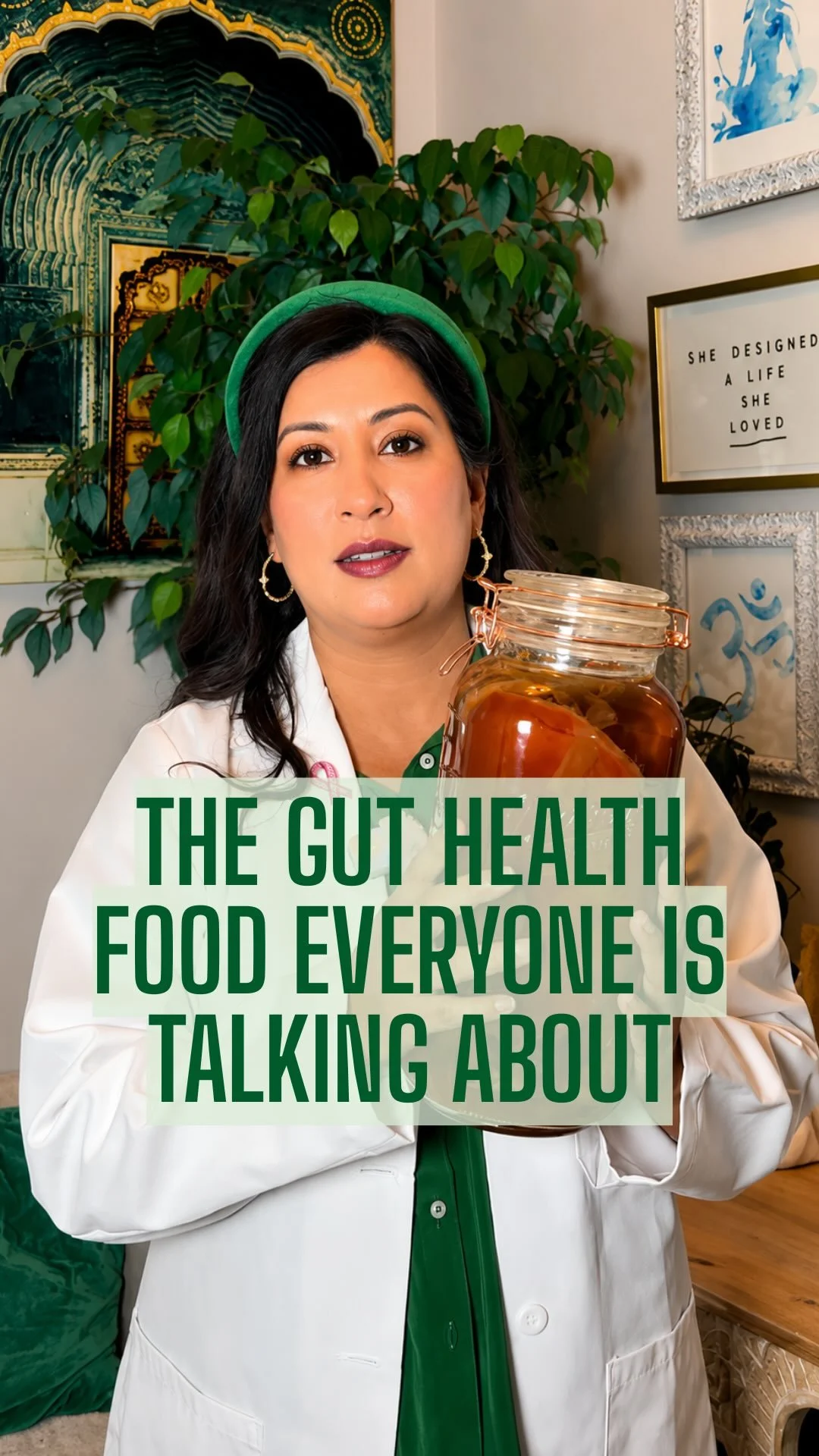
Fermented foods, sauerkraut, kimchi, plain yogurt, kefir, which introduce live beneficial bacteria directly
Colorful produce more broadly, berries, carrots, beets, for the polyphenols and carotenoids that feed and diversify the microbiome
What You Can Do Today
If you manage anxiety, low mood, or brain fog and have never once connected it to your gut, the goal is not to overhaul your entire diet this week. Nutritional psychiatry increasingly favors small, sustainable substitutions over dramatic ones, and Dr. Naidu describes this in her own practice as a three-part framework: swap, add, walk.
Swap one habit that works against your gut for one that supports it. If that is a daily soda, swap it for sparkling water. If it is a sugary snack, swap it for one with fiber and protein.
Add more plant diversity to what you already eat. This is often as simple as adding a serving of vegetables or legumes to a meal you already make, rather than adopting an entirely new way of eating.
Walk, or move, in whatever form actually helps you. This can be a twenty-minute walk, a breathwork practice, or time on a treadmill. Movement supports the same HPA axis regulation that gut health does, and the two working together are more powerful than either alone.
A note for anyone managing IBS, SIBO, IBD, or another diagnosed gastrointestinal condition: increase fiber and fermented foods gradually and under the guidance of your physician. A sudden jump in fiber intake can worsen symptoms in a sensitive gut before it improves them.

A Daily Ritual That Travels With You
For many of my patients, and for me personally, the hardest window to protect gut health is travel. Time zones shift meal timing. Airport food skews toward the ultra-processed end of the spectrum. Sleep gets disrupted, and the HPA axis, already sensitive to circadian disruption, takes on an added load right when the gut needs the most support.
This is part of why I formulated Travela Essentials around a small number of ingredients with meaningful research behind their role in stress physiology, rather than a long list of trend ingredients with little evidence to support them. Three in particular matter directly to this gut-brain, anxiety conversation.
Holy basil, also known as tulsi, is one of the more extensively studied adaptogenic herbs for stress. In randomized, placebo-controlled research, a standardized holy basil extract reduced measures of perceived stress and improved sleep quality over eight weeks, with researchers pointing to regulation of the HPA axis as a likely mechanism (Bhattacharyya et al. 2012), the same stress-signaling system that gut inflammation can inadvertently overactivate.
Gotu kola has a long history in Ayurvedic medicine as a calming herb, and modern placebo-controlled research has measured its effect on the body’s physical startle response, a proxy for baseline nervous system reactivity, finding a measurable calming effect in healthy adults.
Schisandra, a five-flavor berry used for centuries in Traditional Chinese Medicine, belongs to a small class of botanicals researchers classify as true adaptogens: substances that help the body’s stress response normalize rather than simply sedating or stimulating it.
None of these ingredients works by delivering an immediate, noticeable effect the way a cup of coffee does, and I want to be direct about that rather than let you assume otherwise. What research on adaptogens actually shows is a shift over weeks of consistent use, not an event. The most meaningful changes are often what you stop noticing: less travel fatigue creeping in by day three of a trip, fewer digestive disruptions after an unfamiliar meal, a little more room between a stressful moment and the physical reaction to it. Travela Essentials was built to be a daily ritual that travels with you, one small, evidence-informed habit layered onto the lifestyle changes that do the majority of the work.
#CellCare Reflection

Every cell in your body is in constant conversation with every other cell, and the conversation between your gut and your brain may be one of the most consequential ones happening in your body right now. You do not have to overhaul your life to change the terms of that conversation. You can start with what is on your plate tonight: one swap, one added vegetable, one short walk after dinner.
Anxiety that has been quietly living in your gut for years will not resolve in a week, but it can begin to soften, one deliberate choice at a time. That is not a small thing. That is the beginning of feeling like yourself again.


MAKE A DIFFERENCE BY SHARING THIS ARTICLE WITH OTHERS TO ENCOURAGE WELLBEING ⤵
References:
Bhattacharyya, Debashish, Tapan K. Sur, Uma Jana, and Prithwiraj K. Debnath. “Efficacy of an Extract of Ocimum tenuiflorum (OciBest) in the Management of General Stress: A Double-Blind, Placebo-Controlled Study.” Evidence-Based Complementary and Alternative Medicine 2012 (2012): article 894509.
Bradwejn, Jacques, Yueqin Zhou, Diana Koszycki, and Jerzy Shlik. “A Double-Blind, Placebo-Controlled Study on the Effects of Gotu Kola (Centella asiatica) on Acoustic Startle Response in Healthy Subjects.” Journal of Clinical Psychopharmacology 20, no. 6 (2000)
DiNicolantonio, James J., and James H. O’Keefe. “Subclinical Magnesium Deficiency: A Principal Driver of Cardiovascular Disease and a Public Health Crisis.” Open Heart 5, no. 1 (2018).
James, Spencer L., Degu Abate, Kalkidan Hassen Abate, et al. “Global, Regional, and National Incidence, Prevalence, and Years Lived with Disability for 354 Diseases and Injuries for 195 Countries and Territories, 1990–2017: A Systematic Analysis for the Global Burden of Disease Study 2017.” The Lancet 392, no. 10159 (2018).
Panossian, Alexander, and Georg Wikman. “Evidence-Based Efficacy of Adaptogens in Fatigue, and Molecular Mechanisms Related to Their Stress-Protective Activity.” Current Clinical Pharmacology 4, no. 3 (2009)
Santomauro, Damian F., Ana M. Mantilla Herrera, Jamileh Shadid, et al. “Global Prevalence and Burden of Depressive and Anxiety Disorders in 204 Countries and Territories in 2020 due to the COVID-19 Pandemic.” The Lancet 398, no. 10312 (2021): 1700–1712.
Yano, Jessica M., Kristie Yu, Gregory P. Donaldson, Gauri G. Shastri, Phoebe Ann, Liang Ma, Cathryn R. Nagler, Rustem F. Ismagilov, Sarkis K. Mazmanian, and Elaine Y. Hsiao. “Indigenous Bacteria from the Gut Microbiota Regulate Host Serotonin Biosynthesis.” Cell 161, no. 2 (2015)
The information on this website has not been evaluated by the Food & Drug Administration or any other medical body. We do not aim to diagnose, treat, cure or prevent any illness or disease. Information is shared for educational purposes only. You must consult your doctor before acting on any content on this website, especially if you are pregnant, nursing, taking medication, or have a medical condition. Our content may include products that have been independently chosen and recommended by Dr. Monisha Bhanote and our editors. We may earn a small commission if you purchase something mentioned in this article.
YOU MAY ALSO LIKE:



by Dr. Monisha Bhanote
✅ EVIDENCE-INFORMED REVIEWED ARTICLE