
Pesticides, Produce, and Tap Water: How to Protect Your Gut Without the Panic

“Healthy choices begin with clarity, not fear. Eat more plants, wash them well, and learn what is in your water.”
Ray was standing at the kitchen sink on a Sunday afternoon with a colander of red grapes and a squirt of blue dish soap. His grandkids were due at four. Earlier that week, a video on his phone had told him that plain water does nothing for pesticides and that conventional grapes were "basically poison." So he was scrubbing each cluster in suds, the way he would scrub a frying pan.
His daughter Lena came in with the groceries and stopped mid-step. "Dad. You can't wash fruit with dish soap."
"Then what am I supposed to use?"
She opened her mouth and realized she had no answer. Vinegar? A spray from the health food store? Should she be buying organic grapes?
Ray rinsed off the soap and filled a glass from the tap. Lena looked at that glass for a long second. She had spent plenty of energy worrying about what was on her food. She had never once wondered what was in her water.
If you have ever stood in the produce aisle doing mental math between organic and conventional strawberries, or read a headline about "forever chemicals" and felt your stomach tighten, this is for you. The answer is calmer and far more practical than your feed makes it sound.
At the Gut Health & Longevity Summit, I sat down with Dr. Melissa Sundermann, a double board-certified internal medicine and lifestyle medicine physician known to many as Doctor Outdoors, to talk about the ground and water that feed us. Her framework for pesticides is one of the most useful I have heard, and it starts below your feet.

Your Gut Health Begins in the Soil
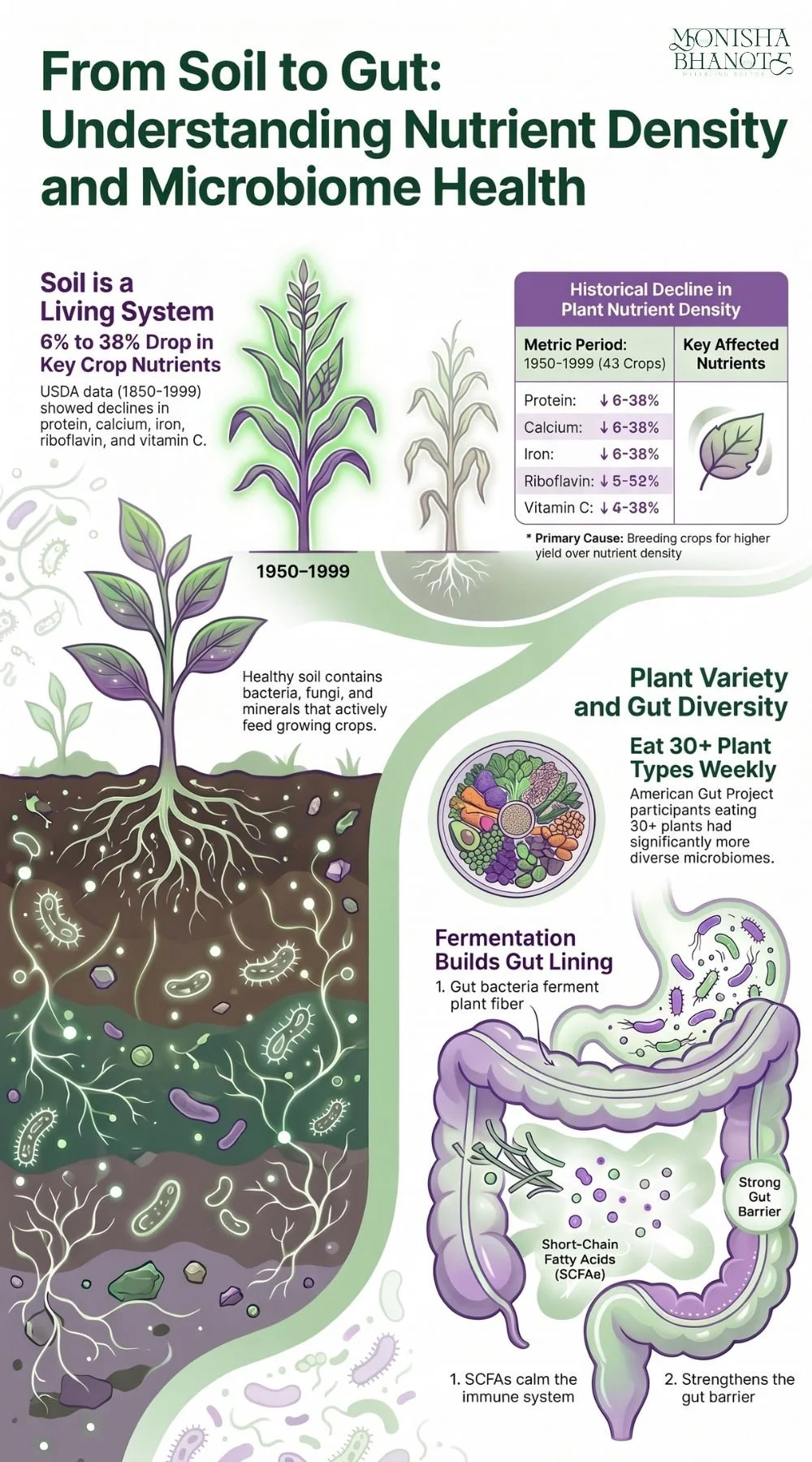
Scoop up a handful of healthy soil and you are holding a living community of bacteria, fungi, protozoa, roots, minerals, and decaying organic matter. That community cycles nutrients, holds water, and protects plants from certain pathogens. Soil has its own microbiome, and like the one in your gut, it thrives on diversity.
Plants don't create nutrients in isolation. They build them from soil, sunlight, water, microorganisms, and the way they are farmed. When researchers compared USDA nutrient data for 43 garden crops between 1950 and 1999, they found declines in six nutrients, including protein, calcium, iron, riboflavin, and vitamin C, with median drops ranging from 6 to 38 percent. The authors pointed mainly to crop varieties bred for higher yield, which can trade size for nutrient density.
That chain runs straight into your microbiome. The fiber, resistant starch, and polyphenols in plants feed your gut bacteria, which ferment them into short-chain fatty acids such as butyrate, propionate, and acetate. These molecules help maintain the gut lining and send calming signals to the immune system throughout the body. In the American Gut Project, people who ate more than 30 different plant types a week had more diverse gut microbiomes than people who ate 10 or fewer. Variety counts as much as volume, which is why I keep coming back to more plants, less perfection.
Hazard Versus Risk: A Calmer Way to Think About Pesticides
Pesticides were created to protect crops from insects, weeds, and fungi. They are also biologically active by design, which is why they worry people. Most of the conversation online sits at two extremes: pesticides are perfectly fine, or anything that isn't organic isn't worth eating.
The lens I now use with patients came out of that summit conversation. A hazard is something with the potential to cause harm. Risk is the likelihood of harm at a specific level of exposure.
Sunlight makes the difference easy to see. Ultraviolet light can damage skin, so it is a hazard. A fair-skinned skier at altitude at noon, with sun bouncing off the snow, carries a very different risk from someone taking a morning walk under a wide-brimmed hat.
Apply that to pesticides and the questions get specific. Which pesticide, how much, and how toxic is it? How often do you eat that food? Are you exposed through other routes, like farm work or living beside treated fields? Are you pregnant, very young, older, or immunocompromised? A detectable residue is a reason to ask those questions. On its own, it doesn't tell you that food is dangerous. The people with the highest exposure are farmworkers, pesticide applicators, and families living near agricultural operations.
What we know about pesticides and the gut microbiome
Animal studies have shown that certain pesticides, including the herbicide glyphosate and some organophosphate insecticides, can shift the composition of gut bacteria. A 2023 review in The ISME Journal gathered this research and concluded that the animal evidence of disruption is real enough to warrant careful study in people. Most of it comes from rodents and other animal models at controlled doses, and research in people eating ordinary diets remains limited. Reasonable caution makes sense. Fear does not.
What eating organic does and doesn't do
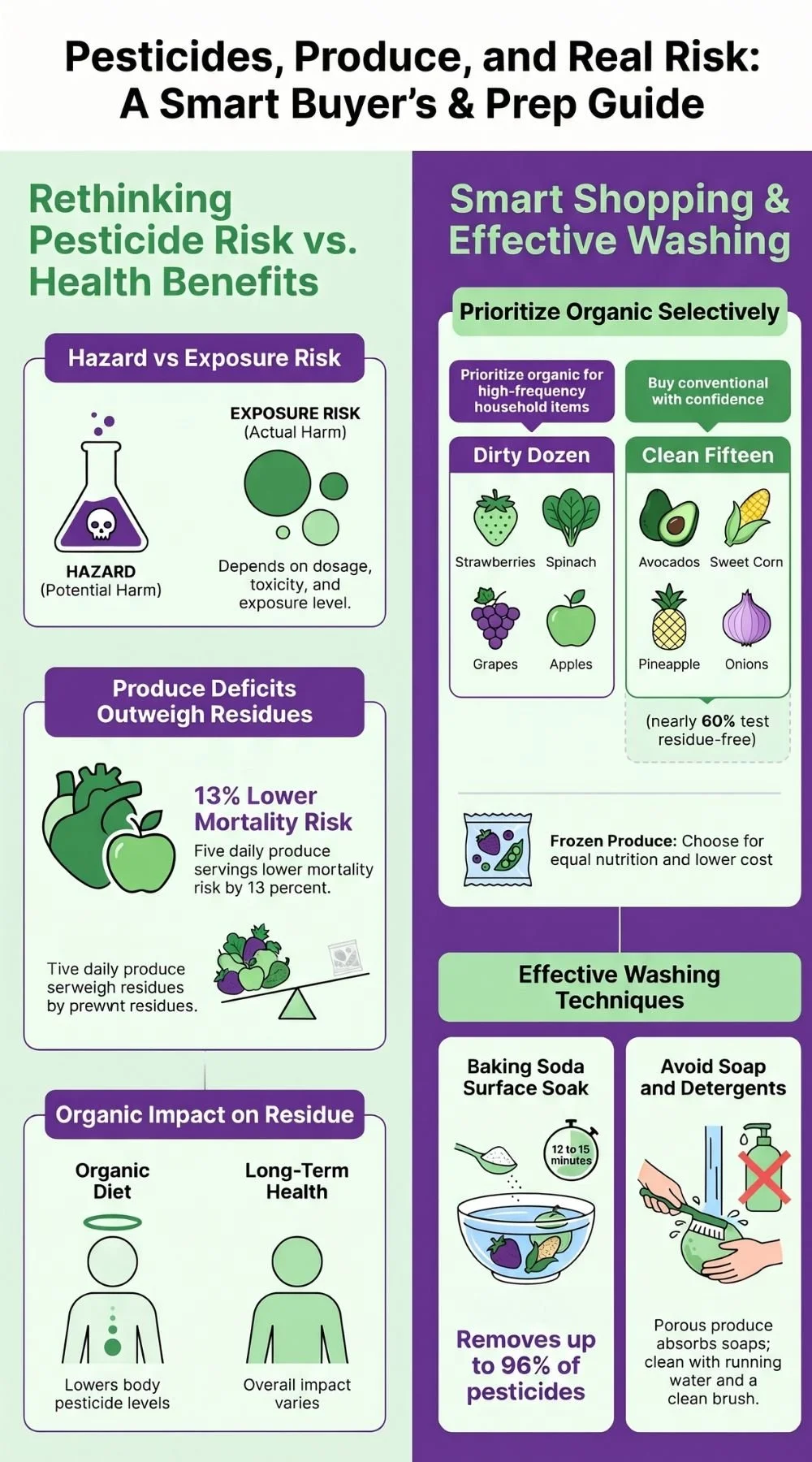
Eating organic clearly lowers your exposure to certain pesticides. In one study, four American families ate their usual diet for six days, then switched to an all-organic diet for six days. Urinary levels of several pesticides and their breakdown products fell quickly, including a 95 percent drop for malathion and about 61 percent for chlorpyrifos.
Whether that translates into less disease is less certain. A French cohort of nearly 69,000 adults found that people who ate organic food most often had about a 25 percent lower risk of cancer. A study of more than 600,000 women in the United Kingdom found little or no difference in overall cancer risk. Both are observational, and people who buy mostly organic tend to have higher incomes, smoke less, exercise more, and already eat more plants. Those differences are hard to separate from the food itself.
Keep the label in perspective, too. Organic farming permits certain approved pesticides, and natural doesn't automatically mean non-toxic.

Why eating too few vegetables is the bigger risk
For most people, the real risk sits on the other side of the plate. In an analysis of two large Harvard cohorts and 26 studies worldwide, people who ate about five servings of fruits and vegetables a day had a 13 percent lower risk of death than those who ate two. The average American eats roughly one serving of fruit and one and a half servings of vegetables a day. An estimated 95 percent of American adults and children fall short on fiber, which I explore in Are You Getting Enough Fiber?
When a video scares someone away from strawberries and spinach, it trades a small, manageable exposure for a well-documented loss.
How to Use the Dirty Dozen and Clean Fifteen on a Budget
Every spring, the Environmental Working Group publishes its Shopper's Guide to Pesticides in Produce, based on USDA testing. The lists are a tool for deciding where to spend, and EWG itself says they are not meant to discourage anyone from eating fruits and vegetables.
The 2026 Dirty Dozen, the conventional produce with the most pesticide residues, is spinach; kale, collard, and mustard greens; strawberries; grapes; nectarines; peaches; cherries; apples; blackberries; pears; potatoes; and blueberries. Many have thin, edible skins or textured surfaces where residues collect.
The 2026 Clean Fifteen, the produce with the lowest residues, is pineapple, sweet corn, avocados, papaya, onions, frozen sweet peas, asparagus, cabbage, cauliflower, watermelon, mangoes, bananas, carrots, mushrooms, and kiwi. Nearly 60 percent of Clean Fifteen samples had no detectable residues, which makes these easy places to buy conventional with confidence.
This is how I use the lists in real life:
Buy organic selectively. Put your organic budget toward the Dirty Dozen items your household eats most often. If berries are in your bowl every morning, that is where organic earns its price.
Compare prices in season. At the height of berry season, organic and conventional often cost about the same.
Keep frozen produce on hand. Fruits and vegetables are frozen at peak ripeness, and a two-year study found frozen produce held its vitamins as well as fresh, and sometimes better than fresh produce that had sat in the refrigerator for five days.
Talk to the grower. At the farmers market, ask how they manage pests. Organic certification is expensive, so a small farm's practices can surprise you in either direction.
Grow something. I have sprouts on my windowsill right now. A pot of herbs on a balcony counts too.
How to Wash Produce the Right Way
Back to Ray's dish soap. Soap, detergent, and bleach don't belong on food. Produce is porous, and the FDA warns that soap residues can be absorbed even after thorough rinsing. Expensive produce sprays aren't necessary either.
The everyday method takes less than a minute:
Wash your hands for 20 seconds first.
Cut away bruised or damaged areas, and discard the outer leaves of lettuce and cabbage.
Wash produce before you cut or peel it, so the knife doesn't carry anything from the surface inside.
Rub produce under cool running water. Use a clean brush on firm items like potatoes, carrots, cucumbers, and melons.
Dry with a clean towel, which further reduces bacteria left on the surface.
The baking soda soak
For fruit with edible skins, like apples, grapes, nectarines, and pears, a baking soda soak goes further. Researchers at the University of Massachusetts tested it on apples treated with two common pesticides. A soak in a 1 percent baking soda solution, roughly one teaspoon per two cups of water, removed about 80 percent of one pesticide after 12 minutes and 96 percent of the other after 15 minutes. A two-minute rinse in tap water, or in the bleach solution used commercially, was far less effective. Baking soda helps break pesticide molecules apart. It can't reach residues that have moved deeper into the peel, which is one more reason to rotate what you buy.
My routine is simple. Fill a large bowl with water, stir in a spoonful or two of baking soda, soak the fruit for 12 to 15 minutes, then rinse well under running water.
Where vinegar fits
In The Anatomy of Wellbeing, I share the household rinses I rely on, including a dilute white vinegar rinse for some foods. Vinegar research is stronger for reducing surface bacteria than for removing pesticides, so I reach for baking soda when residue is my concern. Whichever you use, finish with plain running water.
None of this needs to become a project. A patient once told me it took her three hours to prep a salad because she washed and air-dried every leaf. A good rinse, a salad spinner, and a few minutes are enough. And since spinach tops the Dirty Dozen, give it a proper rinse and turn it into this Spinach & Garlic Sauté.

The Glass of Water Nobody Thinks About
Remember Lena, staring at her father's glass of tap water. Water gets far less attention than food in gut health conversations, yet it touches nearly every process in the body. You drink it, cook with it, and wash your produce in it.
When patients ask which filter to buy, the better first question is this: Where does your water come from, and what is actually in it? That order matters. A filter chosen without that information can spend your money on the wrong problem.
If your water comes from a public system
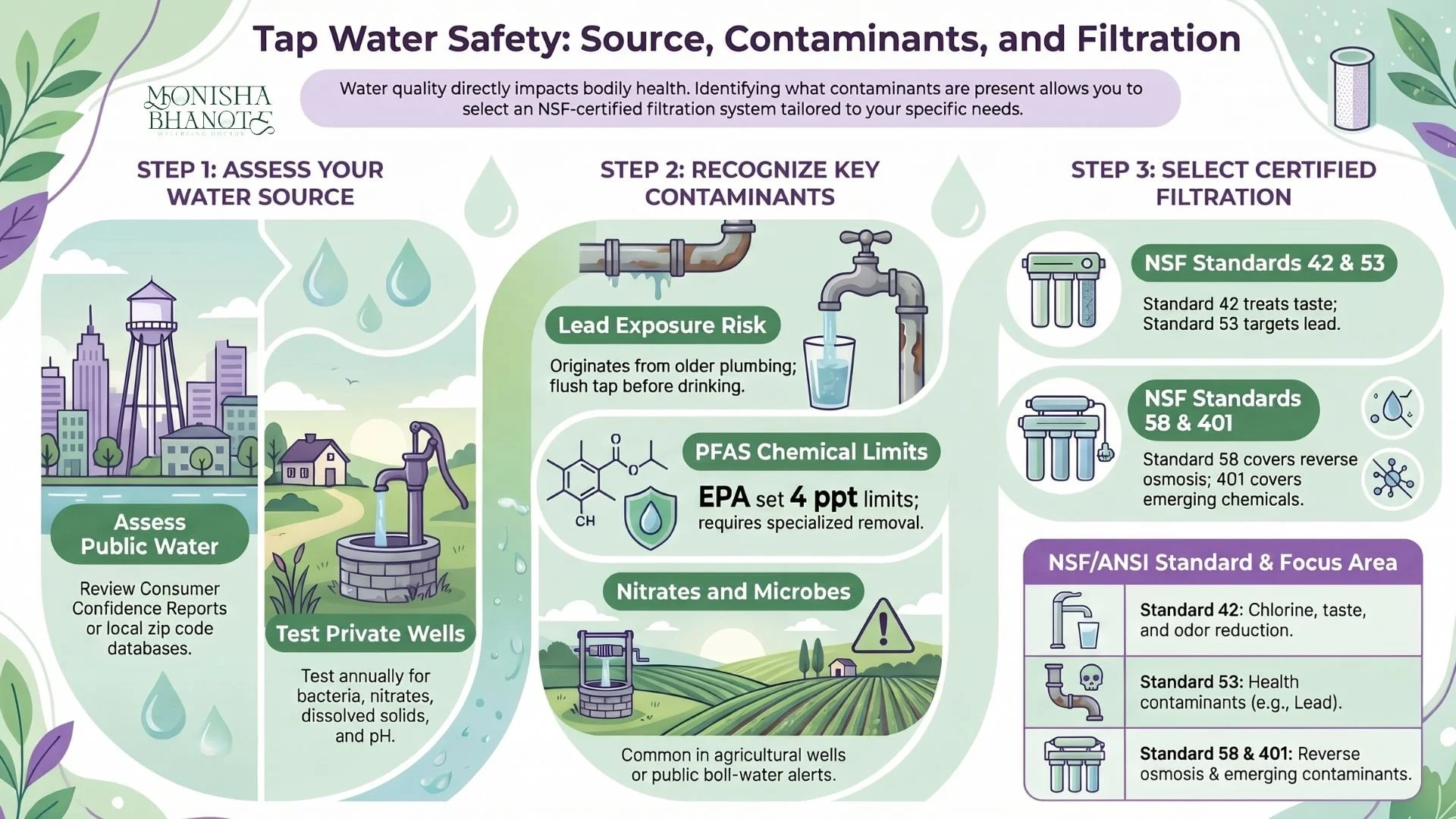
Your utility is required to publish an annual Consumer Confidence Report. It lists where your water comes from, the contaminants detected, how those levels compare with federal limits, and any violations. Most utilities post it online. Starting in 2027, systems serving more than 10,000 people must send it twice a year.
The Environmental Working Group's Tap Water Database lets you enter your zip code and see what has been detected in your local water. I use it with patients because it turns a vague worry into a specific answer.
If you have a private well
Well water is the homeowner's responsibility. The CDC recommends testing at least once a year for total coliform bacteria, nitrates, total dissolved solids, and pH. Test again after flooding or well repairs, if the taste, smell, or color changes, if there is construction nearby, or when a pregnancy or new baby joins the household.
The contaminants worth knowing
Lead. No safe blood lead level has been identified for young children. You can't see, taste, or smell it, and it usually comes from older service lines, solder, and plumbing fixtures, especially in homes built before 1986. Use cold water for drinking and cooking, run the tap to flush water that has been sitting in the pipes, and clean your faucet aerators now and then.
PFAS. These persistent "forever chemicals" come from industrial sites, landfills, and firefighting foam. In 2024, the EPA set enforceable limits of 4 parts per trillion for two of the most common, PFOA and PFOS. In 2026, the agency proposed keeping those limits while allowing some water systems until 2031 to comply. Not every filter removes PFAS.
Nitrates and microbes. Nitrates are most common in agricultural areas and in private wells. Bacteria, viruses, and parasites are mainly a concern for wells, after flooding, or when a public system fails and issues a boil-water notice.
Matching the filter to your water
Once you know what is in your water, choose a filter certified to reduce it under NSF/ANSI standards. Standard 42 covers taste, odor, and chlorine. Standard 53 covers health-related contaminants such as lead. Standard 58 covers reverse osmosis systems, and Standard 401 covers emerging contaminants. For lead, the CDC recommends a filter certified to both Standards 53 and 42. Many pitcher and refrigerator filters are certified only for taste, so check the specific contaminant.
Filtration comes in three levels:
Activated carbon. Pitchers and faucet filters improve taste and reduce chlorine. Some models are certified for lead or specific PFAS, so read the label.
Reverse osmosis. This removes a broader range of dissolved contaminants. It costs more, uses extra water, and strips out some beneficial minerals along with the unwanted ones.
Whole-house systems. These treat every tap and make sense when a contaminant matters for bathing as well as drinking.
In my own home, I use a whole-house filter plus reverse osmosis for drinking water. For renters, or anyone who can't install a system under the sink, I like AquaTru, a countertop reverse osmosis purifier certified by IAPMO to NSF/ANSI Standards 42, 53, 58, and 401. You fill it from the tap and it lives on your counter. I explain why I chose it in What's in Your Water? Why AquaTru Is the Purifier Every Wellness Home Needs, and you'll find it among my #CellCare favorites.
Our content may have affiliate links, through which we earn a small commission at no extra cost to you.

What You Can Do Today
Look up your water. Find your utility's Consumer Confidence Report or enter your zip code in the EWG Tap Water Database. If you have a well, book a test.
Choose one Dirty Dozen item to buy organic, the one your household eats most often.
Try a baking soda soak on your next bag of apples or grapes.
Add one new plant this week, whether that is a fresh herb, a different bean, or a fruit you have never cooked with.
Stock frozen berries and greens so produce is always within reach.
Retire the dish soap for produce. Cool running water, your hands, and a brush do the job.
#CellCare Reflection
When I asked my summit guest for the one thing to do this week, her answer was simple: don't let perfect be the enemy of good. Eat more plants. They don't have to be organic. You don't have to fear every residue, every filter decision, or every headline about oxalates and lectins. Think abundance before restriction.
The health of your gut is downstream of the health of your soil and your water. Every cell in your body is built from what you eat and drink, and the choices that protect those cells look like a bowl of fruit soaking in baking soda water, five minutes with your water report, a handful of frozen blueberries in your morning smoothie. Take care of the ground under your feet, and it will take care of you back.
If you'd like more practical science like this in your inbox, join the #CellCare Wellness Newsletter. And if you would like to experience this way of living in person, explore my wellness retreats, where time in nature is part of the practice.



MAKE A DIFFERENCE BY SHARING THIS ARTICLE WITH OTHERS TO ENCOURAGE WELLBEING ⤵
References:
Mahmud, Md. Rayhan, Sharmin Akter, Sanjida Khanam Tamanna, Lincon Mazumder, Israt Zahan Esti, Sanchita Banerjee, Sumona Akter, Md. Rakibul Hasan, Mrityunjoy Acharjee, Md. Sajjad Hossain, and Anna Maria Pirttilä. "Impact of Gut Microbiome on Skin Health: Gut-Skin Axis Observed Through the Lenses of Therapeutics and Skin Diseases." Gut Microbes 14, no. 1 (2022)
Bradbury, Kathryn E., Angela Balkwill, Elizabeth A. Spencer, Andrew W. Roddam, Gillian K. Reeves, Jane Green, Timothy J. Key, Valerie Beral, and Kirstin Pirie. "Organic Food Consumption and the Incidence of Cancer in a Large Prospective Study of Women in the United Kingdom." British Journal of Cancer 110, no. 9 (2014): 2321–2326.
Davis, Donald R., Melvin D. Epp, and Hugh D. Riordan. "Changes in USDA Food Composition Data for 43 Garden Crops, 1950 to 1999." Journal of the American College of Nutrition 23, no. 6 (2004): 669–682.
Environmental Working Group. "EWG's 2026 Shopper's Guide to Pesticides in Produce." March 2026. https://www.ewg.org/foodnews/.
Hyland, Carly, Asa Bradman, Roy Gerona, Sharyle Patton, Igor Zakharevich, Robert B. Gunier, and Kendra Klein. "Organic Diet Intervention Significantly Reduces Urinary Pesticide Levels in U.S. Children and Adults." Environmental Research 171 (2019): 568–575.
Li, Linshan, Ronald B. Pegg, Ronald R. Eitenmiller, Ji-Yeon Chun, and Adrian L. Kerrihard. "Selected Nutrient Analyses of Fresh, Fresh-Stored, and Frozen Fruits and Vegetables." Journal of Food Composition and Analysis 59 (2017): 8–17.
Matsuzaki, Rie, Eoin Gunnigle, Violette Geissen, Gerard Clarke, Jatin Nagpal, and John F. Cryan. "Pesticide Exposure and the Microbiota-Gut-Brain Axis." The ISME Journal 17 (2023): 1153–1166.
McDonald, Daniel, Embriette Hyde, Justine W. Debelius, James T. Morton, Antonio Gonzalez, Gail Ackermann, Alexander A. Aksenov, et al. "American Gut: An Open Platform for Citizen Science Microbiome Research." mSystems 3, no. 3 (2018): e00031-18.
Quagliani, Diane, and Patricia Felt-Gunderson. "Closing America's Fiber Intake Gap: Communication Strategies From a Food and Fiber Summit." American Journal of Lifestyle Medicine 11, no. 1 (2017): 80–85.
US Environmental Protection Agency. "National Primary Drinking Water Regulations: Consumer Confidence Report Rule Revisions." Federal Register 89 (May 24, 2024).
US Environmental Protection Agency. "Proposed PFOA and PFOS Compliance Extension Rule." May 2026.
Wang, Dong D., Yanping Li, Shilpa N. Bhupathiraju, Bernard A. Rosner, Qi Sun, Edward L. Giovannucci, Eric B. Rimm, et al. "Fruit and Vegetable Intake and Mortality: Results From 2 Prospective Cohort Studies of US Men and Women and a Meta-Analysis of 26 Cohort Studies." Circulation 143, no. 17 (2021): 1642–1654.
Yang, Tianxi, Jeffery Doherty, Bin Zhao, Amanda J. Kinchla, John M. Clark, and Lili He. "Effectiveness of Commercial and Homemade Washing Agents in Removing Pesticide Residues on and in Apples." Journal of Agricultural and Food Chemistry 65, no. 44 (2017): 9744–9752.
The information on this website has not been evaluated by the Food & Drug Administration or any other medical body. We do not aim to diagnose, treat, cure or prevent any illness or disease. Information is shared for educational purposes only. You must consult your doctor before acting on any content on this website, especially if you are pregnant, nursing, taking medication, or have a medical condition. Our content may include products that have been independently chosen and recommended by Dr. Monisha Bhanote and our editors. We may earn a small commission if you purchase something mentioned in this article.
YOU MAY ALSO LIKE:




by Dr. Monisha Bhanote
✅ EVIDENCE-INFORMED REVIEWED ARTICLE