
Running on Empty: A Physician's Look at Cellular Fatigue

“Energy is something your cells create when they're given the conditions to thrive.”
The 2 P.M. Wall You Can't Explain
You wake up before your alarm because you've read that morning sunlight sets your circadian rhythm. You've swapped your afternoon coffee for green tea. You track your sleep, your HRV, your steps. You eat clean, you move your body, you've even started journaling before bed. On paper, you are doing everything a wellness magazine would tell you to do.
And yet, somewhere around 2 or 3 in the afternoon, it hits. Not tiredness exactly — something heavier. Your thoughts slow down. Your legs feel like they're moving through water. You find yourself rereading the same email three times. If you traveled recently, even a short flight, the fatigue doesn't lift after a good night's sleep — it lingers for days, sometimes longer.
I hear this story on repeat in my practice, almost word for word, from women and men in their 40s, 50s, and 60s who are otherwise vibrant, accomplished, health-literate people. They come to me convinced something is wrong with their willpower, their discipline, their diet. What I tell them is usually a relief: this isn't a discipline problem. It's a cellular one.

What Nobody Tells You About Aging Energy
Here is what I wish someone had explained to my patients years earlier, before the fatigue became their new normal: the exhaustion you feel by mid-afternoon may have very little to do with how much sleep you got last night, and everything to do with how well your mitochondria are functioning.
As a quintuple board-certified physician who has spent years studying the human body at the cellular level — first as a pathologist looking directly at tissue under a microscope, now as an integrative physician helping people restore vitality — I can tell you that mitochondria are where the real story of aging is written. These microscopic, bean-shaped structures live inside nearly every cell in your body, and they are responsible for producing more than 90 percent of your cellular energy in the form of ATP. Every thought you think, every step you take, every ounce of resilience you draw on during a hard week — it all starts here.
What almost nobody explains, though, is how steep the decline really is. Research shows mitochondrial function can drop by as much as 30 percent per decade starting around age 40. That is not a gentle slope. That is a cliff. By the time you reach your 60s or 70s, you're not simply working with less energy — you're operating on a power grid that was never designed to run this long without maintenance.
It Isn't Just Age. It's Exposure
Aging alone doesn't fully explain what my patients describe. Increasingly, what I see in the clinic reflects something else: an accumulation of everyday exposures that place chronic, quiet stress on the mitochondria long before a person turns 40. Constant psychological stress. Disrupted sleep from screens and shifting schedules. Ultra-processed food that offers calories without the cofactors cells need to use them. Air pollution. Chronic low-grade inflammation. None of these register as an emergency in the moment, but mitochondria are exquisitely sensitive to this kind of sustained low-level burden — and over years, the wear adds up.
This is the piece I most want people to understand: your mitochondria are not simply aging. In many cases, they are being worn down by a modern environment they were never built to withstand. And that reframes the entire conversation, because it means this isn't a problem you're powerless against. It's one you can actively protect against.
The CoQ10 Myth: Why Your Multivitamin Isn't Enough
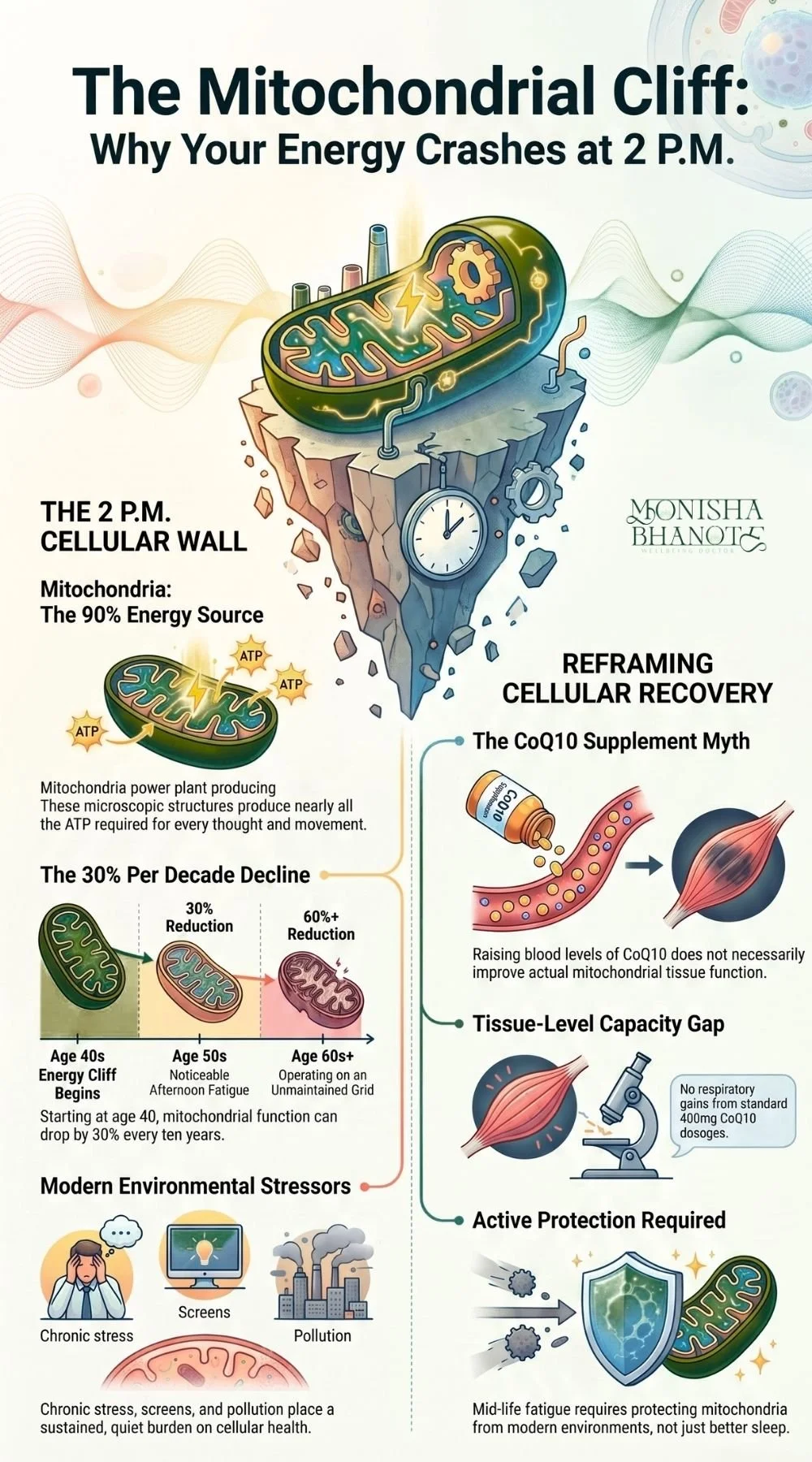
If you've ever walked into a supplement aisle looking for "energy support," you've almost certainly seen Coenzyme Q10 on the label. It has been the gold standard of mitochondrial support for decades, and for good reason — CoQ10 is a genuine antioxidant and a key player in the electron transport chain, the process that generates ATP.
But a landmark study published in 2026 in the journal GeroScience asked a more precise question than most research before it: does raising CoQ10 in the bloodstream actually change how mitochondria function? The researchers ran a twelve-week, double-blind, placebo-controlled trial in older adults with an average age of 74, giving one group a high dose of CoQ10 — 400 milligrams daily. Blood levels of CoQ10 rose significantly, exactly as expected.
But when the researchers looked directly at the muscle tissue — at the actual mitochondria doing the work — nothing had changed. No improvement in mitochondrial respiratory capacity. No reduction in oxidative stress markers inside the cell. No gains in VO2 max or physical performance.
Why More Fuel Didn't Mean More Energy
I find this study fascinating, because it captures something I try to explain to patients constantly: raising a nutrient's level in your bloodstream is not the same as improving how your cells actually use it. CoQ10 got where it was supposed to go, plasma-wise. But getting into the mitochondria, and being put to work once there, is a separate biological event entirely — one that depends on a whole supporting cast of other nutrients and signals.
This is really the foundation of what I call CellCare: the understanding that your cells don't respond to single ingredients in isolation. They respond to synergy. A single "hero molecule" approach — however popular — rarely reflects how a living, integrated system like the human body actually works.

The Missing Half of the Story: Building, Not Just Fueling
If CoQ10 is fuel for mitochondria that already exist, there's a separate and, in my view, far more exciting question: can your body actually build new mitochondria? The research increasingly says yes — and this is where the conversation usually surprises even my most health-literate patients.
PQQ and the Process of Mitochondrial Biogenesis
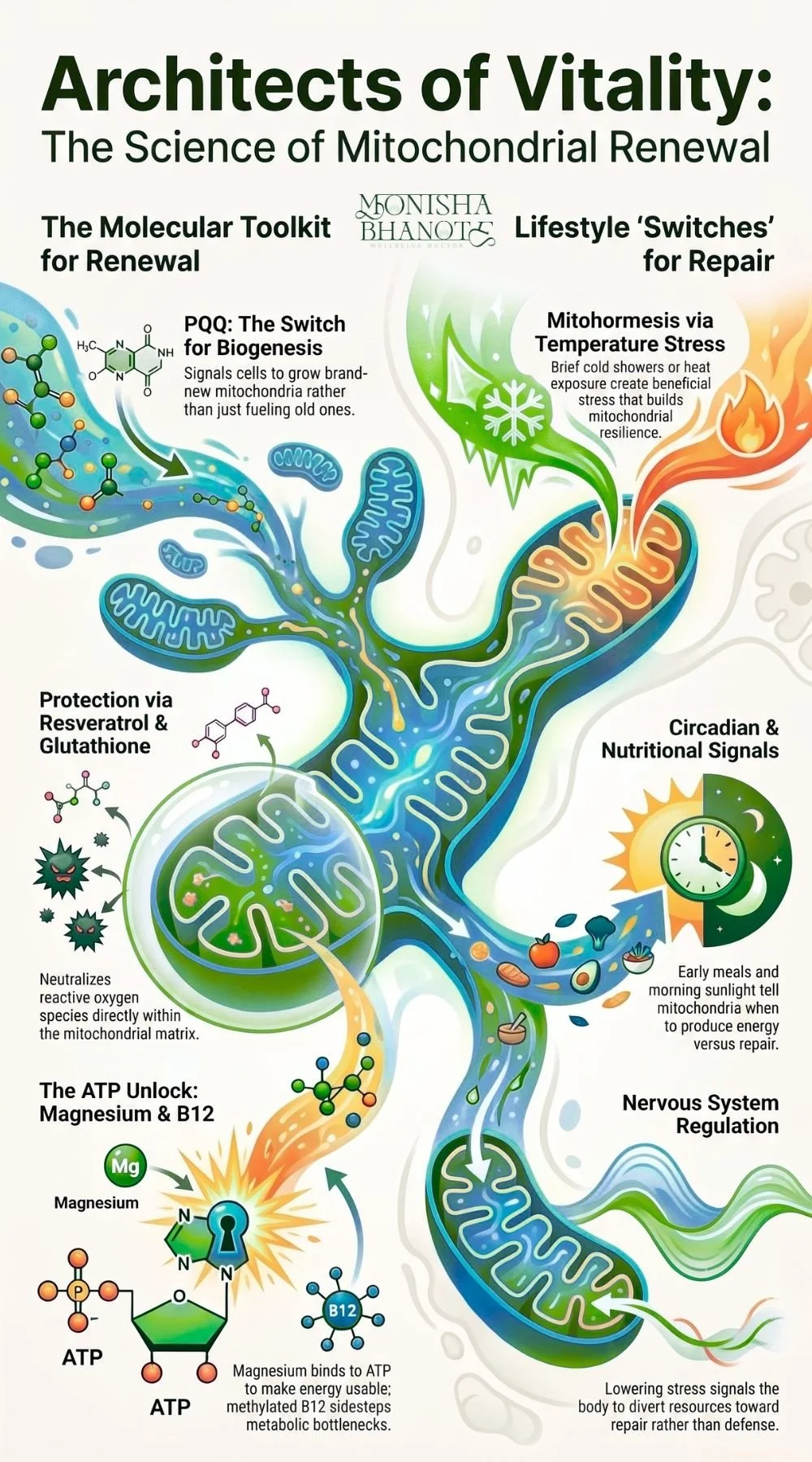
Pyrroloquinoline quinone, or PQQ, is a compound most people have never heard of, despite the fact that it does something CoQ10 cannot: it signals your cells to generate new mitochondria altogether, through a process called mitochondrial biogenesis. PQQ activates a set of pathways — AMPK, SIRT1, and PGC-1α — that function almost like master switches for cellular renewal.
Research published in Frontiers in Aging and in Acta Pharmacologica Sinica has demonstrated PQQ's distinct ability to stimulate mitochondrial growth in aging cells, and additional research in Aging Cell has shown PQQ's capacity to influence the aging immune landscape at the single-cell level. For anyone over 40, this reframes what's actually possible. We are not limited to squeezing marginally more output from tired, damaged organelles. There is real, published evidence that the body can be signaled to renew its own cellular power supply.
Protecting What You Build: Resveratrol and Glutathione
Building new mitochondria is only half the story, though, because the very process of producing energy generates its own exhaust — reactive oxygen species that, left unchecked, damage mitochondrial DNA and membranes over time. This is why any serious approach to mitochondrial health has to include protection, not just production.
Resveratrol, sometimes called the longevity molecule, works alongside PQQ by activating SIRT1, helping prime the cellular environment for repair rather than decline. Glutathione, often referred to as the master antioxidant, is one of the only compounds capable of working directly inside the mitochondrial matrix — meaning it neutralizes damage at its source, inside the very structure under stress, rather than mopping it up elsewhere in the body.
The Cofactors Nobody Mentions: Magnesium and Methylated B12
Here is something I wish more people understood: even with plenty of fuel, a growing new supply of mitochondria, and adequate antioxidant protection, the system still won't run without the right operational tools. Every single molecule of ATP must bind to a magnesium ion before it can be used by your body. Without sufficient magnesium, the energy your mitochondria produce is effectively locked away, unusable. Magnesium bisglycinate in particular is well absorbed and has the added benefit of supporting a calm, regulated nervous system.
Mitochondrial metabolism is also deeply dependent on methylation, a biochemical process many people struggle with due to common genetic variations like MTHFR, which make it harder to process standard synthetic B12. Methylated B12, or methylcobalamin, sidesteps that bottleneck, giving cells what they need to convert nutrients into usable energy without the metabolic lag so many of my patients describe.

Solutions Start With Lifestyle — Not Another Bottle
I want to be honest about something: I did not become a physician to sell supplements, and I do not believe any bottle should be the first answer to fatigue. Before we talk about anything you might take, I want to talk about what you can change.
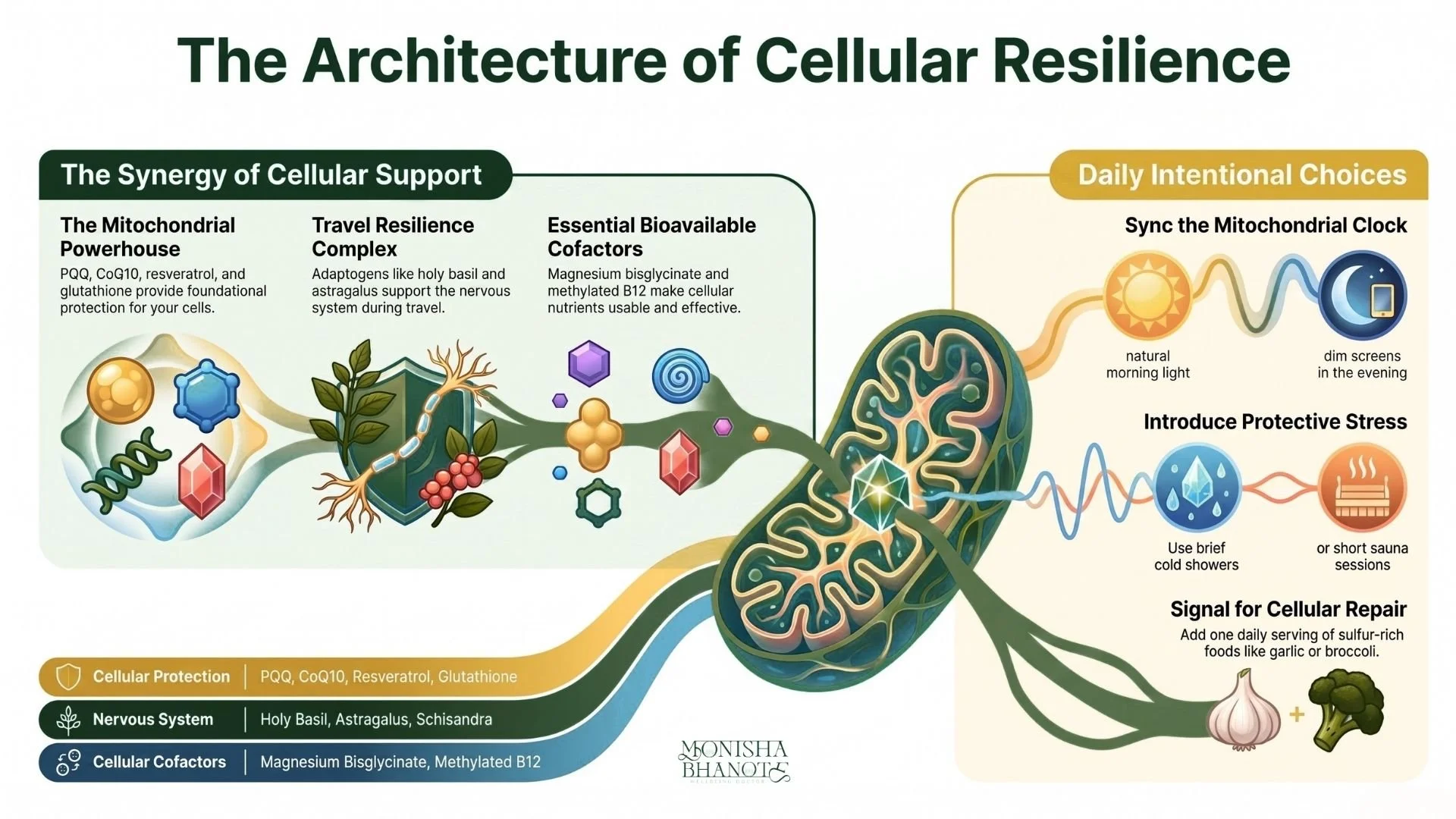
The first place I look with patients is circadian rhythm, because your mitochondria have their own internal clocks, and they repair most efficiently when your daily rhythms are consistent. Eating your largest meal earlier in the day, getting natural light within the first hour of waking, and dimming screens in the evening all send your cells a clear, consistent signal about when it's time to produce energy and when it's time to rest and repair.
The second is what I call temperature as medicine — brief, intentional exposure to cold or heat. A thirty-second cold shower at the end of your normal routine, or a short sauna session if you have access to one, creates a mild, beneficial stress called mitohormesis. In small, controlled doses, this kind of stress actually makes your mitochondria more resilient, not less.
The third is food, and specifically the sulfur-rich foods that support your body's own natural glutathione production — arugula, garlic, and cruciferous vegetables like broccoli and cauliflower. You do not need a supplement to start supporting your master antioxidant; you need a grocery list.
And the fourth, which I believe is the most overlooked, is nervous system regulation. When your nervous system is dysregulated — living in a low-grade state of stress or hypervigilance — your mitochondria divert resources toward defense rather than repair. A few minutes of slow breathing before a stressful meeting, a short walk without your phone, or a consistent wind-down ritual before bed all send your nervous system, and by extension your mitochondria, the signal that it's safe to rebuild.
When You're Already Doing "All the Right Things"

I want to speak directly to something many of my patients admit almost sheepishly: they are already taking a handful of supplements, and the idea of adding one more feels exhausting in itself. I understand that completely, and I want to be clear that lifestyle changes come first, always. No supplement replaces sleep, sunlight, food, or nervous system regulation.
But for people who have already built a strong foundation and are looking for the next layer of support — particularly those who are simply asking more of their bodies at 45 or 55 than they did at 25 — this is often where a conversation about Travela Essentials comes up in my practice. Rather than isolating a single ingredient, it was formulated around the same synergy I've described throughout this article: PQQ alongside CoQ10, resveratrol and glutathione for protection, and the cofactors — magnesium bisglycinate and methylated B12 — that make all of it usable at the cellular level. It also includes what I call the Travel Resilience Complex, a blend of adaptogens including holy basil, astragalus, and schisandra, designed to support the nervous system during the specific stress of travel, so your mitochondria can stay focused on repair rather than defense.
I want to be honest about what this can and cannot offer. It is not a twenty-minute fix, and I would be skeptical of anything that claims to be. In my experience, the most meaningful shifts are often the ones you stop noticing rather than the ones you feel immediately — less travel fatigue after a long flight, less digestive disruption when your routine changes, less brain fog by mid-afternoon, a little more resilience the next time life gets stressful. I think of it as a daily ritual that travels with you, meant to support your body's own intelligence rather than override it.
What You Can Do Today
If you take one thing from this article, let it be this: you do not need to overhaul your entire life to begin supporting your mitochondria. A few consistent, intentional choices matter more than any dramatic change.
Get natural light within the first hour of waking, and dim screens in the evening to support your mitochondrial clock.
Try a brief cold shower or a short sauna session to introduce healthy, protective stress.
Add one serving of a sulfur-rich food — arugula, garlic, or broccoli — to a meal today.
Give your nervous system a few minutes of true rest before your most stressful hour of the day.
If you're considering any new protocol, give it real time. Cellular renewal unfolds over months, not days.
#CellCare Reflection
Every cell in your body is in constant conversation with the choices you make — what you eat, how you move, whether you allow your nervous system to rest. Mitochondrial health may be the clearest expression of that conversation, because it reminds us that vitality is not something we chase from the outside in. It is something we build, quietly and cumulatively, from the inside out.
You don't have to solve for energy today. You simply have to give your cells one clear signal that you're listening. That, to me, is the essence of Cell Consciousness: small, intentional choices, repeated with patience, that allow your body's own intelligence to do what it was designed to do — repair, renew, and thrive, for decades to come.




MAKE A DIFFERENCE BY SHARING THIS ARTICLE WITH OTHERS TO ENCOURAGE WELLBEING ⤵
The information on this website has not been evaluated by the Food & Drug Administration or any other medical body. We do not aim to diagnose, treat, cure or prevent any illness or disease. Information is shared for educational purposes only. You must consult your doctor before acting on any content on this website, especially if you are pregnant, nursing, taking medication, or have a medical condition. Our content may include products that have been independently chosen and recommended by Dr. Monisha Bhanote and our editors. We may earn a small commission if you purchase something mentioned in this article.
YOU MAY ALSO LIKE:




by Dr. Monisha Bhanote
✅ EVIDENCE-INFORMED REVIEWED ARTICLE