
Nothing Worth Building Happens in a Week: A Physician's Case for Cellular Patience

“Your cells respond from day one, but lasting change is built through what you repeat”
Two Mondays ago, you started something new. Not one thing — two. A resistance training program, three mornings a week, because your trainer promised visible results by summer. And, on the same day, a foundational supplement protocol — magnesium, a gut-support blend, a daily adaptogen — because your labs suggested you needed the support, and you were finally ready to be consistent.
Fourteen days later, you are standing in front of the bathroom mirror, flexing at an angle that feels a little desperate, looking for a change that has not arrived. Your arms look the same. Your stomach still bloats after dinner most nights. You open the app that logs your workouts and see fourteen dutiful check marks, seemingly unrewarded, and a small, familiar voice starts to ask: is any of this actually doing anything?
That question is not about willpower. It is about expectation. Somewhere along the way, most of us learned that consistency should produce a result we can see within two weeks — and when the body declines to cooperate on that schedule, it feels like proof that something went wrong, rather than proof that we are exactly on time.
You are exactly on time. You simply do not yet have the vocabulary for what “on time” means at the level of your muscle fibers, your gut lining, and your cells. That vocabulary is the subject of this piece — and once you have it, the mirror on day fourteen stops reading like a verdict and starts reading like a single frame in a process that was always going to take longer than two weeks. It has always taken longer for a body to grow strong, for a gut to grow resilient, and for a bottle of supplements to earn its place in your morning.

The Expectation We Inherited From the Medicine Cabinet, Not the Supplement Shelf
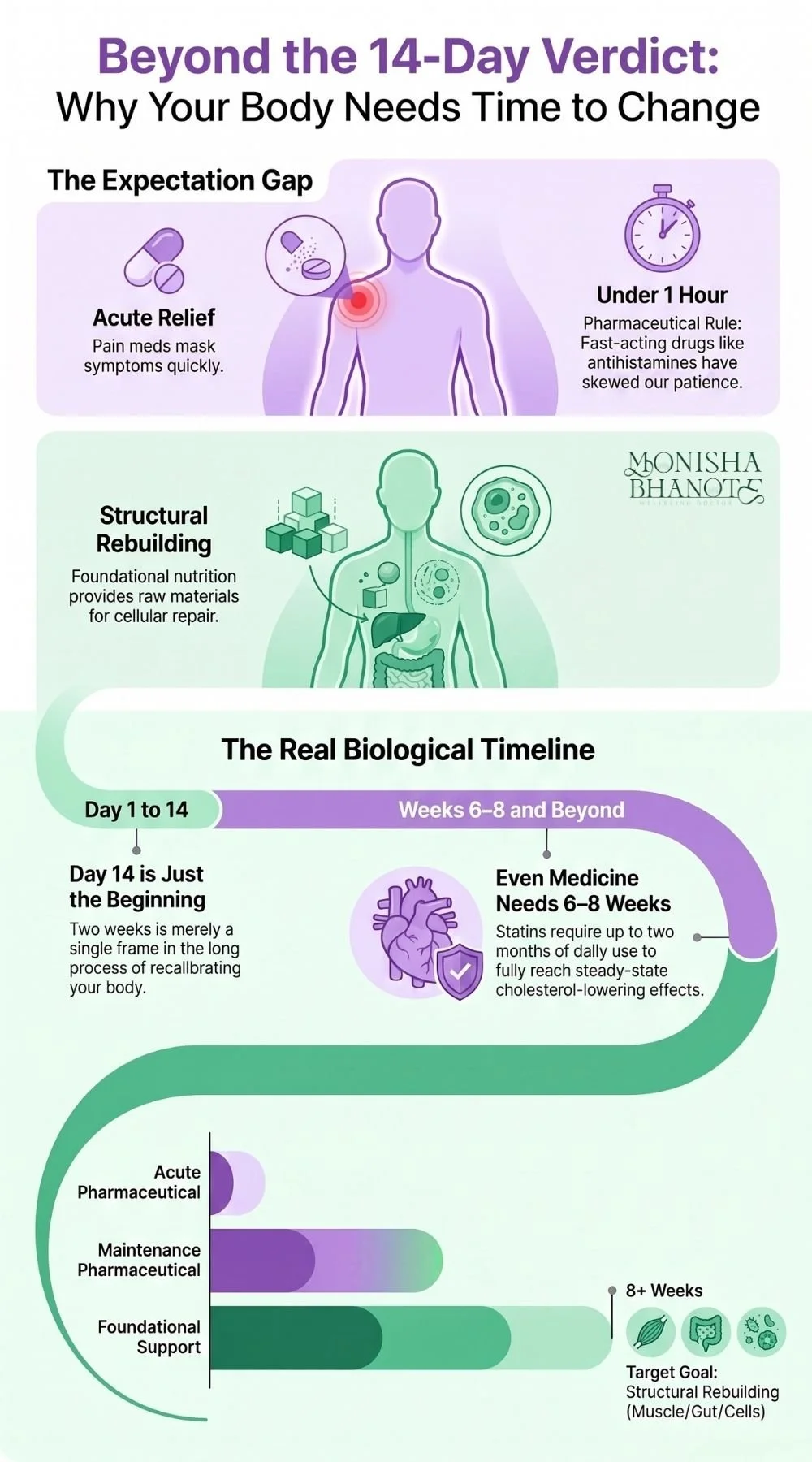
Most of us learned how “working” is supposed to feel from pharmaceuticals, not from foundational nutrition. Take a pain reliever, and the ache softens within the hour. Take an antihistamine, and the sneezing stops before lunch. Experiences like these quietly wrote a rule into our expectations: real intervention should be felt almost immediately, or it isn’t real.
But even inside the world of pharmaceuticals, that rule is closer to the exception than the norm. Consider the statin, among the most widely prescribed medications for cholesterol management. A statin does begin inhibiting its target enzyme within hours of the first dose. Yet the cholesterol-lowering effect a physician actually measures in blood work does not fully arrive on day one — it builds gradually over four to six weeks and typically reaches its full, steady-state effect only after six to eight weeks of daily use, as the liver slowly up-regulates the receptors that clear LDL cholesterol from circulation.
I share this not to suggest that supplements and medications are interchangeable — they are not, and I would never imply otherwise. I share it because even our fastest-acting, most rigorously studied pharmaceuticals still ask the body for weeks, not days, to complete their work. If a statin needs six to eight weeks to fully lower cholesterol, it is not reasonable to expect a botanical compound working through gentler, more indirect pathways to prove itself in fourteen days.
The compounds that shaped our instincts — the ones that work within the hour — are almost always addressing an acute symptom: pain, congestion, a spike in blood pressure. They are not rebuilding tissue, recalibrating a hormonal axis, or restoring a depleted store. Supplements, botanicals, and food-based compounds are rarely doing acute symptom control. They are doing something slower, and ultimately more structural: giving your cells consistent raw material and consistent signals so they can do the rebuilding themselves.
Why the Gym Is the Best Teacher You Already Have
Here is where your own body offers the clearest lesson, if you let it.
Nobody walks into a gym for the first time, trains three days a week for two weeks, and expects to look like a different person. You already understand, intuitively, that visible muscle takes months. But the biology behind that intuition is worth naming, because the same biology governs your supplement cabinet.
When you lift a weight, muscle protein synthesis — the cellular process that builds new contractile tissue — rises quickly, staying elevated for up to seventy-two hours after a single training session. That is the invisible, cellular-level “yes” your body offers almost immediately. But an elevated synthesis rate is not the same thing as visible muscle. Research on trained individuals has shown that measurable increases in muscle fiber size generally begin to appear after roughly six weeks of consistent, high-volume resistance training, with the kind of definition you can actually see in a mirror typically taking eight to twelve weeks or longer. The training was working from day one. The evidence of that work simply needed time to accumulate.
Your supplement routine follows an almost identical arc. Magnesium, adaptogenic botanicals, and omega-3 fatty acids begin acting on your cells immediately — supporting enzyme function, calming an overactive stress axis, becoming part of a cell membrane — but the outward, measurable sign of that action needs the same kind of accumulation a bicep does. In one of the more precise studies on this question, researchers tracking omega-3 fatty acid levels directly in human skeletal muscle found that twelve full weeks of consistent fish oil supplementation were required before those fatty acids meaningfully increased within the muscle's own membranes. Twelve weeks — three months — for a compound to become structurally part of the tissue it was meant to support. That is not a slow supplement. That is simply how membranes are built.
What a Week of Meal Prep Actually Does to Your Microbiome
The second analogy lives in your kitchen, and it is, if anything, even more precise.
Your gut microbiome is well known, at this point, for reacting fast. A landmark study out of Harvard found that switching human volunteers to an entirely plant-based or entirely animal-based diet altered the composition of their gut bacteria within a single day, with the changes fully established by the third day. That finding gets cited constantly, usually to argue that dietary change works instantly. It does — but the same body of research, and studies that followed its protocol, revealed something people mention far less often: those changes reverse almost as quickly as they appear. When volunteers returned to their normal way of eating, their microbial communities drifted back toward baseline within a matter of days.
A more recent study out of the University of Florida measured this directly. Researchers placed healthy volunteers on a short, calorie- and protein-restricted diet for four days, then returned them to their usual eating pattern. The beneficial shift in gut bacteria they had achieved — including increases in the very species responsible for producing butyrate, the short-chain fatty acid that nourishes the colon and calms intestinal inflammation — had largely reverted within three days of resuming a normal diet.
This is the meal-prep truth in a single data point. One disciplined week of vegetables, fiber, and fermented foods genuinely moves your microbiome, sometimes within twenty-four hours. But your gut does not bank that progress the way a savings account holds a deposit. It behaves more like a living garden that needs tending on a schedule than a project you complete once. The species that support your digestion, your mood, and your immune tolerance are opportunistic — they expand when you feed them and contract almost the moment you stop. A single strong week is real. Biologically, though, it functions more like a rehearsal than a renovation.

What Consistency Is Actually Asking of Your Cells
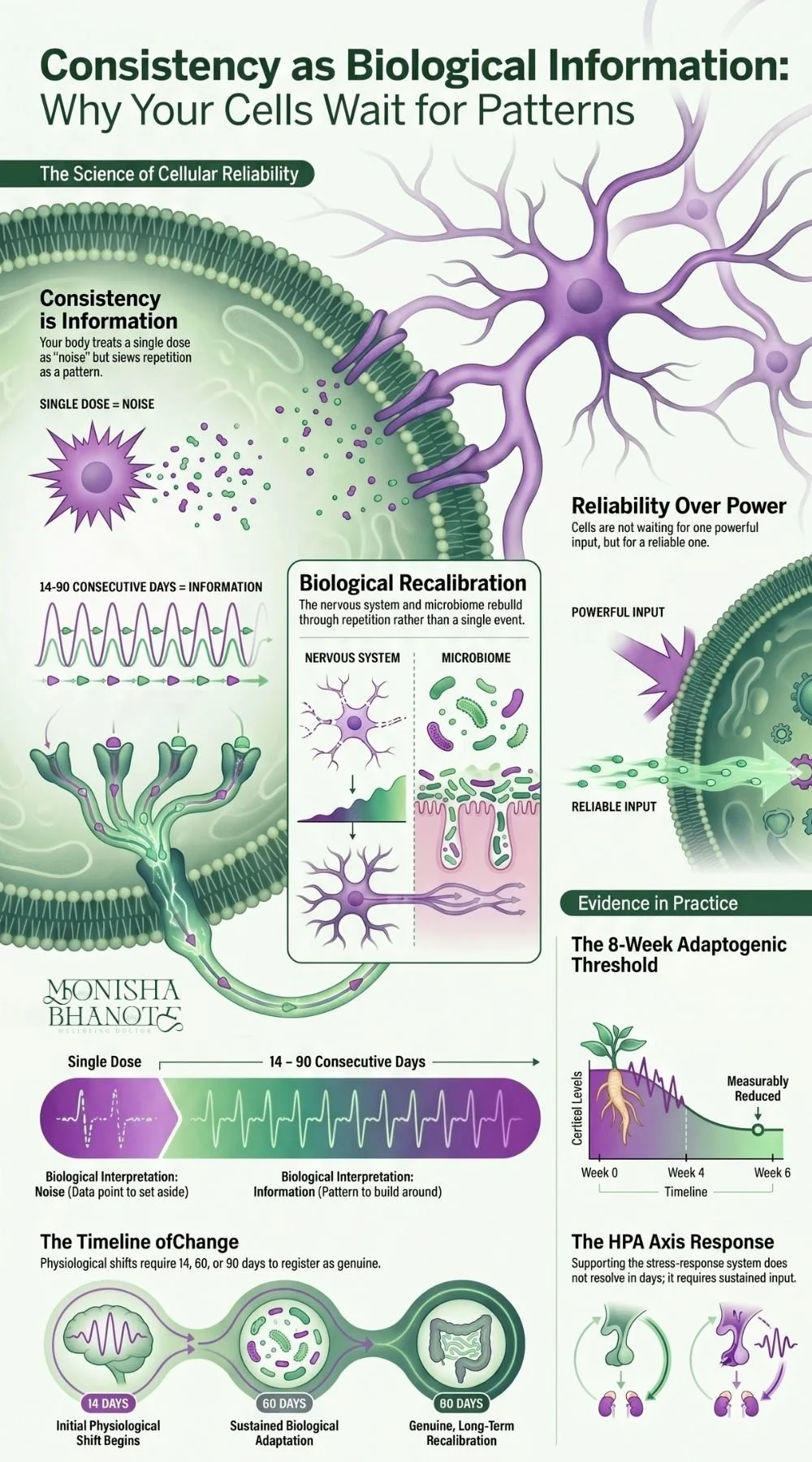
Once you see this pattern across muscle, gut, and blood chemistry, the underlying mechanism becomes easy to hold onto: your cells are not waiting for one powerful input. They are waiting for a reliable one.
The common thread running through the statin, the muscle fiber, the microbiome, and the adrenal axis is this: your body treats consistency as information. A single dose of almost anything, however well-formulated, reads to your physiology as noise — a data point it can reasonably set aside. Fourteen consecutive days, sixty consecutive days, ninety consecutive days: that begins to read as a pattern your cells can safely build around. Even the most sophisticated cellular machinery cannot distinguish a genuine lifestyle shift from a two-week experiment until enough time has passed to tell the difference.
What You Can Do Today
You do not need to overhaul anything to work with this biology instead of against it. A few adjustments make the difference:

Anchor your supplements to an existing habit — your morning coffee, your toothbrushing — so consistency does not depend on memory alone.
Choose a routine and stay in it for at least eight weeks before judging results — long enough for muscle protein synthesis to translate into visible change, and long enough for a botanical compound to reach the tissue it was meant to support.
Track how you feel, not only how you look. Digestion, sleep quality, and afternoon energy often shift weeks before anything visible does.
Feed your gut daily, not occasionally. A single vegetable-forward day helps; a repeated pattern of fiber, variety, and fermented foods is what your microbiome actually recognizes as home.
Simplify before you add. A routine built around three things you take every single day will outperform one built around twelve things you take some days, because your cells respond to frequency more than they respond to volume.
A Ritual Built for the Timeline Your Cells Actually Keep
This is precisely the philosophy behind Travela Essentials. Formulated with ingredients like magnesium bisglycinate, holy basil, and CoQ10, it was never designed to be felt by Wednesday. It was designed to be taken every day, for long enough, that your gut lining, your mitochondria, and your stress response have the raw material — and the rhythm — they actually require to rebuild.
The honest measure of whether it is working is rarely a dramatic before-and-after. More often, it is what quietly stops happening: the travel fatigue that used to linger for three days now clears in one. The digestive disruption you used to expect after a long flight does not show up at all. The three o’clock fog that once derailed your afternoon simply isn’t there anymore. Travela Essentials is not a rescue. It is a daily ritual that travels with you, built for a body that keeps its promises on its own timeline.

#CellCare Reflection
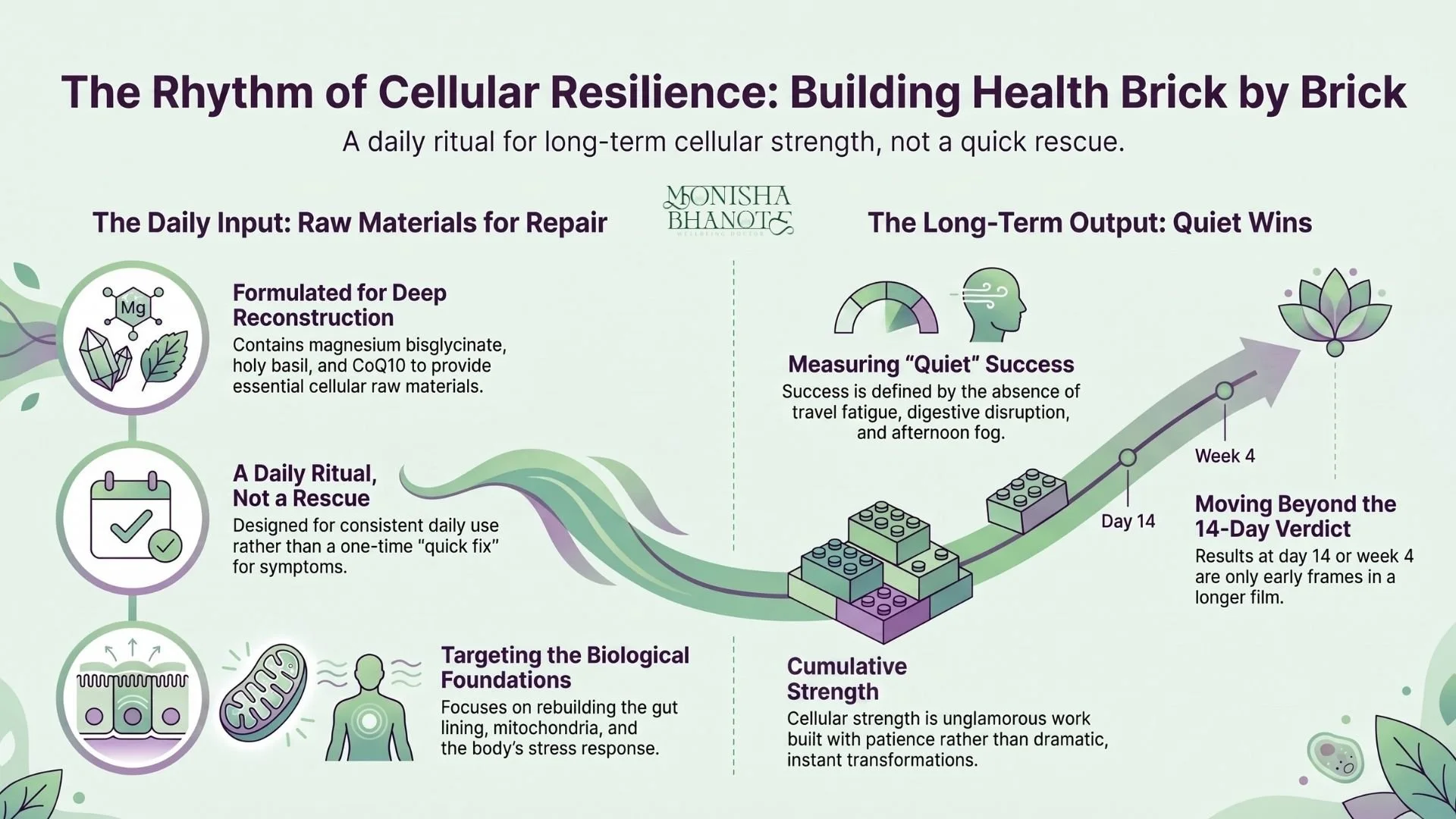
Your cells have never asked you to be perfect. They have only ever asked you to be repeatable. The mirror on day fourteen, the lab result at week four, the supplement that “isn’t doing anything yet” — none of these are verdicts. They are early frames in a longer film, one your body is still shooting on a timeline it never borrowed from a pharmacy. Real cellular resilience, the kind that outlasts a single good week, is built the way anything durable is built: brick by brick, day by day, with far more patience than drama.
That is the quiet, unglamorous work of #CellCare — and it is, without exception, worth finishing what you started.



MAKE A DIFFERENCE BY SHARING THIS ARTICLE WITH OTHERS TO ENCOURAGE WELLBEING ⤵
References:
David, Lawrence A., Corinne F. Maurice, Rachel N. Carmody, David B. Gootenberg, Julie E. Button, Benjamin E. Wolfe, Alisha V. Ling, et al. “Diet Rapidly and Reproducibly Alters the Human Gut Microbiome.” Nature 505, no. 7484 (2014): 559–63.
Salve, Jaysing, Sucheta Pate, Khokan Debnath, and Deepak Langade. “Adaptogenic and Anxiolytic Effects of Ashwagandha Root Extract in Healthy Adults: A Double-Blind, Randomized, Placebo-Controlled Clinical Study.” Cureus 11, no. 12 (2019): e6466.
Haun, Cody T., Christopher G. Vann, Shelby C. Osburn, Petey W. Mumford, Paul A. Roberson, Matthew A. Romero, Carlton D. Fox, et al. “Muscle Fiber Hypertrophy in Response to 6 Weeks of High-Volume Resistance Training in Trained Young Men Is Largely Attributed to Sarcoplasmic Hypertrophy.” PLOS ONE 14, no. 6 (2019): e0215267.
Anderson, Erik M., Jared M. Rozowsky, Brian J. Fazzone, Emilie A. Schmidt, Bruce R. Stevens, Kerri A. O’Malley, Salvatore T. Scali, and Scott A. Berceli. “Temporal Dynamics of the Intestinal Microbiome Following Short-Term Dietary Restriction.” Nutrients 14, no. 14 (2022): 2785.
Gerling, Christopher J., Kazutaka Mukai, Adrian Chabowski, George J. F. Heigenhauser, Graham P. Holloway, Lawrence L. Spriet, and Sebastian Jannas-Vela. “Incorporation of Omega-3 Fatty Acids Into Human Skeletal Muscle Sarcolemmal and Mitochondrial Membranes Following 12 Weeks of Fish Oil Supplementation.” Frontiers in Physiology 10 (2019): 348.
Statin Medications.” In StatPearls. Treasure Island, FL: StatPearls Publishing, updated 2024. National Center for Biotechnology Information Bookshelf.
The information on this website has not been evaluated by the Food & Drug Administration or any other medical body. We do not aim to diagnose, treat, cure or prevent any illness or disease. Information is shared for educational purposes only. You must consult your doctor before acting on any content on this website, especially if you are pregnant, nursing, taking medication, or have a medical condition. Our content may include products that have been independently chosen and recommended by Dr. Monisha Bhanote and our editors. We may earn a small commission if you purchase something mentioned in this article.
YOU MAY ALSO LIKE:






by Dr. Monisha Bhanote
✅ EVIDENCE-INFORMED REVIEWED ARTICLE