The Resveratrol Conversation: What Happens When your Berries Talk to your Gut

“Every plant you eat carries a message. Your microbes translate it, your cells respond, and resilience is built in the conversation.”
Picture a hotel terrace in Porto, string lights just switched on, a client dinner three courses deep. Someone lifts a glass of Douro red and toasts “to longevity” — resveratrol, they say, is why the French live so long, why a good wine is practically medicine. You nod and sip, and by the second glass you have nearly convinced yourself this is self-care. The next morning tells a different story: puffiness under the eyes, a stomach that feels swollen despite the salads and grilled fish you ordered all week, a low fog that no amount of espresso quite clears. You did everything “right” and still feel undone.
If that disconnect sounds familiar — the well-intentioned toast, the quiet confusion the next morning — you are not imagining it. The cultural story around resveratrol has been hijacked by bottles of red wine for so long that we have forgotten wine is a clumsy, diluted, and frankly inflammatory way to deliver a molecule that was never designed to travel with alcohol in the first place. When we look at resveratrol through the lens of cellular biology, something more interesting than a wine myth emerges: your food is not simply fuel. It is a conversation with the trillions of microbes living in your gut, and that conversation is where this polyphenol’s real power begins.

Beyond the bottle: where resveratrol actually lives
When people hear the word resveratrol, their minds drift reflexively to vineyards and wine cellars. But if we want to engage our biology with any real intention, we need to look past the glassware to the whole foods nature actually designed to carry this polyphenol.

At the top of that list sits the muscadine grape (Vitis rotundifolia), native to the southeastern United States. Unlike common table grapes, muscadines carry exceptionally thick skins and extra chromosomes, concentrating resveratrol and related compounds at levels most other fruits cannot match. The skin and seeds are where that botanical archive is stored — which is exactly why we do not peel our grapes in this house.
Beyond muscadines, the resveratrol spectrum is rich and refreshingly accessible: wild blueberries and bilberries, which develop their deep pigment by upregulating their own antioxidant defenses under environmental stress — defenses that transfer some benefit to us when we eat them; tart cranberries and lingonberries; mulberries, long used in traditional botanical medicine; the papery skins of peanuts and pistachios; and dark chocolate or raw cocoa, rich in complementary flavonoids.
A 2026 review in the journal Dietary Supplements and Nutraceuticals, part of the broader Functional Food Science literature curated by researcher Danik Martirosyan and colleagues, makes a useful case for this whole-food approach: resveratrol from grape skins, berries, and peanuts arrives bundled with fiber, co-occurring flavonoids, and micronutrients — a complex matrix that an isolated capsule, or a glass of wine, simply cannot replicate. We do not need alcohol to access the intelligence of the vine. We need to return to the unadorned brilliance of the whole fruit.
The polyphenol paradigm: signaling, not forcing
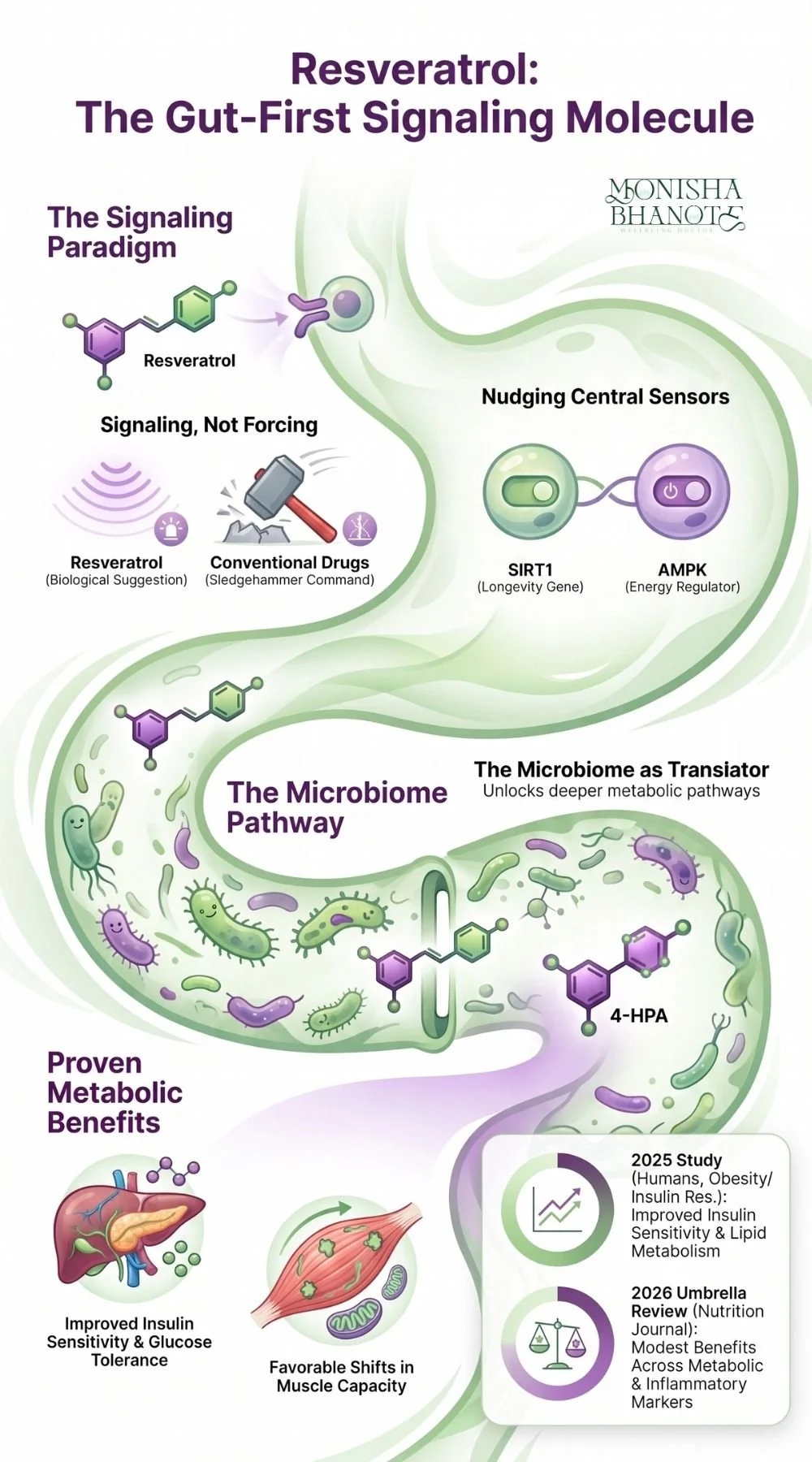
Conventional pharmacology tends to work like a sledgehammer — forcing receptors open, blocking enzymes with brute force, overriding the body’s own feedback loops. Polyphenols operate on an entirely different register. Resveratrol is not a drug forcing an outcome; it is an informational molecule, offering your cells a suggestion rather than a command.
When you eat resveratrol-rich foods, you are introducing a signal to two of your body’s central sensors: SIRT1, often called the “longevity gene,” and AMPK, the master regulator of cellular energy. Neither is dragged into a new state; both are nudged, gently and repeatedly, toward greater efficiency. But to understand how a berry skin on your tongue eventually reaches these deep cellular sensors, we have to look at the organ that does the actual translating: your gut microbiome.
The gut-first molecule: your microbiome as translatoR
For years, researchers were puzzled by a pharmacokinetic paradox. When people take resveratrol directly, very little of it appears intact in the bloodstream — the liver metabolizes it quickly through glucuronidation and sulfation. Critics used this to dismiss resveratrol’s relevance. They were looking in the wrong place.
Resveratrol is, at its core, a gut-first molecule. Your digestive tract is not a passive pipe; it is a densely populated ecosystem of trillions of microbial residents. When resveratrol reaches this community, certain bacterial strains do not simply tolerate it — they metabolize it, transforming it into active secondary compounds your own cells could never produce alone.
A 2024 study in Gut Microbes, led by researcher Pan Wang and colleagues, traced this exact pathway. Working in mouse models, the team showed that gut bacteria convert resveratrol into a metabolite called 4-hydroxyphenylacetic acid, or 4-HPA, which went on to reverse diet-induced obesity, improve glucose tolerance, and activate SIRT1 signaling in fat tissue. It is early-stage, preclinical evidence — mice, not people — but it reframes the entire question of what resveratrol “does.” You are not eating solely for your own cells. You are feeding microbial partners who, in turn, manufacture the biochemical keys that unlock deeper metabolic pathways.
What a 2025 human trial adds — and what it doesn’t yet prove
Most resveratrol research to date has happened in rodents. A study published in the European Journal of Nutrition, led by researcher Martha Guevara-Cruz and colleagues in Mexico City, brought this question to actual people. Thirty-two adults with obesity and insulin resistance took either resveratrol or a placebo for two months. By the end, the resveratrol group showed improved insulin sensitivity and lipid metabolism, alongside favorable shifts in skeletal muscle oxidative capacity and gut microbiota composition.
It is a small, short trial, and it should be read as exactly that: a meaningful signal, not a verdict. A broader 2026 umbrella review in Nutrition Journal, led by researcher J.N. Sun and colleagues, pooled dozens of existing meta-analyses on resveratrol and human health — explicitly because prior findings across the field had been inconsistent. The review found real, if often modest, benefits across several metabolic and inflammatory markers, with effect sizes and evidence quality that vary by outcome. This is the honest shape of the science: promising, biologically coherent, and still being refined — which is precisely why the whole-food, gut-first framing matters more than chasing any single headline.

The bidirectional conversation
This is the heart of #CellCare philosophy: wellness is never a monologue. It is a conversation. Consider the loop that unfolds each time you choose a bowl of dark berries over a glass of wine:
You eat whole-food sources of resveratrol — muscadine skins, wild blueberries, raw cacao.
Your resident gut microbes metabolize these compounds into active derivatives like 4-HPA.
Those metabolites cross into circulation and activate SIRT1 and AMPK signaling.
Upregulated SIRT1 supports insulin sensitivity, reduces oxidative stress, and favors mitochondrial resilience — mechanisms explored more broadly in a 2026 Frontiers in Physiology review by researchers Dassoff, Islam, and Allen on the emerging “gut-AMPK axis.”
A calmer inflammatory environment in the gut creates better terrain for your microbiome to thrive — reinforcing the loop.
It is a dialogue, not a directive. You are offering your gut a message of resilience, and your microbes are answering back in the language of biochemistry.
What you can do today
Whether you are managing back-to-back client dinners or simply trying to feel more like yourself by 3 p.m., here is how to bring this science into an ordinary week:

Start your morning with a bowl of wild blueberries or blackberries, a scattering of raw cacao nibs, and a handful of crushed peanuts or pistachios — skins on.
Leave the skins on grapes and apples. That thin layer is where the botanical archive lives.
Feed your microbial translators with prebiotic fiber — artichokes, leeks, garlic, and flaxseed all support the bacteria that do the metabolizing.
Eat your polyphenol-dense meals during daylight hours; microbial and enzymatic activity tends to track your circadian rhythm.
When traveling and a bowl of muscadine grapes is not on the breakfast menu, choose whole fruit over the toast of resveratrol wine — your gut will thank you the next morning.
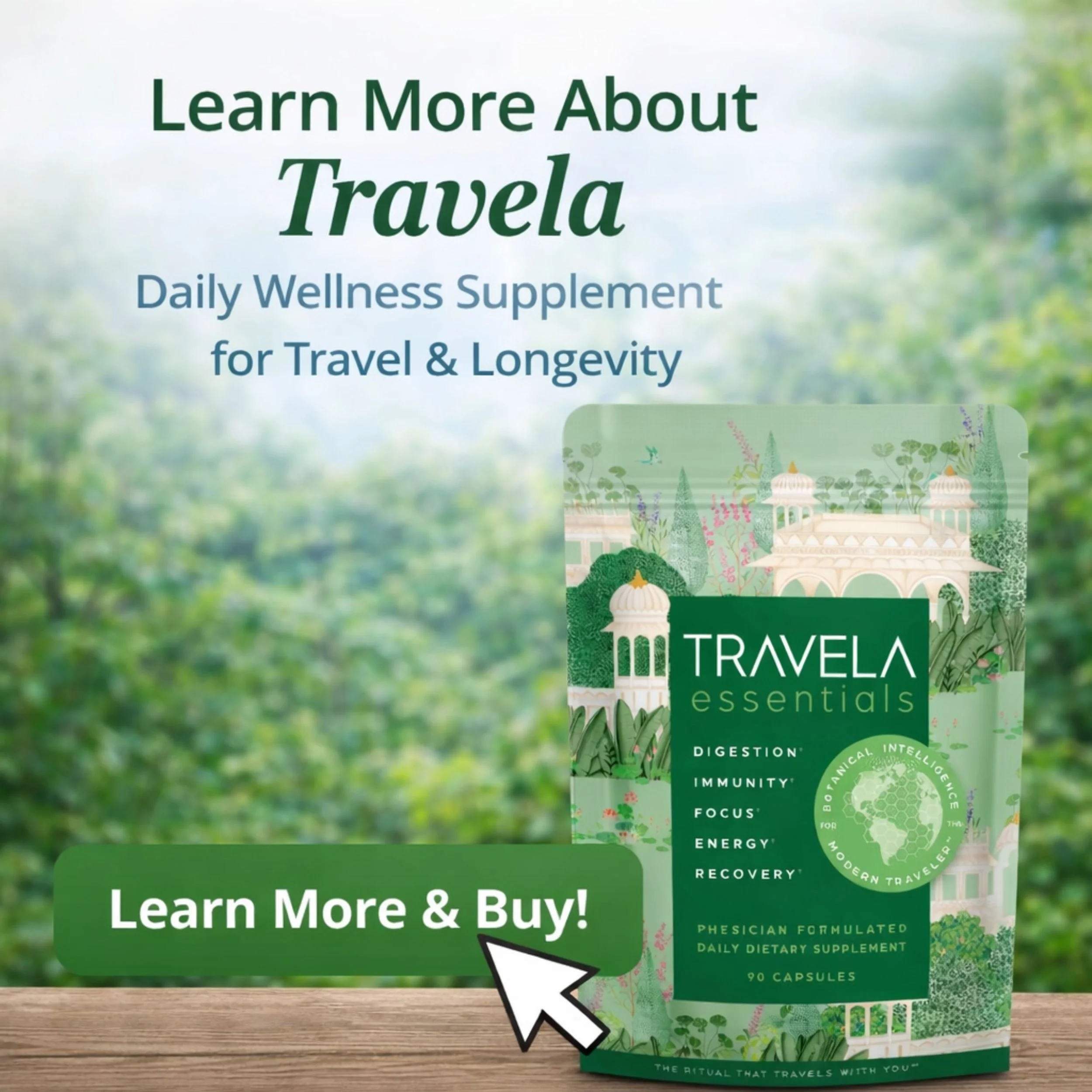
This daily rhythm is also why resveratrol earned a place in the Travela Essentials formulation — not as a substitute for the whole foods above, but as a companion ritual for the mornings when a bowl of berries simply is not within reach. The most meaningful changes here are often what you stop noticing: less travel fatigue, less digestive disruption, less of that low afternoon fog, and, over time, a little more resilience in the face of an unpredictable schedule. It is a daily ritual designed to travel with you.

#CellCare Reflection

We live in a culture that reaches for quick fixes and dramatic before-and-afters. But the deepest wisdom of longevity tends to live in quieter places — in the silent exchange between the pigment of a berry skin and the microbes waiting in your gut to receive it. When you nourish your body with whole, plant-forward foods, you stop fighting your biology and start collaborating with it. That is the essence of Cell Consciousness: not a single dramatic choice, but the accumulation of small, intentional ones.
Tomorrow morning, you do not need a toast. You need a bowl of berries, skins and all — and the quiet trust that your cells are listening.


MAKE A DIFFERENCE BY SHARING THIS ARTICLE WITH OTHERS TO ENCOURAGE WELLBEING ⤵
References:
Guevara-Cruz, Martha, Mónica Sánchez-Tapia, Laura A. Velazquez-Villegas, Ivan Torre-Villalvazo, Rocio Guizar-Heredia, Einar Godínez-Salas, Adriana López-Barradas, Omar Granados, Gonzalo Torres-Villalobos, Nimbe Torres, and Armando R. Tovar. “Supplementation with Resveratrol Modified Gut Microbiota Improving Insulin Sensitivity and Lipid Metabolism in Subjects with Obesity and Insulin Resistance.” European Journal of Nutrition 65, no. 1 (2026): 8.
Sun, J.N., R. Yang, L. Fang, et al. “Effects of Resveratrol Supplementation on Multiple Health Outcomes: An Umbrella Review of Systematic Reviews and Meta-Analyses of Randomized Controlled Trials.” Nutrition Journal 25, no. 1 (2026): 63.
Wang, Pan, Ruiqi Wang, Wenting Zhao, Yuanyuan Zhao, Dan Wang, Shuang Zhao, Zhiwen Ge, Yue Ma, and Xiaoyan Zhao. “Gut Microbiota-Derived 4-Hydroxyphenylacetic Acid from Resveratrol Supplementation Prevents Obesity through SIRT1 Signaling Activation.” Gut Microbes 17, no. 1 (2025): 2446391.
Kulkarni, A., G. Santrosyan, and D. Martirosyan. “Resveratrol as a Bioactive Compound in Functional Food Science: Sources, Quantification, and Health Implications.” Dietary Supplements and Nutraceuticals 5, no. 1 (2026): 1–10.
Dassoff, E., M.T. Islam, and J.M. Allen. “Toward a Gut-AMPK Axis: The Microbiome and AMPK Signaling in Nutrition and Healthy Aging.” Frontiers in Physiology 17 (2026): 1861013.
Yang, Jiale, Shuping Chen, Tiantian Zeng, Yuxuan Zhang, Zhaoxin Li, and Haifang Li. “The Role of the Resveratrol-Sirtuin Axis in the Treatment of Metabolic Dysfunction-Associated Diseases.” Exploration of Endocrine and Metabolic Diseases 3 (2026): 101470.
The information on this website has not been evaluated by the Food & Drug Administration or any other medical body. We do not aim to diagnose, treat, cure or prevent any illness or disease. Information is shared for educational purposes only. You must consult your doctor before acting on any content on this website, especially if you are pregnant, nursing, taking medication, or have a medical condition. Our content may include products that have been independently chosen and recommended by Dr. Monisha Bhanote and our editors. We may earn a small commission if you purchase something mentioned in this article.
YOU MAY ALSO LIKE:



by Dr. Monisha Bhanote
✅ EVIDENCE-INFORMED REVIEWED ARTICLE